routstrd-pi0.2.1
Pi agent footer that shows routstrd session spend and wallet balance in sats (₿/⚡) instead of dollars.
Untested on omp
This is a pi package. No one has reported whether it works on omp yet. If you try it, add your result below.
Reports 0
No reports yet.
Readme
routstrd-pi
A pi agent package that shows routstrd session spend and wallet balance in satoshis — with a ⚡ / ₿ glyph instead of pi's dollar estimate.
What it does
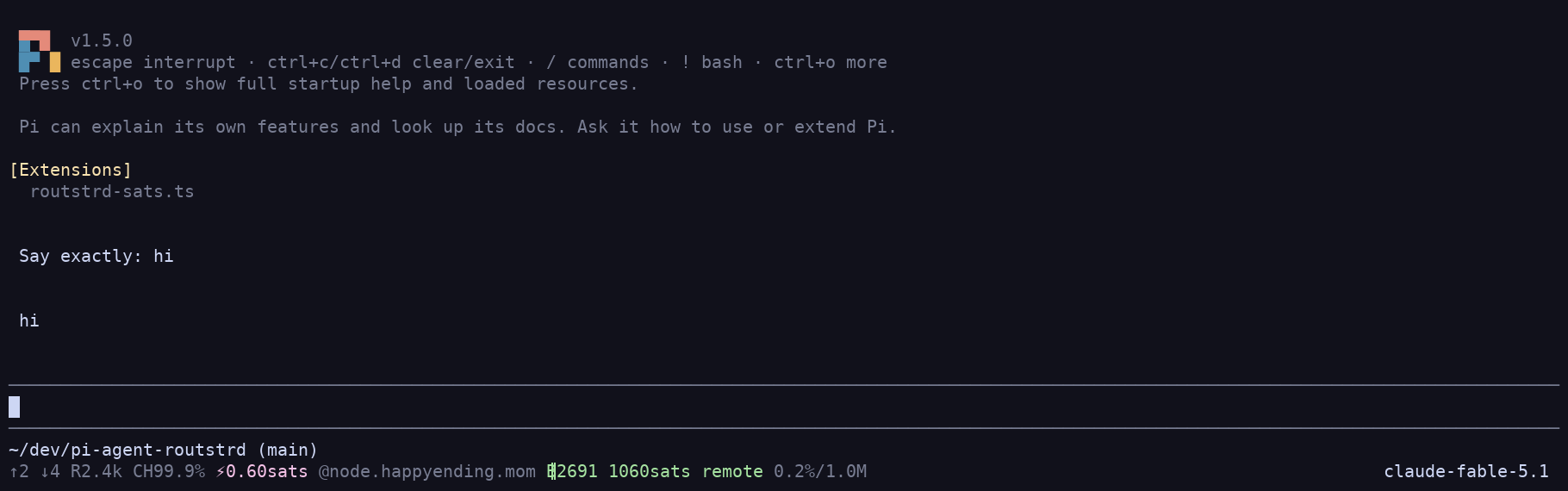
It replaces pi's built-in footer with a faithful copy that swaps the money figures for routstrd's real, wallet-signed numbers:
⚡13.99sats— what this session actually spent, summed from the routstrd daemon's per-requestsatsCost. A trailing…marks requests still syncing;⚡--marks an unreachable daemon.@ai.redsh1ft.com— the routstr node that served the most recent response, from the daemon's usage rows.₿1519— total left in your local routstrd Cashu wallet, across mints.72sats remote— total held as API-key credit on remote routstr providers (daemonGET /keys/balance).- Everything else stays as you know it:
↑ ↓ R Wtoken stats,CHcache-hit rate, context%/window with the usual color thresholds, git branch, session name, model name with thinking level, and other extensions' status lines.
Every figure can be turned on/off or made width-aware — see Configuration below.
Example footer (stats line):
↑32.0k ↓254 R512 W0 CH1.6% ⚡13.99sats @ai.redsh1ft.com ₿1519 72sats remote 24.0%/1M (routstr) glm-5.3 • medium
The package is fully standalone — no other package is required. On a vanilla pi install it replaces the footer itself; nothing depends on Gentle Shell (see below for what happens when Gentle Shell is present).
The session spend is exact: every assistant message routed through a routstr
daemon carries the daemon's response id (visible as responseId in the session
file — gen-… from OpenAI-shaped routes, msg_… from the Anthropic-shaped
route), and the daemon's GET /usage reports the sats charged for each of
those ids. The extension matches the session's ids against the daemon's
usage rows, so it survives /resume, /fork and compaction, and it never
counts requests made by other clients (Claude Code, OpenCode, other pi
sessions) against your pi session.
Gentle Shell
If you use gentle-pi (Gentle Shell), its
footer extension replaces pi's (and ours), so the package automatically
switches to status mode: ⚡13.99sats used @ai.redsh1ft.com · ₿1519 wallet · 72sats remote appears in gentle's status surfaces (the INTEGRATIONS card /
status bar), alongside gentle's own ctx/$ segments. Those segments come
from gentle-pi; hide them via gentle's visibility settings if you want the
sats figures to stand alone. Without gentle-pi (or any other footer
extension), the package renders its own footer — this is the default path.
Debugging
Set ROUTSTRD_PI_DEBUG=1 to append a trace of lookups and matches to
/tmp/routstrd-pi-debug.log.
Install
Prerequisites: a running routstrd daemon
with pi wired up (routstrd clients add --pi-agent), and pi itself.
pi install git:github.com/jeroenubbink/routstrd-pi      # from git, or:
pi install npm:routstrd-pi                               # once published to npm
Then start pi normally — the footer appears once the first events fire.
Configuration
All display options are optional and live in a small JSON file. Default
location: ~/.routstrd/pi.json (honoring ROUTSTRD_DIR); ROUTSTRD_PI_CONFIG
points at another path. The file is read when pi starts — restart pi (or run
/reload) to apply changes. A missing or invalid file simply means defaults.
{
  "daemonUrl": "http://127.0.0.1:8008",
  "show": {
    "spend": true,
    "usd": false,
    "node": "auto",
    "wallet": true,
    "remote": "auto"
  }
}
| Key | Default | Shows | Rules |
|---|---|---|---|
show.spend |
true |
⚡13.99sats — sats this session spent |
true/false |
show.usd |
false |
$0.012 — USD equivalent of the session spend, from the daemon's usage rows |
true/false/auto |
show.node |
auto |
@ai.redsh1ft.com — routstr node that served the latest response |
true/false/auto |
show.wallet |
true |
₿1519 — local Cashu wallet balance |
true/false/auto |
show.remote |
auto |
72sats remote — API-key credit on remote routstr providers |
true/false/auto |
daemonUrl |
— | Daemon base URL override | URL string |
Rule semantics:
true— always show the figure (even when narrow).false— never show it."auto"— show it only while it fits the terminal, so a narrow window never shows a figure half-written. Extras drop in this order when space runs out:usd, thenremote, thennode; the spend and wallet figures come last. When the terminal is resized the line re-fits immediately.
The daemon base URL is otherwise resolved in this order:
ROUTSTRD_BASE_URLenvironment variabledaemonUrlfrom the display config filehost/portfrom~/.routstrd/config.json(honoringROUTSTRD_DIR)- Default
http://127.0.0.1:8008
Caveats
- Sats are attributed per completed assistant response. Requests that fail
after payment, and auxiliary requests that produce no assistant message,
are not counted — they still drain the wallet, so treat
₿as the source of truth for what you have left. ₿shows the local Cashu wallet (proofs held at your mints) and can dip briefly mid-payment while proofs are in flight.Nsats remoteshows API-key credit on remote routstr providers (refreshed on start and about once a minute; the daemon asks remote nodes live, so the first figure can take a few seconds).- The extension is display-only; it never mutates wallet or daemon state.
- Requires a routstrd daemon with
/keys/balancefor the remote figure (0.3.0+); without it, the other figures still work.
Roadmap
- Session spend in sats (⚡)
- Node that served the latest response (@host)
- Local wallet balance in sats (₿)
- Remote provider deposits — API-key credits (
Nsats remote) - Per-mint / per-node breakdown
For agents: how to configure this for a user
If you are an agent asked to set this package up, this is the whole picture.
What it is. A display-only pi extension: it swaps pi's dollar-priced
footer/status figures for routstrd's real numbers — session spend in sats,
the routstr node in use, the local Cashu wallet balance, and remote API-key
credits. It never spends, moves, or mutates funds; it only makes GET
requests to the local routstrd daemon.
Prerequisites. A running routstrd
daemon (default http://127.0.0.1:8008) and pi wired to it
(routstrd clients add --pi-agent). If curl http://127.0.0.1:8008/health
answers {"ok":true} the daemon is up.
How it computes session spend. Each assistant message routed through the
daemon carries the daemon's response id in message.responseId. The extension
collects those ids, looks up each in GET /usage, and sums the per-request
satsCost. That makes the ⚡ figure exact for this pi session (other clients,
other pi sessions, failed requests are not counted) and stable across
/resume, /fork and compaction. Balances come from GET /balance (local
Cashu wallet) and GET /keys/balance (credit held on remote providers).
To install for the user:
pi install git:github.com/jeroenubbink/routstrd-pi
Then restart pi. Under Gentle Shell the figures appear in the status surfaces; on vanilla pi the footer itself is replaced. Nothing else to enable.
To configure: create or edit ~/.routstrd/pi.json (honoring
ROUTSTRD_DIR; ROUTSTRD_PI_CONFIG overrides the path) exactly as documented
in Configuration above. All keys are optional; an invalid or
missing file means the defaults. Restart pi (or /reload) after edits.
Useful presets:
{"show":{"remote":false}}
— minimal line (sats + node + wallet only).
{"show":{"usd":true,"node":true,"remote":true}}
— everything, forced on even when narrow.
Diagnostics. ⚡--/₿-- (footer) or ⚡ offline (status) mean the daemon
is unreachable — check routstrd status. A trailing … marks a response
whose usage row has not synced yet. Set ROUTSTRD_PI_DEBUG=1 to append a
trace (lookups, matches, refreshes) to /tmp/routstrd-pi-debug.log.
License
MIT