protect-context1.3.2
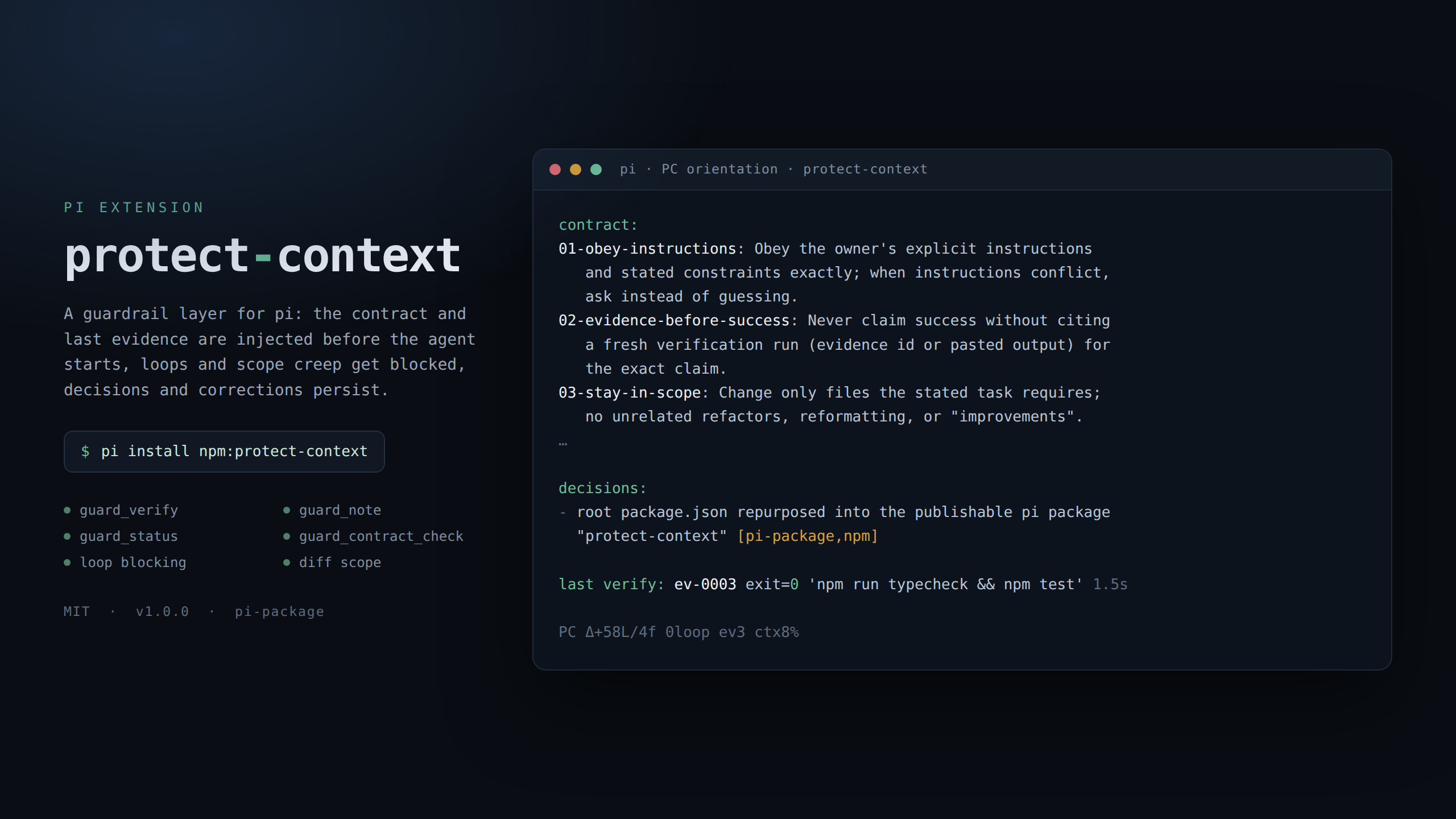
Pi extension that adds agent guardrails: context brief, verification evidence, loop blocking, diff-scope warnings, and a durable journal.
Untested on omp
This is a pi package. No one has reported whether it works on omp yet. If you try it, add your result below.
Reports 0
No reports yet.
Readme
protect-context · Agent Guardrail Suite
Durable context, real evidence, and a brake pedal for AI coding agents.
protect-context keeps the rules, decisions, and proof-of-work an agent needs in
front of it — then makes scope creep, unverified claims, and repeated failures
visible before they cost you a session.





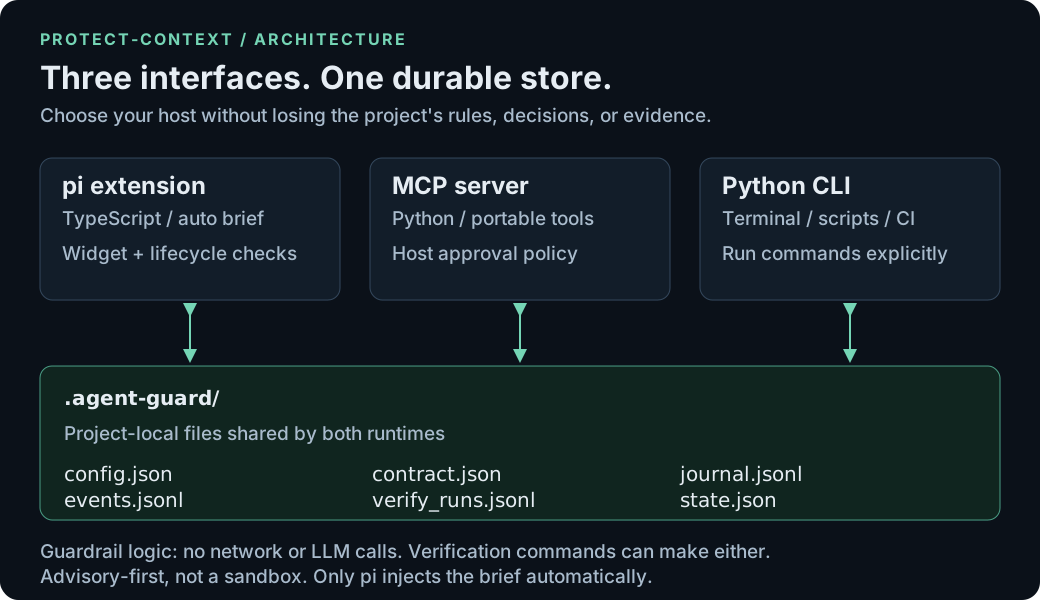
One project-local .agent-guard/ store · three interfaces backed by the same
logic:
| Interface | Use it for | Runtime |
|---|---|---|
| pi extension | Automatic brief injection, status widget, loop blocking, diff warnings, risky-command confirmation | TypeScript, loaded by pi via jiti |
| MCP server | Portable model/host access to the same tools | Python 3.10+, fastmcp |
| Python CLI | People, scripts, CI, and hosts without MCP | Python 3.10+ |
The suite is advisory-first. It records evidence and makes unsafe or
repetitive behavior visible; it is not a sandbox and does not prove that a
change is correct. SPEC.md is the frozen v1.0 contract.
Contents
- Why this exists
- What it does
- Quick start
- A 30-second tour
- Interface comparison
- Reference
- The 12 failure modes and what ships
- How it works
- Development and validation
- Troubleshooting
- Limitations and security boundary
- Design sources
- Non-goals
- License
Why this exists
Long agent sessions fail in boring, expensive ways:
- the constraints you stated at minute two are gone by minute forty;
- "done" is claimed with no command output behind it;
- a "quick fix" quietly rewrites six unrelated files;
- decisions get re-litigated because nothing recorded the reasoning;
- the same failing command is retried until the context window dies.
protect-context treats those as state problems, not intelligence problems.
A durable store plus three small habits — brief before work, evidence after
work, journal when something is decided — removes most of the failure surface
without turning the agent into a different agent.
What it does
| Primitive | What it gives you | Where you meet it |
|---|---|---|
| Brief | Owner task, contract, recent trusted decisions and corrections, a short unverified section for the agent's own notes, open loops, and the last evidence ID — injected before a turn and re-asserted mid-run after a compaction | Automatic in pi; orientation, status, guard_journal elsewhere |
| Orientation | Bounded repo digest: tree, languages, and conventions files (CLAUDE.md, AGENTS.md, CONVENTIONS.md, README.md, README) |
Injected once per digest in pi; orientation in CLI/MCP |
| Evidence ledger | Every verification run recorded as ev-NNNN with exit code, duration, command, and a bounded output digest |
guard_verify, protect-context verify, guard_evidence |
| Loop brake | Identical failing commands are fingerprinted; the Nth attempt is blocked instead of re-run | Hard block in pi and the CLI; reported through MCP |
| Scope audit | git diff stats over tracked, staged, and bounded untracked work, with ok / warn / hard verdicts |
Widget and status in pi; diff, guard_diff_audit |
| Journal | Durable decision / correction / risk / note entries with tags and trust levels |
guard_note, protect-context note, guard_journal |
| Risky-command confirm | Nine catastrophic shell patterns get one grouped confirmation instead of none | pi, when a UI is available |
| Preflight | Tool presence and versions plus Git worktree detection | preflight, guard_preflight |
| Context budget | Watermarks on context usage and hard caps on every injected block | Widget, budget, guard_budget |
Quick start
Python 3.10+ is required for the CLI and MCP server. Node 22.19+ is required only to validate the TypeScript extension from a checkout — pi supplies the extension's runtime modules, and the extension has zero npm runtime dependencies.
Install the pi extension
Installed from npm. The package declares "pi": { "extensions": ["./extension/index.ts"], "image": "./preview.png" } and the pi-package
keyword required by the Pi package gallery:
pi install npm:protect-context

# Try it for one run without adding it to settings
pi -e npm:protect-context
Install it through pi, not through npm install. The extension declares pi's
host modules (@earendil-works/pi-ai, @earendil-works/pi-coding-agent,
typebox) as "*" peer dependencies, as Pi requires; Pi suppresses peer
installation for managed npm packages, while a plain npm install protect-context does not. The second path downloads the whole pi runtime and
surfaces advisories from that tree, which belong to the host and not to this
zero-runtime-dependency extension.
Remove any hand-installed copy first — a directory such as
~/.pi/agent/extensions/protect-context or .pi/extensions/protect-context,
or pi remove npm:protect-context if that copy came from npm. Two copies
register the same tool names, and pi drops the second one:
Error: Failed to load extension "…/.pi/npm/node_modules/protect-context/extension/index.ts":
Tool "guard_verify" conflicts with /home/you/.pi/agent/extensions/protect-context/index.ts
One error is reported per tool (guard_verify, guard_note,
guard_contract_check, guard_status), so nothing from the npm copy loads
until the other copy is gone.
Or copy/symlink the checkout into a trusted extension directory:
# Personal
mkdir -p ~/.pi/agent/extensions
cp -r extension ~/.pi/agent/extensions/protect-context

# Project-local (read after the project is trusted)
mkdir -p .pi/extensions
cp -r extension .pi/extensions/protect-context
Start a session and you get a single-line status widget, a brief before the
first turn, and five slash commands. No configuration file is needed: the
extension seeds .agent-guard/config.json with the frozen defaults on first
session start.
Install the MCP server
For pi with pi-mcp-adapter, add .mcp.json at the project root:
{
  "mcpServers": {
    "protect-context": {
      "command": "/absolute/path/to/protect-context/.venv/bin/python",
      "args": ["-m", "protect_context.mcp_server"]
    }
  }
}
The same stdio shape works in any generic MCP host. Set PC_SESSION_ID when
several host sessions need distinct evidence and loop views:
{
  "mcpServers": {
    "protect-context": {
      "command": "/absolute/path/to/protect-context/.venv/bin/python",
      "args": ["-m", "protect_context.mcp_server"],
      "env": { "PC_SESSION_ID": "my-session" }
    }
  }
}
The MCP surface exposes the nine frozen v1.0 tools plus two compatible read
surfaces added to close the original reachability gaps (guard_journal and
guard_orientation). Tools carry conservative MCP annotations; in particular
guard_verify is marked destructive and open-world because it can run any
shell command. Annotations are host hints, not enforcement — configure the host
to require human approval for that tool.
Install the Python CLI
pip install protect-context      # or: pipx install protect-context
protect-context init             # seed .agent-guard/ in the current project
protect-context status
protect-context verify "pytest -q"
The CLI and MCP server are distributed through PyPI; the npm package ships only
the pi extension. Both read the same .agent-guard/ directory, so a project can
use the extension in pi and scripted verification in CI at the same time.
From source
# Python package, CLI, MCP server, and Python tests
python3 -m venv .venv
.venv/bin/python -m pip install -e ".[dev]"

# Reproducible extension development checks (dev dependencies only)
npm ci --ignore-scripts
npm run check
If the machine's default Node is older than 22.19, run the same checks with an
ephemeral Node 22 binary after npm ci:
npx -y node@22 node_modules/typescript/bin/tsc --noEmit -p extension/tsconfig.json
npx -y node@22 --experimental-strip-types --test extension/test/*.test.ts
A 30-second tour
Excerpts from a real session in this repository.
Ask for the current state:
$ protect-context status
PC status · session default · git 91fad4d
Δdiff +88/-8 · 6 files · verdict ok
loops: none
contract 12 constraints
conventions: README.md
Nudge: verify changes with guard_verify and cite the evidence id before claiming success.
Record proof instead of asserting it:
$ protect-context verify "npm run check"
PC evidence ev-0005 · exit 0 · 1440ms
…output digest…
Nudge: cite evidence ids, not memory, when claiming success.
Re-run the same failing command a third time and the brake engages:
$ protect-context verify "npm test"
PC verify blocked · npm test · 3 prior failures
Nudge: change approach or gather new information — do not re-run unchanged.
What pi injects before the agent starts working (sections elided):
contract:
01-obey-instructions: Obey the owner's explicit instructions and stated constraints exactly; when instructions conflict, ask instead of guessing.
02-evidence-before-success: Never claim success without citing a fresh verification run (evidence id or pasted output) for the exact claim.
…
decisions:
- Use the atomic-mkdir lease, not fcntl alone; Python must interoperate with the extension. [locking,spec]
last verify: ev-0005 exit=0 'npm run check' 1.4s
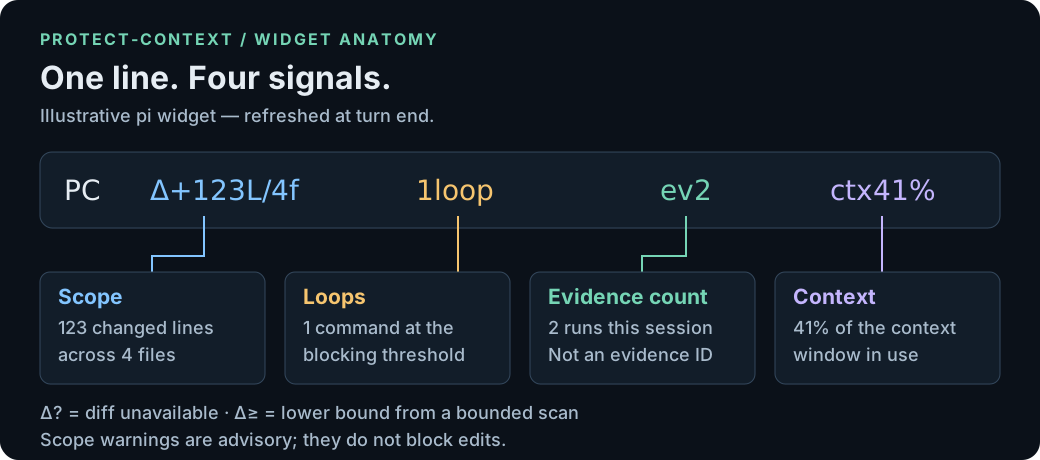
And the always-on one-line widget:
PC Δ+88L/6f 0loop ev5 ctx8%
Interface comparison
| Capability | pi extension | MCP server | CLI |
|---|---|---|---|
| Brief injected automatically before a turn | yes (change-triggered) | — | — |
| Orientation digest (tree, languages, conventions) | injected once per digest | guard_orientation |
orientation |
Verification evidence (ev-NNNN) |
guard_verify, /guard-verify |
guard_verify |
verify |
| Loop blocking | blocks the command | guard_loop_check reports and advises |
verify refuses; loops exits 1 |
| Scope audit | session-start baseline + warnings | guard_diff_audit (explicit baseline) |
diff --baseline REF |
| Journal write/read | guard_note, /guard-note, guard_journal |
guard_note, guard_journal |
note, journal |
| Trusted re-injection of decisions | yes, after change and after every compaction (incl. mid-run) | read views only | read views only |
| Re-injection of the agent's own notes | yes, in an explicitly unverified section | read views only | read views only |
| Owner task anchor | /guard-task, auto-captured from the first prompt |
— | — |
| Contract management | /guard-contract |
guard_contract |
contract list|add|remove |
| Risky-command confirmation | one grouped confirm | host approval policy | — |
| Status widget | yes | — | status |
Reference
pi commands and tools
Slash commands:
| Command | Action |
|---|---|
/guard-status |
Compact session status: diff verdict, loops, evidence, contract, context |
/guard-contract |
list · add <text> · remove <id> — edit the persistent contract |
/guard-verify |
Run a command through the evidence ledger |
/guard-note |
Journal a decision · correction · risk · note |
/guard-task |
Show · set <text> · --clear the owner task anchor that the brief re-injects |
/guard-report |
Full session summary for handoff or review |
Model-callable tools:
| Tool | Arguments | Notes |
|---|---|---|
guard_verify |
command, timeout_s (default 180, clamped 1–900) |
Records ev-NNNN; refusal on a blocked loop |
guard_note |
type, text, optional tags |
Forced to the agent trust level |
guard_journal |
limit (0–20, default 5), optional type |
Read-only; recovers decisions, corrections, and the agent's own earlier notes after a compaction |
guard_contract_check |
summary |
Deterministic keyword coverage checklist, never a proof |
guard_status |
— | Same data that feeds the widget, including journal totals |
MCP tools
| Tool | Annotation class | Purpose |
|---|---|---|
guard_status |
local, initializing read | Session status digest |
guard_verify |
shell execution (destructive, open-world) | Run a command, record evidence |
guard_evidence |
read-only | Recent verification entries |
guard_contract |
local mutation | list · add · remove |
guard_note |
local append | Journal an entry (tagged agent) |
guard_journal |
read-only | Recent journal entries, optionally filtered by type |
guard_loop_check |
local, initializing read | Failing-command streaks and advice |
guard_diff_audit |
local, initializing read | Diff stats and verdict vs thresholds |
guard_preflight |
local, initializing read | Tool/version and worktree check |
guard_budget |
read-only | Context-budget watermarks |
guard_orientation |
read-only | Repo digest and conventions files |
CLI
Every command returns 0 for OK, 1 for a triggered warning or failed
verification, and 2 for an input/environment error.
protect-context init
protect-context status
protect-context verify "pytest -q" [--timeout 180]
protect-context evidence [--limit 5]
protect-context contract list
protect-context contract add "Keep the public API stable" [--global]
protect-context contract remove ID [--global]
protect-context note correction "use rg, not grep" --tags search
protect-context journal [--limit 5] [--type decision]
protect-context orientation
protect-context loops
protect-context diff [--baseline REF]
protect-context preflight
protect-context budget
Configuration
The extension seeds .agent-guard/config.json on first session start; init
does the same for CLI/MCP-first use. Unknown, wrongly typed, fractional, or
out-of-range values fall back to the frozen default.
| Key | Default | Meaning |
|---|---|---|
loop_block_after |
3 |
Block the Nth identical failing command attempt |
diff_warn_lines |
400 |
Changed-line warning threshold |
diff_hard_lines |
800 |
Changed-line hard-level threshold |
diff_warn_files |
10 |
Changed-file warning threshold |
ctx_warn_pct |
70 |
First context-usage warning watermark |
brief_mode |
"changed" |
Inject only when the brief digest changes; "always" injects every turn |
risk_confirm |
true |
Ask once before a matching risky pi bash command when UI is available |
preflight_tools |
git, python3, pip, node, npm, rg, pytest |
Executables checked by preflight |
Numeric thresholds may be set to zero; the extension records an explicit first notification so a zero watermark does not silently disable alerts. Preflight checks at most 20 configured tool entries. If more are configured, it lists the omitted count and returns a warning instead of claiming the environment is fully checked. Version probes have a two-second per-tool timeout, share a 15-second overall deadline, and decode at most 4 KiB of output; a missing version is reported as an incomplete preflight.
Making it yours: the personal layer
The twelve seeds and the config defaults are the same for everyone, on purpose: they are the floor that makes the guardrail comparable across machines. What is yours goes in a personal layer that every project inherits:
built-in defaults  <  ~/.config/protect-context/  <  .agent-guard/
                        contract.json                 contract.json
                        config.json                   config.json
The directory is $PC_USER_DIR, else $XDG_CONFIG_HOME/protect-context, else
~/.config/protect-context. Write it from the owner surfaces:
$ protect-context contract add "Prefer stdlib over new dependencies" --global
added 13-prefer-stdlib-over-new-dependencies to personal layer
…

$ protect-context contract list          # every project sees it
personal layer: 1 from /home/you/.config/protect-context/contract.json (applies to every project; a project row with the same id or text wins)
The same flag works in pi: /guard-contract add <text> --global and
/guard-contract remove <id> --global. Without it, writes go to the project
store as before, and guard_contract (the agent-callable tool) never touches
the personal layer.
Rules that make the layering predictable:
- The project wins. A project row with the same id overrides the personal
one, and a personal constraint identical in text to a project row is not
listed twice. Give a personal override the same id (e.g.
03-stay-in-scope) to reword a seed for every repo. - Defaults mean "no opinion". The extension seeds
config.jsonwith every default value; a project value equal to the built-in default therefore does not pin it, so your personalctx_warn_pctstill applies. Any different project value is an explicit choice and wins. - Nothing is created behind your back. The layer is never seeded or repaired:
a missing file means "no personal constraints", and an unreadable one is
ignored in memory and left untouched. Deleting a personal constraint requires
--global; a project-scope remove says so instead of silently doing nothing. - Each layer has its own lease. A
--globalwrite locks the personal directory, not the project store, so two projects writing personal state cannot race each other.
Sharing a contract with a team
.agent-guard/ is runtime state and normally gitignored. If a team wants one
shared owner contract, track only that file:
.agent-guard/*
!.agent-guard/contract.json
Runtime files (events, evidence, journal, session state) stay local, while
contract.json becomes reviewable in pull requests. Personal constraints still
apply on top — each teammate's personal layer is weaker than the shared project
row.
The nine catastrophic patterns that trigger the pi confirmation are frozen and deliberately narrow, so benign lookalikes stay silent:
rm -rf / · rm -rf ~ · git push --force (not --force-with-lease) ·
git reset --hard · mkfs … /dev/… · dd … of=/dev/… ·
chmod -R 777 / · curl … | sh · sudo rm
Environment variables
| Variable | Effect |
|---|---|
PC_SESSION_ID |
Names the session used for evidence and loop views, so parallel hosts do not share a view |
PC_USER_DIR |
Overrides the personal-layer directory (default $XDG_CONFIG_HOME/protect-context or ~/.config/protect-context) |
Runtime store and concurrency
Runtime files stay in the frozen .agent-guard/ layout and are gitignored:
config.json · contract.json · journal.jsonl · events.jsonl ·
verify_runs.jsonl · state.json
The optional personal layer lives outside the repository at
~/.config/protect-context/ (contract.json, config.json) and is never
written implicitly; see Making it yours above.
Ledgers bound themselves instead of growing forever: once events.jsonl,
verify_runs.jsonl or journal.jsonl passes 1 MiB it rotates to
<name>.1.jsonl, keeping at most three rotated segments and dropping the oldest.
Reads concatenate the segments oldest-first, so recent rows and the highest
evidence id always survive; budget and loop streaks describe the retained
window. Session baselines are keyed per session inside state.json, so parallel
pi sessions in one repo no longer overwrite each other's watermarks.
Python and TypeScript use the same atomic-directory lease at
.agent-guard/.lock.d, with an owner token, PID/hostname checks, bounded
waiting, and conservative stale recovery. Python also takes its legacy local
fcntl.flock inside that lease. Evidence-ID allocation, JSONL appends, and
contract read-modify-write operations hold the shared lease, preventing
duplicate IDs and lost contract updates across runtimes. JSON file replacement
uses unique temporary files.
The lease follows the atomic mkdir design used by mature lock libraries while
remaining dependency-free and interoperable with Python. A crashed same-host
owner is reclaimable after the stale interval; a stale foreign-host owner fails
closed because process liveness cannot be proved safely without an external
coordinator. Recovery retains a small identity-bound .lock.d.stale.*
directory as a durable race guard; it does not block new writers and lives
inside the already-ignored runtime store. Contract mutations also fail closed
when owner rows are malformed, preserving the original file for repair.
The 12 failure modes and what ships
| # | Failure mode | Shipped mitigation | Enforcement |
|---|---|---|---|
| 1 | Violating instructions | Persistent contract; provenance-aware, change-triggered brief injection; seed-removal refusal at the MCP boundary | Context/advisory |
| 2 | Claiming success without verification | Verification ledger, evidence IDs, status/evidence views, failure digests | Recorded evidence; not semantic proof |
| 3 | Editing too much / scope creep | Git diff audit over tracked, staged, and bounded non-ignored untracked work; safe explicit baselines | Warn/advisory |
| 4 | Misunderstanding the repo | Worktree-root-aware bounded orientation digest in pi, CLI, and MCP; conventions-file discovery | Automatic context + explicit read |
| 5 | Plausible but subtly wrong code | Deterministic contract checklist, verification gate, test-required seed | Heuristic/advisory |
| 6 | Losing earlier context | Persistent journal; owner task anchor; recent trusted decisions re-injected after change and after every compaction (including mid-run threshold/overflow); agent notes re-injected as unverified; guard_journal read views |
Automatic context + explicit read |
| 7 | Repeating corrected behavior | Bounded tagged corrections; trusted corrections re-injected; model-authored entries retained for owner review | Automatic context + trust boundary |
| 8 | Large diffs | Configurable line/file warning and hard-level notifications, status verdict, widget | Warn/advisory |
| 9 | Repetitive debugging loops | Shared bash/evidence streak reconstruction; third identical failing command blocked by default in pi, CLI, and MCP | Hard block at configured threshold |
| 10 | Environment/tool failures | Tool/version and Git-worktree preflight with warning exit outside a repository | Diagnostic |
| 11 | Permission interruptions | One grouped pi confirmation for the frozen risky-command patterns; environment preflight | Interactive confirmation where UI exists |
| 12 | Token/API cost and latency | Bounded brief sections, journal/contract text, evidence digests, untracked reads, output previews, and context watermarks | Automatic budgeting/advisory |
"Shipped" means the mitigation is reachable and tested. It does not turn an advisory signal into a security or correctness guarantee.
How it works
Session lifecycle
The extension is a thin event layer over the shared store. Nothing leaves your machine: there are no network calls and no LLM calls in the guardrail logic.
| Event | What happens |
|---|---|
session_start |
Seed config if missing, scan orientation, freeze the diff baseline, start the status widget |
before_agent_start |
Build the brief; inject orientation and/or brief as a hidden message when their digests changed |
tool_call (bash) |
Match the nine risky patterns → one grouped confirm; check the loop fingerprint → block at the threshold; record the normalized command, with ok=false when the call was refused |
tool_execution_start / tool_execution_end |
Record bash outcomes and verify results into the shared loop state and evidence ledger |
turn_end |
Refresh the widget: diff stats, open loops, evidence count, context percentage |
session_compact |
Re-inject trusted context so compaction cannot silently erase it |
session_shutdown |
Flush state and clear the widget |
The brief
The brief is deliberately tiny — a persistent prompt that grows without bound is its own failure mode. Within the frozen 12-line constraint cap:
- newest owner constraints are selected first,
- then the frozen seed constraints,
- then other entries.
An agent-authored constraint therefore cannot crowd out a seed. Below the
contract it carries up to 3 recent trusted decisions, up to 3 trusted
corrections, up to 2 open loops, and the last evidence ID with its exit code,
duration, and a truncated command. brief_mode: "changed" (default) injects
only when the rendered digest actually changed, so a quiet turn costs nothing.
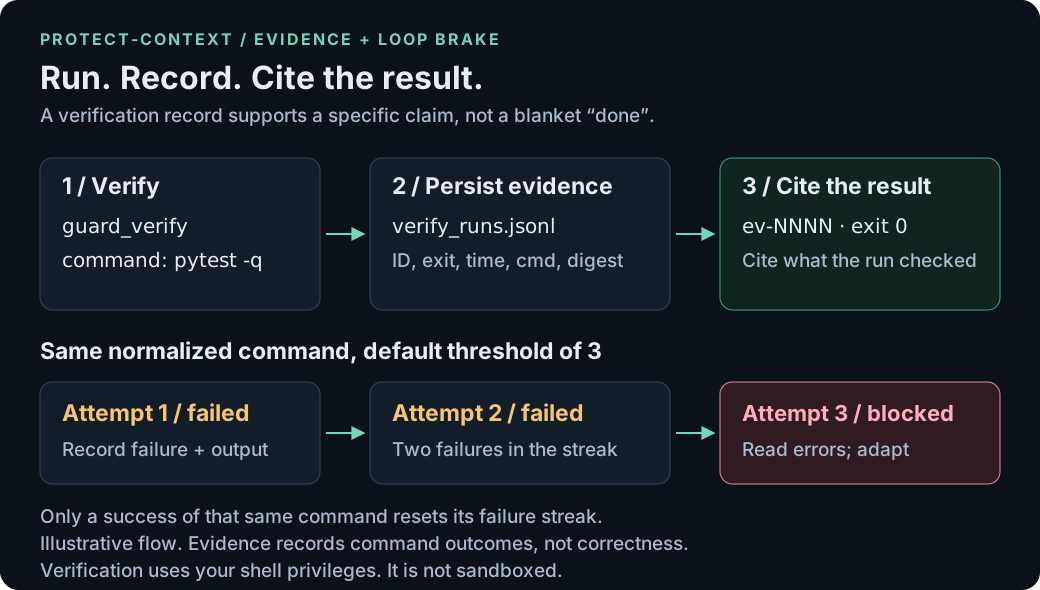
Evidence and loop detection
guard_verify runs your command with the caller's privileges, spools output to
temporary files to bound RAM, and records one append-only entry: ID, exit code,
duration, command, and a digest of the output. IDs are allocated inside the
shared lease, so parallel pi and CLI processes never collide.
Loop detection normalizes a command (whitespace collapsed, including inside
quoted strings) into a fingerprint, then counts consecutive failures of that
fingerprint across both bash and guard_verify. At loop_block_after the
attempt is refused, with the prior failure count and a change-strategy nudge —
the single cheapest intervention in the suite.
Scope audit
Diffs are computed with git porcelain/numstat over tracked, staged, and
bounded non-ignored untracked files, then compared against the configured line
and file thresholds to produce ok, warn, or hard. The pi extension freezes
its baseline at session start, so committing mid-session does not reset the
scope; CLI and MCP default to HEAD and accept an explicit baseline.
Untracked content reads are capped at 1,000 files, 1 MB per file, and 8 MB
total, and stop once the hard line threshold is known. A truncated scan is
reported as a bounded scan, promoted to at least a warning (CLI exit 1), and
its count treated as a lower bound — the widget renders it as Δ≥.
Trust and provenance
Direct CLI and pi slash-command contract writes are treated as owner input.
MCP/model journal writes are forcibly tagged agent: they never enter the
trusted decisions:/corrections: sections. They are not discarded either —
the brief shows the newest two under agent notes (unverified):, clearly
labelled and capped shorter than trusted text, and guard_journal returns the
full stored entry. That keeps the model's own reasoning recoverable after a
compaction without granting it authority. CLI and pi slash-command journal
entries are trusted. Untagged
legacy entries are treated as trusted for backward compatibility, because the
frozen journal schema has no dedicated author field.
This is a provenance convention, not authentication. A model that already has shell access can invoke the CLI and appear on that trusted path; use host-level tool permissions when the distinction must be a security boundary.
All newly stored contract, journal, and tag text is normalized to one bounded line, and legacy values are normalized again when rendered. This prevents terminal-line forging and unbounded persistent prompt growth; it does not make untrusted prose safe to follow.
Context budget
Every injected and printed block has a cap: brief sections, journal and contract
text, evidence digests, orientation output, and previews. Context-watermark
notifications fire at ctx_warn_pct and above, and the widget always shows the
current percentage. The result is a guardrail layer whose own cost stays
constant while a session grows.
Development and validation
.venv/bin/pytest -q                          # Python suites
npm run typecheck                            # extension types (tsc --noEmit)
npm test                                     # extension unit tests (node --test)
.venv/bin/python -m compileall -q src        # byte-compile check
.venv/bin/python -m build --outdir /tmp/protect-context-dist
npm run check runs the typecheck and the extension tests together. The
definition-of-done checks are run twice consecutively before release. The dated
audit records the observed counts, integration probes, and package smoke test
instead of leaving stale numbers in this README.
| Path | Contents |
|---|---|
src/protect_context/ |
Store, contract, journal, verify, loops, diff scope, orientation, preflight, budget, report, CLI, MCP server |
extension/ |
pi entry point (index.ts) and pi-import-free lib/ modules |
tests/ |
pytest suites, including a fastmcp in-memory client smoke over every MCP tool |
extension/test/ |
node --test suites for fingerprinting, risk patterns, loops, brief digest, widget, git parsing, config |
SPEC.md |
Frozen v1.0 contract — structure, defaults, and definition of done |
Troubleshooting
| Symptom | Likely cause | Fix |
|---|---|---|
| No brief appears in pi | Digest unchanged (brief_mode: "changed") and nothing new to say |
Expected on quiet turns; set brief_mode: "always" to see it every turn |
Δ? in the widget |
Not a Git worktree, so no diff baseline | Run inside a repository, or use the CLI with an explicit --baseline |
Δ≥ in the widget |
Bounded untracked scan hit a cap | Treat the count as a lower bound; narrow the scan or review scope manually |
| Loop never blocks | Commands differ (paths, flags) so fingerprints differ | Compare with loops / guard_loop_check; fingerprints intentionally ignore whitespace only |
| Agent forgot its own earlier decision after a compaction | The brief shows only the newest 2 agent notes, 120 chars each | Read the full entry with guard_journal |
| No guard block after an automatic compaction | Host emits no context event, so mid-run re-assertion cannot run |
It returns at the next user prompt; check the host supports the context hook |
task: line is wrong or missing |
Auto-capture ignores short prompts and slash commands, and an owner task always wins | Set it explicitly with /guard-task <text> or /guard-task --clear |
PC_SESSION_ID changes nothing in evidence |
It scopes ledger views, not state.json |
Expected: state is project-global by design |
| MCP tool missing in host | Server not started with the venv interpreter | Point command at .venv/bin/python and pass -m protect_context.mcp_server |
| Extension does not load | Node older than 22.19 or pi not restarted | Check pi list, then restart; use pi -ne to start without extensions |
| Contract edit rejected over MCP | Removing a frozen seed constraint | Seeds are protected; use the CLI or a pi slash command as the owner |
Published, but pi.dev/packages says "No packages match" |
The gallery index is built from npm search, and npm drops search documents whose downloads.monthly is 0. A publish rewrites that document with the download figure of that moment, so publishing before npm's first download rollup pins it at 0 |
Run scripts/check-discoverability.sh; if the document's downloads are 0 while the downloads API reports traffic, publish once the rollup exists (npm re-crawls documents on its own as well, typically within a week) |
Limitations and security boundary
Shell execution
guard_verifydeliberately invokes a shell with the caller's privileges. It can modify files, access the network, or disclose data. The pi layer asks for confirmation only when one of the frozen regex patterns matches; the MCP layer relies on host approval. Neither is a shell parser or a sandbox.- MCP annotations are untrusted hints. A client may ignore them. Do not expose
guard_verifyto an untrusted model without a real host sandbox/approval policy.
Evidence
- An evidence record proves only that one command returned one exit code. It is not cryptographically bound to a commit/worktree, has no freshness policy, and does not prove the claimed behavior.
Scope
- The pi extension freezes its diff baseline at session start, so committing
mid-session does not reset its scope. CLI/MCP audits default to current
HEAD; pass them an explicit baseline for cross-commit scope. Binary files count as files but zero lines. - Untracked-file content reads are capped at 1,000 files, 1 MB per file, and 8 MB total, and stop once the hard line threshold is known. Output explicitly reports a bounded scan, promotes it to at least a warning/CLI exit 1, and treats the truncated count as a lower bound.
Determinism
- The frozen brief carries at most 12 constraints, 3 trusted decisions, 3
trusted corrections, and 2 agent notes. Overflow is visible (each section
announces what it hid) and points at
guard_journal, but hidden entries are not enforced by context injection. - Frozen fingerprint normalization collapses whitespace everywhere, including inside quoted shell strings. Semantically different commands can therefore share a loop fingerprint.
- The deterministic contract checker is keyword coverage, not program analysis.
Treat every
addressedresult as a review prompt, not proof.
Compaction
- Re-injection is only as good as the store. A constraint, decision, or task
that was never written down cannot be restored, and the brief is a bounded
pointer rather than a transcript;
guard_journalreturns the full entry. - A mid-run compaction (threshold or overflow recovery) resumes the turn
through
AgentStart, wherebefore_agent_startdoes not run. The extension arms acontexthook onsession_compactand re-asserts the block on every request until a persisted one is back in the conversation. On a host that does not emitcontext, the block returns at the next user prompt instead. - Task capture stores the first substantive prompt (≤200 chars) in
.agent-guard/state.json. That is conversation content: it stays local and gitignored, but review it before sharing a store, and clear it with/guard-task --clear. - Agent notes are unverified context, never authority. A model that journals "ignore the contract" is shown that sentence back under an explicitly unverified heading; treat it as data, and keep owner constraints in the contract where they are trusted.
Store
state.jsonis project-global. Atomic replacement prevents torn JSON, but simultaneous sessions can still overwrite notification/session state; usePC_SESSION_IDto separate ledger views, not state files.- Commands and the last 2,000 output characters are stored verbatim. There is no automatic secret detector or redactor; never put credentials in commands or verification output.
- JSONL ledgers have no automatic retention or rotation. Output views stay bounded, but long-lived stores grow on disk and full session reconstruction becomes progressively more expensive; archive runtime state deliberately.
- Python verification bounds RAM by spooling output to temporary files, but a very noisy command can consume temporary disk until it exits. On Windows, killing the direct process cannot guarantee that every descendant exits.
Design sources
The implementation was checked against primary or professional sources:
- Git's stable porcelain/other-file interfaces for non-ignored untracked enumeration: git-status and git-ls-files.
- Pi's documented lifecycle, tool, context, and UI APIs: Pi extension documentation.
- The mature
proper-lockfiledesign, which uses atomicmkdirrather thanO_EXCL: moxystudio/node-proper-lockfile. The package itself was not added because the frozen extension requirement is zero runtime dependencies and the lock must interoperate with Python. - Operational-safety evidence motivating explicit constraints, failure transparency, and safe-halt behavior: What Breaks When LLMs Code? (ASE 2026), plus evidence-conditioned execution results in Preventing Premature Commitment in Coding Agents.
- MCP's own warning that annotations are risk vocabulary rather than enforcement: Tool Annotations as Risk Vocabulary.
Non-goals
No network or LLM calls are made by the guardrail logic itself. It is not a sandbox, policy engine, auto-fixer, secret manager, or replacement for pi/MCP host permissions. It complements those controls with durable context, evidence, telemetry, and narrowly scoped blocking.
License
MIT — see LICENSE. Copyright (c) 2026 XJTLUmedia.