pi-vision-handoff0.10.11
Give text-only pi models vision — describe images with a vision model you pick via an interactive picker, then hand off the text description to non-vision models
Untested on omp
This is a pi package. No one has reported whether it works on omp yet. If you try it, add your result below.
Reports 0
No reports yet.
Readme
👁️ pi-vision-handoff
Give text-only pi models vision
Describe images with a vision model you pick, then feed the text to models that can't see.


Pi 1.0 compatibility (0.10.8)
Tested with Pi 1.0.0. Host-provided Pi packages and TypeBox are peers (*), not bundled runtime dependencies; development uses exact Pi 1.0.0 pins and host-compatible TypeBox where needed.
Vision calls use the native ModelRegistry streaming runtime (including native providers/auth/hooks). Fetch energy capture remains necessary for raw SSE comments, but cleanup now preserves later wrappers and retained predecessors cannot recurse after reinstall. Native nested read results are covered.
Run bun run test:host for the offline real-host load, native codemode/nested-call, module-identity and reload checks. Set PI1_HOST_PACKAGE to an installed Pi package directory to test that host explicitly; add PI1_HOST_ENTRY=bundle to check the bundled CLI runtime's constructors.
The Problem
Some of the best coding models are blind. You paste a screenshot, a UI mock, a stack trace, or a diagram into pi — and a text-only model either silently ignores the image or rejects the request outright. Up to now your only options were to describe the image yourself, or switch to a (often weaker-for-coding) vision model just to read it.
The pi-umans-provider extension quietly solved this for GLM 5.1: a hardcoded "vision handoff" pipeline that had umans-flash describe each image at prompt time and swapped the text in for the image block before the request left. It worked great — but it was welded to one provider, one describer, and one set of models.
The Solution
pi-vision-handoff extracts that pipeline and makes it provider-agnostic:
- Pick any vision-capable model from your registry via an interactive picker — OpenAI, Anthropic, Google, Ollama, or any custom provider pi knows about.
- Your choice persists to
~/.pi/agent/extensions/pi-vision-handoff.json. - For any model that doesn't declare image input (or any model you explicitly target),
pi-vision-handoffdescribes the image with your chosen vision model and swaps the image block for its description text at thecontextevent — which fires before pi-ai'sdowngradeUnsupportedImagescan strip image blocks for non-vision models. This covers every image source: pasted/attached images,read-tool results, and custom extension-injected messages. (Read-tool images additionally keep the description + image in the storedtool_resultfor kitty inline rendering and/resume.) - Works across all four image-block shapes pi uses — the three provider-transformed formats (OpenAI Chat Completions, OpenAI Responses, Anthropic Messages) plus pi-ai's internal
{ type: "image", data, mimeType }emitted by thereadtool — detected by shape. - Descriptions are cached per image hash (LRU) and produced one batched vision call per image set (dataloader-style: a prompt describing N images does not spin up N describer calls), so the swap is instant by the time the request fires.
No settings.json touched. No per-provider glue. Pick a describer once and every text-only model you own can suddenly see.
Features
- 🎮 Interactive picker —
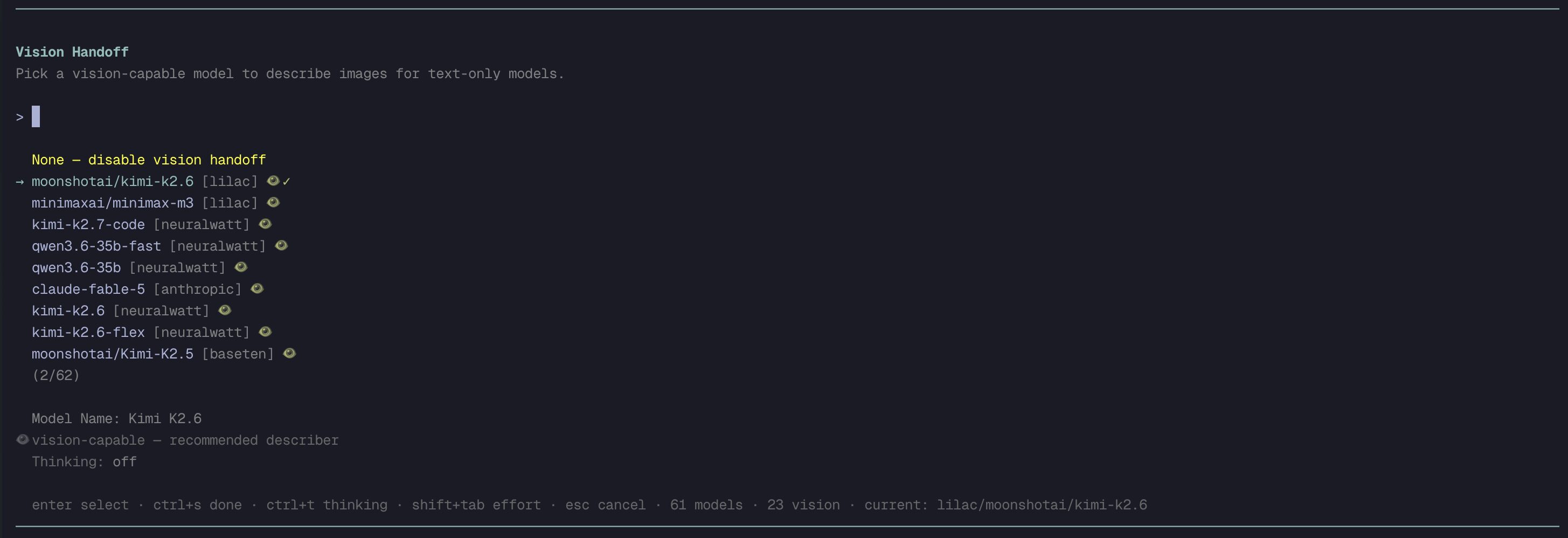
/vision-handoffopens a TUI listing every model, vision-capable ones first (👁), to choose your describer. - 🖼️ DataLoader-batched descriptions — the
readtools areload()callers: N parallel reads coalesce into ONE batched vision call (dispatched viasetImmediateafter the poll phase, so reads completing together batch instead of splitting), awaited during the tool-result phase (free time) so the agent's next turn never blocks on the describer. Descriptions are ready beforecontextfires, so the swap is a non-blocking cache hit. - 🧹 Hides pi's "model does not support images" note — on read results the extension strips pi's
[Current model does not support images…]note from the text block (it's misleading once the handoff delivers the image's content as text), while keeping the image block for kitty inline rendering and/resume. - 🔌 Provider-agnostic — uses pi's own model execution machinery (
@earendil-works/pi-ai'scompleteSimple()), so it works with any provider/configured model, including custom provider extensions. - 🧠 Automatic targets — by default, handoff applies to every model that lacks native vision. Opt out with
/vision-handoff auto off. - 🗂️ Explicit overrides — force handoff for specific models (e.g. a weak vision model) with
/vision-handoff add. - ⚡ Pre-warmed at paste-enter — the moment you press enter,
before_agent_startscans the prompt for pasted image temp-file paths — pi-clipboard, localterm-paste, and any other paste mechanism that writes a pasted image to a temp file and inserts the path as text — reads them, and kicks off the ONE batched vision call concurrent with the agent's first response — so by the time the agent reads the files, they're already cache hits. - 🚀 Paste-time prewarm (opt-in) —
prewarmPastedImages(off by default) wraps the editor so pasted clipboard images are described the instant their path lands in the prompt — before you hit enter — not at submit. The vision call starts concurrent with you typing your question. Tradeoff: the description is generated without your typed question as context (the question usually isn't entered yet at paste time), and a paste-then-abandon wastes one vision call. TUI only; inactive if another extension replaces the editor. Toggle with/vision-handoff prewarm on. - 🏁 Async pasted-path fallback (opt-in) —
asyncClipboardHandoffraces the normal read path against asynchronous delivery. A directreador nested Fabricpi.readof the pasted path cancels the fallback and uses the normal tool-result/context flow; otherwise the completed description is queued as a steering message. Its transcript row is collapsed to one line by default and expands withCtrl+O. Toggle it in the picker withCtrl+Aor run/vision-handoff fallback on. - 🧠 Aware prompt (opt-in) —
awarePrompt(off by default) injects a system-prompt note on handoff targets telling the text-only model it CAN read images via the read tool (the handoff swaps image blocks for descriptions). Some models otherwise refuse image-reading requests from self-knowledge even though the description is delivered as text. Toggle with/vision-handoff aware on. - 💾 Session persistence (opt-in) —
persistDescriptionswrites each generated description into the session file as a[Image described: <hash>]marker + text block next to the read-result blob (the blob stays for kitty rendering). On/resume— a new process with an empty in-memory cache — thecontexthook matches the marker to the blob by hash and reuses the persisted description, so a resumed session never re-calls the vision model for already-described images (no 30-40s re-describe on the first resumed "ciao"). The persisted description is also seeded into the session cache, so later re-reads of the same image hit too. Toggle with/vision-handoff persist on. - 🛡️ Graceful degradation — no API key? Describer unreachable? Aborted? The image is replaced with a clean
[Image: description unavailable]placeholder instead of crashing your turn. - 📋 Error logging — every describer failure and every
image description failedwarning is appended as a JSONL line to~/.pi/agent/logs/pi-vision-handoff/errors.log, so a warning likeimage description failed — unknown erroris troubleshootable: the detailed reason (exception stack,stopReason, config snapshot) is captured at the describer's failure source even when the in-memory error string was already reset by the time the warning fired. Size-capped with a single.1backup. - 📊 Usage reporting — every real describer call reports model + tokens (and Neuralwatt energy/cost when the vision model is a Neuralwatt model), via
pi.appendEntry+ avision-handoff:usageevent for live consumers. - 🔧 Tunable — cap description length (
maxDescriptionLines; unbounded by default, soread's nativectrl+ocollapse handles compactness) and cache size, in the config file.
Usage
Interactive Commands
| Command | What it does |
|---|---|
/vision-handoff |
Open the interactive picker to choose the vision model |
/vision-handoff select |
Same as /vision-handoff |
/vision-handoff model openai/gpt-4o |
Set the vision model directly |
/vision-handoff status |
Show current config + whether handoff is active for the current model |
/vision-handoff enable / disable |
Master switch (keeps your configured model) |
/vision-handoff auto on / off |
Toggle automatic handoff for all non-vision models |
/vision-handoff prewarm on / off |
Toggle paste-time prewarm (opt-in, off by default) |
/vision-handoff fallback on / off |
Race matching reads against async pasted-path description injection (opt-in) |
/vision-handoff aware on / off |
Tell handoff targets they can read images via the read tool (opt-in, off by default) |
/vision-handoff persist on / off |
Persist descriptions to the session file; resumed sessions reuse them with no new vision call (opt-in) |
/vision-handoff add ollama/llava:13b |
Force handoff for an extra model |
/vision-handoff remove ollama/llava:13b |
Stop forcing handoff for a model |
/vision-handoff clear |
Clear the configured vision model |
/vision-handoff help |
Show usage reference |
Config File
Created automatically at ~/.pi/agent/extensions/pi-vision-handoff.json on first change:
{
  "enabled": true,
  "visionModel": "openai/gpt-4o",
  "autoHandoff": true,
  "handoffModels": ["ollama/llava:13b"],
  "prewarmPastedImages": false,
  "asyncClipboardHandoff": false,
  "awarePrompt": false,
  "persistDescriptions": false,
  "maxTokens": null,
  "cacheMax": 50,
  "maxDescriptionLines": 0,
  "prompt": "Describe this image exhaustively…",
  "userPromptPrefix": "The user's request about this image: "
}
| Field | Default | Effect |
|---|---|---|
enabled |
true |
Master switch. When false, no handoff occurs. |
visionModel |
null |
The describer, as provider/id. null = not configured (handoff inactive). |
autoHandoff |
true |
Apply handoff to every model whose input does not include image. |
handoffModels |
[] |
Extra provider/id refs that should also receive handoff. |
prewarmPastedImages |
false |
Opt-in paste-time prewarm. When true, a custom editor wrapper describes pasted clipboard images the instant their temp-file path lands in the prompt (pre-submit), instead of at submit. Trades a bit of description quality (the description is generated without your typed question as context, since the question usually isn't entered yet at paste time) and a speculative vision call on paste-then-abandon, for earlier prewarm. TUI mode only; inactive if another extension has replaced the editor. |
asyncClipboardHandoff |
false |
Opt-in async fallback. Starts from the existing submit-time prewarm. A matching direct read or Fabric-nested pi.read cancels message delivery; if no matching read wins, the description is queued asynchronously as a collapsed custom message and triggers/continues the agent turn. |
awarePrompt |
false |
Opt-in aware prompt. When true, injects a system-prompt note on handoff targets telling the text-only model it CAN read images via the read tool (the handoff swaps image blocks for descriptions). Some models otherwise refuse image-reading requests from self-knowledge. |
persistDescriptions |
false |
Opt-in session persistence. When true, every generated description is written into the session file as a [Image described: <hash>] marker + description text block in the read tool-result content, next to the blob (which stays for kitty rendering). On /resume, the context hook matches the marker to the blob by hash and reuses the persisted description — no vision call, no wait. Only real descriptions are persisted (a failed [Image: description unavailable] is not replayed; the next turn re-attempts). |
maxTokens |
(unset = model max, clamped to context window) | Cap on a single description's output. null/unset = use the vision model's declared max output (model.maxTokens), clamped so maxTokens + 8192 <= contextWindow (a model whose declared max equals its full context window would otherwise be rejected with a 400). Set a number only to cap cost/latency. A truncation is always surfaced via a [... description truncated …] marker when the model hits the limit, so a cut-off description is never mistaken for complete. |
cacheMax |
50 |
Max described images kept in the in-memory cache per session. |
maxDescriptionLines |
0 |
Cap on description lines (0 = unbounded). Default keeps the full description so the read tool's native collapse (ctrl+o) handles compactness and the model gets complete context; setting > 0 applies a lossy head-cap to both the TUI render and the model. |
prompt |
(built-in) | Override the describer system prompt. |
userPromptPrefix |
(built-in) | Override the prefix prepended to your original prompt. |
The config path uses pi's
getAgentDir()— setPI_CODING_AGENT_DIRto relocate it.
Troubleshooting
When handoff fails, pi shows a short warning like pi-vision-handoff: image description failed — <reason>. Vision model: <model>. The full detail is in the error log:
~/.pi/agent/logs/pi-vision-handoff/errors.log
(one JSON object per line; relocate via PI_CODING_AGENT_DIR). Each entry records the phase (batch / single = describer failure source, warn = the user-facing warning), the reason, the visionModel, the failing imageHashes, and — when applicable — the stopReason, errorMessage, errorStack, and a config snapshot (maxTokens / thinking / thinkingLevel).
reason: "unknown error" in a warn entry means the engine's shared last-error string was already reset (typically a concurrent batch cleared it) by the time the warning fired — so the real cause isn't in the warning. Correlate it with the matching batch/single entry: match on the imageHashes (and the timestamp) to recover the actual exception/stopReason. Deliberate user cancels (ESC) are not logged — they aren't errors.
The log is append-only and size-capped (10 MB, rotating to errors.log.1), so a runaway broken vision model can't fill the disk; truncate it any time.
Installation
With pi install (recommended):
pi install npm:pi-vision-handoff
Or install from GitHub:
pi install https://github.com/monotykamary/pi-vision-handoff
With npm:
npm install pi-vision-handoff
Or in ~/.pi/agent/settings.json:
{
  "packages": [
    "npm:pi-vision-handoff"
  ]
}
Then /reload or restart pi.
For a quick one-off test:
pi -e ./vision-handoff.ts
How It Works
The extension implements the Facebook DataLoader pattern for image descriptions. The read tools are the load() callers; a per-image cache memoizes promises; all load() calls in the same execution frame coalesce into ONE batched vision call, dispatched via setImmediate after the poll phase (so reads completing together batch instead of splitting into N calls).
With prewarmPastedImages on (opt-in), an even earlier stage runs:
→ editor onChange (paste-time, pre-submit)
    • pi has no "image pasted" event; the earliest signal is the editor's
      `onChange(text)`, which fires when pi's `handleClipboardImagePaste`
      inserts the temp-file path via `insertTextAtCursor`
    • a wrapping CustomEditor chains `onChange` (pi assigns its own
      `onChange` — for bash-mode border tracking — after construction, so
      the wrapper captures it via an accessor and runs it alongside an
      observer that `diffPrewarmPaths`s new `pi-clipboard-*` paths and
      `loadDescription()`s them at paste-time — the vision call starts
      before you hit enter; `before_agent_start`'s same-path prewarm is
      then a cache hit
    • it does NOT override `handleInput`, so keybindings + `ctrl+v` paste
      are untouched; TUI only, and skipped when another extension has
      replaced the editor (installing over one would break paste, since
      pi wires paste-image to the outermost editor only)
With asyncClipboardHandoff on, submit-time prewarm also schedules a non-blocking delivery race. A matching read tool call for the pasted path cancels only the custom-message injection (the in-flight description remains available to that read); if description delivery wins, Pi queues it as a steering message. The full description remains model-visible while the transcript shows a one-line row until Ctrl+O expands it.
The default submit-time pipeline below runs regardless:
→ before_agent_start
    • captures this turn's user prompt (shared by every image description)
    • binds turn context (vision model + abort signal) to the loader
    • PRE-WARMS at paste-enter via the loader, two sources coalescing into
      ONE batch:
      1. attached image blocks (event.images) — vision-capable targets
      2. pasted image FILE PATHS in the prompt text — the common non-vision
         flow: pi-clipboard, localterm-paste, and other paste mechanisms
         write each pasted image to a temp file and insert the PATH as text
         at the cursor, so on a non-vision model they arrive as path tokens
         in `event.prompt`, NOT as `event.images`. The extension scans the
         prompt for those temp paths (confined to the OS temp dir — a
         prompt can't trick it into reading arbitrary files), reads the
         files synchronously (keeps all load() calls in one batch frame →
         one vision call), and `loadDescription()`s them — so the vision
         call starts the INSTANT you press enter, concurrent with the
         agent's first response, not waiting for it to `read` the files
→ read tool / tool_result   (PRIMARY injection point)
    • pi runs `read` calls in parallel (Promise.all); each read's
      tool_result handler calls `loadDescription(img)` for its image
      blocks and AWAITS the shared batch
    • DataLoader: all `load()` calls in one event-loop poll iteration
      land in ONE batch → ONE `completeSimple()` vision call for the whole read
      set. `enqueuePostPromiseJob` schedules dispatch via `setImmediate`
      (the check phase, which runs AFTER the whole poll phase — not
      `process.nextTick`, which would drain between the reads' I/O
      callbacks and split them into N single-image calls)
    • awaits the shared batch — runs the describer during the tool-result
      phase (free time: the agent is just waiting for tool results), so
      the batch is COMPLETE before `context` fires → `context` is a
      non-blocking cache hit, not a cold miss on the critical path
    • does NOT mutate the result by default: the image stays in storage for
      kitty inline rendering and `/resume`; the image→text swap happens in
      the `context` hook (on the cloned LLM-bound payload only). With the
      opt-in `persistDescriptions`, it additionally appends a
      `[Image described: <hash>]` marker + description text block after
      each image block, so the description survives in the session file
      for `/resume` (the blob still stays for kitty rendering)
→ context   (FALLBACK + swap — fires before each LLM call)
    • catches image blocks that didn't go through `read`'s tool_result —
      user-attached images, custom extension-injected messages — and
      swaps read images too (cache hits from the tool_result priming)
    • `loadDescription()` is a cache hit (warmed above) or queues into the
      loader's current batch; swaps images for text in the cloned LLM-bound
      payload (`emitContext` does a `structuredClone`), leaving storage
      intact for kitty inline rendering and `/resume`
    • persistence fast-path (opt-in): on `/resume` — new process, empty
      in-memory cache — images whose session content carries a
      `[Image described: <hash>]` marker matching their hash are NOT sent
      to the vision model at all: the persisted description is reused
      verbatim (blob dropped from the clone, marker stripped) and seeded
      into the session cache for later re-reads
Because the describer runs during the tool-result phase (before the agent's next turn), not during the context transform (the critical path right before the LLM call), the agent gets described text immediately when its turn starts — it never waits on the describer inline.
Batching: the DataLoader
A single frame's image set is described with one vision-model call, not one per image. loadDescription(img) is synchronous: on a cache miss it pushes the image's key (hash) into the current batch and returns a memoized promise; on a cache hit it returns the existing (in-flight or resolved) promise. enqueuePostPromiseJob schedules dispatch via setImmediate (the check phase, after the whole poll phase AND after the microtask queue drains), so every load() caller — whether from sync code, a .then cascade, or a separate I/O callback in the same poll iteration — registers its key before the single vision call fires. This is why N parallel reads coalesce into one call rather than splitting into N single-image calls: setImmediate defers past the entire poll phase, whereas DataLoader's classic process.nextTick would drain between the reads' I/O callbacks and fire a dispatch after the first read but before the second. The batched call sends every uncached image in a single user message with per-image <<<IMAGE k>>> … <<<END>>> delimiters; the response is parsed back into per-image descriptions (keyed by sha256(mime + base64) in the per-image cache). If the vision model ignores the delimiter format and the batched response can't be split, each unparsed image falls back to its own single-image completeSimple() call in parallel (no delimiters to cooperate with) — descriptions still arrive together. Only when a per-image call itself genuinely fails (auth, timeout, empty) does that image degrade to [Image: description unavailable]; one bad image never voids the rest.
Because pi runs parallel read tool calls via Promise.all and fires each read's tool_result event as that read's I/O completes (poll phase) — via agent.afterToolCall → finalizeExecutedToolCall — the loader's setImmediate dispatch defers to the check phase AFTER the whole poll iteration, so reads completing together share ONE batch → ONE vision call, all resolving together. Reads completing in separate poll iterations get separate calls, but always in parallel, never sequential. (The per-image cache also dedupes a duplicate load() of the same image in one frame: dispatch resolves every callback by hash, so a second load whose first cache entry was evicted mid-frame still resolves — it never hangs.)
Failures are never cached.
Failures are never cached. A genuine describer failure returns [Image: description unavailable] for that turn but is NOT written to the per-image cache, so the next turn re-attempts (and surfaces the real error via a ctx.ui.notify warning instead of serving a stuck placeholder). This avoids a transient failure poisoning the cache for the rest of the session.
Per-image-set warning. The context hook fires before every LLM turn, and describer failures aren't cached — so without dedup the same broken vision model would re-warn every turn. Each distinct image is warned about at most once per session (tracked by image hash, reset on /resume/new session); subsequent turns for the same failing image degrade silently to the placeholder instead of spamming.
Timeout scales with batch size. The describer generates an exhaustive multi-paragraph description per image, and the call is batched (N images → 1 request). The timeout is DESCRIBE_TIMEOUT_MS (120s) plus a per-image budget (45s × (imageCount − 1)), so a 5-image batch isn't held to the same wall-clock budget as one image. A timeout surfaces as describer timed out after <N>s rather than a misleading stopReason "aborted".
No silent truncation. The describer prompt says "be exhaustive", so the default maxTokens is unset — the describer uses the vision model's declared max output (model.maxTokens) as the cap, rather than relying on a provider's small omitted-default. That value is clamped so maxTokens + 8192 <= contextWindow: a model whose declared maxTokens equals its full contextWindow (e.g. a custom provider that sets both to the same number) would otherwise be rejected by the provider with a 400 (you can't request output tokens equal to the entire context window when you also have input), so the clamp subtracts a small input reserve. If the model still hits a token limit (a cap you set, or the provider's hard output maximum), stopReason becomes "length"; the describer appends a visible [... description truncated …] marker to the (still useful) partial text rather than letting a cut-off description pass as complete. For a batched call the marker lands on the last image being emitted when the cap hit (the one cut off mid-stream); earlier sections had <<<END>>> delimiters and are complete.
Aborts propagate. The context hook runs in the foreground (pi awaits it before the LLM call), so a slow describer would also make aborting a turn slow — pi has to wait for the transform to return. The hook therefore wires the turn's abort signal (ctx.signal, the active run's AbortController) into the describer's completeSimple() call, so a user cancel kills the in-flight vision request immediately. A deliberate abort is not warned about (it's not a vision-model failure) and the LLM-bound payload is left untouched since the turn is being torn down anyway.
Image-block formats handled
| Hook | Image block shape | Handling |
|---|---|---|
context (all messages) |
{ type: "image", data, mimeType } (pi-ai internal) |
undescribed → replaced with description text; already-described (persisted [Image described: <hash>] marker present) → image dropped, marker stripped, persisted description reused — no vision call on resume |
context (all messages) |
{ type: "image_url", image_url: { url: "data:…" } } (OpenAI Chat Completions) |
detected by shape → replaced with { type: "text", text } |
context (all messages) |
{ type: "input_image", image_url: "data:…" } (OpenAI Responses) |
detected by shape → replaced with { type: "input_text", text } |
context (all messages) |
{ type: "image", source: { type: "base64", media_type, data } } (Anthropic Messages) |
detected by shape → replaced with { type: "text", text } |
The describer call itself goes through pi's normal model machinery (completeSimple()), not the agent event loop — so it never re-triggers context (no recursion). Every real describer request receives a dedicated helper session ID. For Neuralwatt, the request also receives a matching isolated X-NW-Conversation-ID instead of inheriting the main Pi session ID; the unrelated image prompt therefore cannot replace the main agent's server-side cache lineage. The read tool result keeps its image block untouched (kitty inline + /resume); only the context-cloned LLM-bound payload has images swapped for text.
Usage reporting
Every real describer call (cache misses only — cache hits emit nothing) reports its model + tokens so pi and other extensions can account for the handoff cost. When the vision model is a Neuralwatt model, the response's : energy / : cost / : mcr-session SSE comments are also captured (the OpenAI SDK discards comment lines, so the response body is teed and parsed — the same technique pi-neuralwatt-provider uses). For non-Neuralwatt vision models the energy fields are omitted (not zeroed), so consumers can distinguish "no energy" from "zero energy".
Each record is published two ways, mirroring pi-neuralwatt-provider's neuralwatt:turn-energy pattern:
pi.appendEntry("vision-handoff-usage", record)— persisted to the session log, so it replays on/resume, fork, and branch navigation.pi.events.emit("vision-handoff:usage", record)— live event-bus channel a consumer (e.g. api-tps-style extension) can filter on to see tokens and energy in one payload.
Record shape:
{
  imageHash: string,            // sha256(mime + base64), first 32 hex chars
  model: string, provider: string,
  responseModel?: string, responseId?: string,
  usage: Usage,                 // { input, output, cacheRead, cacheWrite, totalTokens, cost }
  imageHash: string,            // representative (first) member of the batch; sha256(mime + base64), first 32 hex chars
  imageHashes?: string[],        // present only for batched calls (length > 1): every image the call covered
  model: string, provider: string,
  responseModel?: string, responseId?: string,
  usage: Usage,                 // { input, output, cacheRead, cacheWrite, totalTokens, cost }
  // Present ONLY when Neuralwatt SSE energy comments were captured:
  energyJoules?: number, costUsd?: number,
  energyRaw?: object, mcrSessionRaw?: object, costRaw?: object,
}
One record is emitted per real describer call (a batched call describing several images still emits a single record, with imageHashes listing every member so consumers can attribute the call's tokens/energy per image without double-counting). Because before_agent_start fires a batched describe fire-and-forget, the fetch interception is refcounted (installed only while ≥1 describe is in flight) and uses AsyncLocalStorage to route each teed response body to the describe call that issued it — so concurrent describes each attribute their own energy correctly without clobbering globalThis.fetch. When the vision model is a Neuralwatt model, pi-neuralwatt-provider's own streamNeuralwatt tee nests on top and restores back to this interceptor; both tees read the same comment lines independently (the accepted duplication for easy filtering).
Comparison with Alternatives
| Approach | Pros | Cons |
|---|---|---|
| pi-vision-handoff (this) | Provider-agnostic; pick any describer; automatic for text-only models; cached; batched (one call per image set); survives across providers | Adds one extra model call per image set per turn |
| Native vision on every model | Zero overhead | Not all models support it; you may be forced off your preferred coding model |
| Manually describing images | No extension | Tedious; lossy; kills the "paste a screenshot" workflow |
The original pi-umans-provider handoff |
Battle-tested | Hardcoded to umans-flash + UMANS models only |
| Switching to a vision model to read an image, then back | Works | Context loss across model swaps; worse coding model for the actual work |
Development
pnpm install
pnpm test          # Vitest unit tests
pnpm typecheck     # TypeScript validation
pnpm lint:dead     # Dead code detection (knip)
Structure
.
├── vision-handoff.ts            # Wiring layer: pi hooks, /vision-handoff command
├── src/
│   ├── index.ts                  # Config schema, read/write, image-block helpers, batching (barrel)
│   ├── dataloader.ts              # DescriptionLoader — DataLoader-batched descriptions (Disposable)
│   ├── describer.ts              # Vision describer calls (runBatch / describeSingle) with `using` resource guards
│   ├── image.ts                  # Image hashing, MIME sniffing, clipboard-path reading
│   ├── prewarm-editor.ts        # Opt-in paste-time prewarm CustomEditor wrapper (chains onChange)
│   ├── dispose.ts                 # `Disposable` guard factories for `using` (fetch interceptor, timer, abort wire)
│   ├── error-log.ts              # Best-effort JSONL error log → ~/.pi/agent/logs/pi-vision-handoff/errors.log
│   ├── usage.ts                  # Describer usage + Neuralwatt energy capture, fetch interceptor
│   └── vision-model-selector.ts  # Interactive picker TUI component
├── __tests__/unit/
│   ├── config-dir.test.ts        # Ensures getAgentDir() usage
│   ├── usage.test.ts             # Energy parsing, usage records, concurrency-safe fetch routing
│   ├── vision-handoff.test.ts    # Config, refs, image-block extraction, insertion, truncation, round-trip
│   ├── dataloader.test.ts        # Batch coalescing, memoization, failure eviction, Disposable reset
│   ├── describer.test.ts        # stopReason handling (length → truncation marker, aborted/error), error-log wiring
│   ├── image.test.ts             # MIME sniffing, clipboard-path confinement, file reading, diffPrewarmPaths
│   ├── error-log.test.ts         # JSONL error log: path resolution, append, size-capped rotation, never-throws
│   └── dispose.test.ts           # `using` guards: fetch refcount, timeout, abort-wire propagation
├── package.json
├── tsconfig.json
├── knip.json
└── vitest.config.ts
Acknowledgements
The vision handoff concept and the exhaustive describer prompt originate from the pi-umans-provider GLM 5.1 pipeline. The picker TUI builds on the patterns from pi-hide-providers, which in turn mirror pi core's built-in selectors.
License
MIT