pi-system-pin1.0.2
Stops pi re-reading your whole conversation when an extension's message starts a run: keeps the system block byte-identical so prefix caches hold. A stopgap for pi#5581; uninstall it once pi fixes that issue.
Untested on omp
This is a pi package. No one has reported whether it works on omp yet. If you try it, add your result below.
Reports 0
No reports yet.
Readme
pi-system-pin
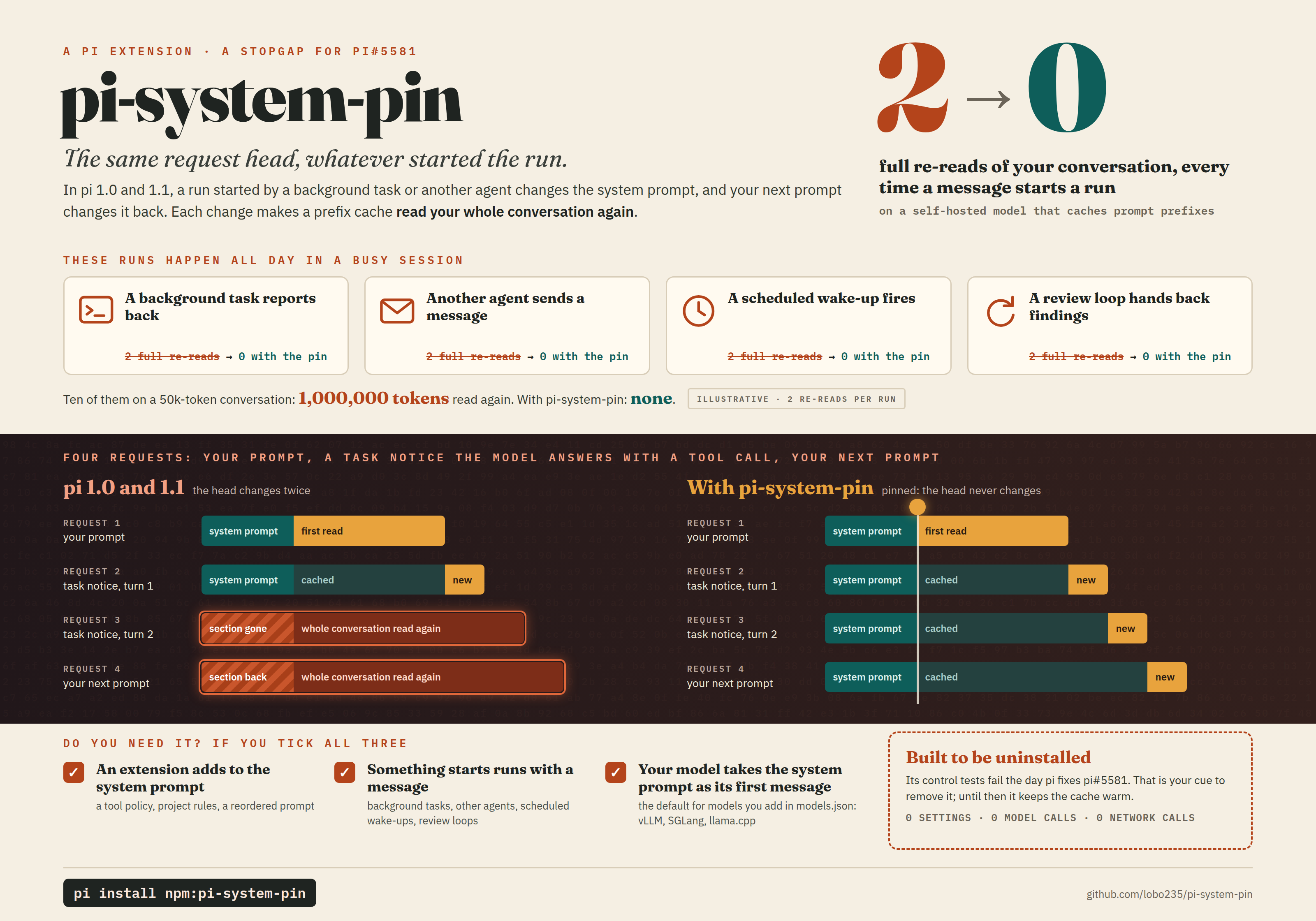
The same request head, whatever started the run. A stopgap for pi#5581: it keeps a request's system block byte-identical when an extension's message starts a run, so a prefix cache does not read the whole conversation again.
Retired. pi 1.2.0 fixes pi#5581, so this package is only useful on pi 1.1 and earlier. On pi 1.2.0 or newer it registers nothing and shows one notice per session; remove it with
pi remove npm:pi-system-pin. See When pi fixes pi#5581.
pi install npm:pi-system-pin
Why pi-system-pin
In pi, extensions shape the system prompt in the before_agent_start
event, and pi fires that event only for a user prompt. A run started by an extension's custom message
(pi.sendMessage(..., { triggerTurn: true })) falls back to pi's base prompt, so the sections extensions added
drop out for the rest of that run and come back with the next user prompt. On a model that receives the system
prompt as one leading message, each of those changes rewrites the head of the request, and a provider that
caches prompt prefixes has to read the whole conversation again, twice per such run. pi-system-pin holds those
fallback changes back, so the system block stays the same whatever started the run.
Those runs are common in a busy session: a background task reporting back, a message from another agent, a scheduled wake-up, a review loop handing back its findings. On a self-hosted model with prefix caching, each one can cost two full re-reads of a conversation that may be tens of thousands of tokens long.
It is a workaround, not a feature. When pi fixes the flaw upstream, remove it (see When pi fixes pi#5581); its tests are built to tell you when that has happened.
Do you need it?
Only if all three are true:
- An extension adds or rewrites system-prompt sections in
before_agent_start(a tool policy, project rules, a reordered prompt). - Something starts runs with custom messages: an extension that calls
pi.sendMessagewithtriggerTurn: true, such as a background-task notice, a message from another agent, a scheduled wake-up or a review loop that hands its findings back. - The model gets its system prompt folded into one leading message. pi-ai does this for every model whose
supportsMidConvoSystemMessagescompat setting is off, which is the default for models you define yourself inmodels.json(a self-hosted vLLM, SGLang or llama.cpp server, an OpenAI-compatible proxy) and for any catalog model not verified for mid-conversation system messages. It costs most where the provider caches prompt prefixes: every head rewrite is a full re-read of the conversation.
With a model that does accept mid-conversation system messages, pi sends each change as a later system message and the cached prefix survives; the run still loses the extensions' sections from its second turn on. pi-system-pin keeps them there too (the next user prompt's patch, which sets the section to the text it already has, still goes out as one appended system message), but the cost it saves is much smaller.
You do not need it when no extension shapes the system prompt, or when nothing starts runs with custom messages: it then never pins anything and only reads each request. You should not keep it once pi fixes pi#5581.
Install
pi install npm:pi-system-pin
Requirements:
- pi 0.87.1 or newer, on a release line listed in pi-compat.json. Another pi works too; it warns once per session (see pi versions). Every pi from 0.87.1 to 1.1.0 (0.87.1, 0.99.0, 0.99.1, 0.99.2, 1.0.0, 1.0.1, 1.0.2, 1.0.3, 1.0.4 and 1.1.0) is verified to have the flaw.
- Node.js 22.19 or newer (pi's own requirement).
It loads with the next pi session (or /reload) and has no configuration.
What pi does
Here is a session where one extension adds a section to the system prompt on every user run, and another starts a run with a custom message when a background task finishes. The model answers that notice with a tool call, so the custom run has two turns.
| Request | Started by | System block sent (pi 0.87.1 to 1.0.4) | With pi-system-pin |
|---|---|---|---|
| 1 | user prompt | base prompt + section | base prompt + section |
| 2 | custom message, first turn | base prompt + section | base prompt + section |
| 3 | custom message, second turn | base prompt (section removed) | base prompt + section |
| 4 | next user prompt | base prompt + section | base prompt + section |
Before the custom run's second turn, pi prepares the prompt from its base options, which carry none of the
extensions' changes, and appends a system patch to the transcript that removes the section (or puts back the
original text of a built-in section an extension rewrote). The next user prompt runs before_agent_start
again and appends a patch that restores it. A model that folds system messages into the head rebuilds the
head from every patch, so requests 3 and 4 each start with different bytes than the request before them.
How it works
Pin. A system patch with section changes that pi writes while no user run is active is pi falling back to its base prompt, not a decision anyone made. A user run starts at
before_agent_startand is confirmed by its own prompt message; it lasts untilagent_settled. Any other message ends a run that was started but not confirmed, so a user prompt that fails afterbefore_agent_startcannot exempt the custom run that comes next. The pinned patch's key (its timestamp and a hash of its section changes) is recorded in asystem-pin.patchentry on the transcript.Hold. On every request (pi's
context_with_systemevent), the section changes of pinned patches are left out. Their tool changes stay, because those are real. A patch left with nothing is left out whole. The transcript's own messages are never rewritten.Restore in place. When the next user run puts the section back, its patch sets the same text the request already carries, and pi-ai replaces a section where it stands, so the head stays byte-identical.
Release. At each request of a user run, a held change that no later patch touches is one that run agreed with: an extension stopped adding the section, or a context file changed. It is recorded in a
system-pin.releaseentry and applies from then on. The head is rewritten once, at the moment it really changed.Compaction. At a compaction pi stores the current system state, every system message replayed, on the compaction entry, and that becomes the leading system message of every later request. A change still held at that moment is folded into it. pi-system-pin rebuilds that head the same way from the original system messages, which stay on the branch, leaving the held changes out. It does so only when replaying the branch gives exactly pi's own folded head; otherwise it leaves the head as pi built it. Release works as above: a user run that leaves a folded section alone releases it.
Both entry types live on the transcript, so a reopened session sends the same requests as before.
Costs and limits
- It reads pi internals that are not a stable API: the system patch shape (
sections,toolsAdded,toolsRemoved), thecontext_with_systemevent and the run lifecycle events. Each pi release line is verified before it is listed (see pi versions). - Per request, nothing while nothing is pinned. Once a patch is pinned, one pass over the messages and a
SHA-256 hash of each system patch's sections, plus one pass over the branch's entries once a compaction is on
the branch. Per pin or release, one small custom entry on the transcript. No network calls and no model
calls; the only file it reads is its own
pi-compat.json, once at load. - A change a custom-message run makes on purpose waits for the next user run. On pi 0.87.1 to 1.0.4 no
extension can make one, since custom runs never reach
before_agent_start. - The first run of a session, when a custom message starts it before any user prompt, is sent by pi 1.0.4 with no system prompt at all. pi-system-pin keeps that run's head as it started; the head changes once, at the first user prompt.
- Patches written before you installed it are not pinned. The head is stable from the first pinned patch on.
- Compaction is tested with pi's own compaction on a fake model, with the pinned patch both kept in the recent window and summarized. pi 1.0.4 stores the system state on every compaction entry, including one an extension's compactor made, so those take the same path, but only pi's own compaction is tested.
- The tests use a fake model. They prove that the request pi hands the provider keeps the same system block; they do not measure any provider's cache.
When pi fixes pi#5581
pi 1.2.0 (released 2026-10-12) fixes pi#5581: it runs before_agent_start for runs started by custom messages
too, so the fallback patches stop and pi-system-pin has nothing left to do.
How the fix was detected. Two tests, named control: in src/session.test.ts, run a
real pi session without pi-system-pin and assert that pi still has the flaw: one checks that a custom run
drops a section an extension added, the other that it reverts a built-in section an extension rewrote. The
real-pi smoke (npm run smoke) makes the same check with the pi binary, with folded and with mid-conversation
system messages. The nightly job ran them against the newest pi, and on pi 1.2.0 every control check failed.
What happened to this package. v1.0.2 is the final release. Its pi-compat.json stops at the last pi line
that has the flaw (1.1). On pi 1.2.0 or newer it steps aside: it registers no handler, so every request is
exactly what pi sends, and it shows one notice per session saying it can be removed. The package is deprecated
on npm, and the nightly job no longer runs on a schedule.
What you do. Once you run pi 1.2.0 or newer, uninstall it:
pi remove npm:pi-system-pin
From v1.0.2, leaving it installed on a fixed pi costs nothing but that notice (v1.0.1 and earlier did not step
aside, and held a section change an extension made on purpose during a custom-message run until the next user
run). After you remove it, a session that has pinned patches may rebuild its head once, on its next request,
from the transcript's own system messages. Its system-pin.* entries stay in the transcript and pi ignores them.
Transcript entries
pi-system-pin writes two custom entry types. Code that reads, filters or rewrites pi transcripts (a compactor, an exporter, a fork tool) must keep both, or a reopened session holds back nothing and its head changes as it would without pi-system-pin.
customType |
data |
Meaning |
|---|---|---|
system-pin.patch |
{ "key": "<timestamp>:<16 hex digits>" } |
A system patch pi wrote outside a user run; its section changes are held back. |
system-pin.release |
{ "key": "<patch key>#<section name>" } |
A held section change a user run agreed with; it applies from then on. |
The key is the patch message's timestamp and the first 16 hex digits of the SHA-256 of
JSON.stringify(sections).
Configuration
None: no settings, no environment variables, no files. To turn it off, uninstall it
(pi remove npm:pi-system-pin).
pi versions
pi-system-pin relies on parts of pi that are not a stable API, so each pi release line it supports is verified and listed in pi-compat.json. On a listed line (same major and minor version) it runs silently. On any other pi it warns once per session and keeps running. A nightly job tests against the newest pi, including both control tests and the real-pi smoke, and opens an issue when anything fails.
Tested with pi 0.87.1, 0.99.0, 0.99.1, 0.99.2, 1.0.0, 1.0.1, 1.0.2, 1.0.3, 1.0.4 and 1.1.0: the full suite, both control tests and the real-pi smoke on each.
Known issues
- Another extension that also returns messages from
context_with_systemruns before or after this one by load order. pi-system-pin only removes section changes from patches it pinned and leaves everything else as it receives it.
Versioning
pi-system-pin follows Semantic Versioning. The contract is:
- the custom entry types
system-pin.patchandsystem-pin.release, theirdataand the key format, including that pins in an older transcript are still honoured; - that it never rewrites the transcript, and that a request only ever loses held section changes: from the patch messages and, after a compaction, from the leading system message pi folded them into.
Removing or renaming any of these, or changing what it means, is a major version. The warning text is not part of the contract. Dropping support for an old pi line is a minor version. Changes are listed in CHANGELOG.md.
More
CONTRIBUTING.md, SECURITY.md, CODE_OF_CONDUCT.md.