pi-persian-rtl-bundle1.2.0
Persian/Farsi RTL support for Pi 1.0+ that patches the REAL runtime bundle (dist/bundle/chunks/*.js), not the unused node_modules pi-tui copy.
Untested on omp
This is a pi package. No one has reported whether it works on omp yet. If you try it, add your result below.
Reports 0
No reports yet.
Readme
pi-persian-rtl-bundle


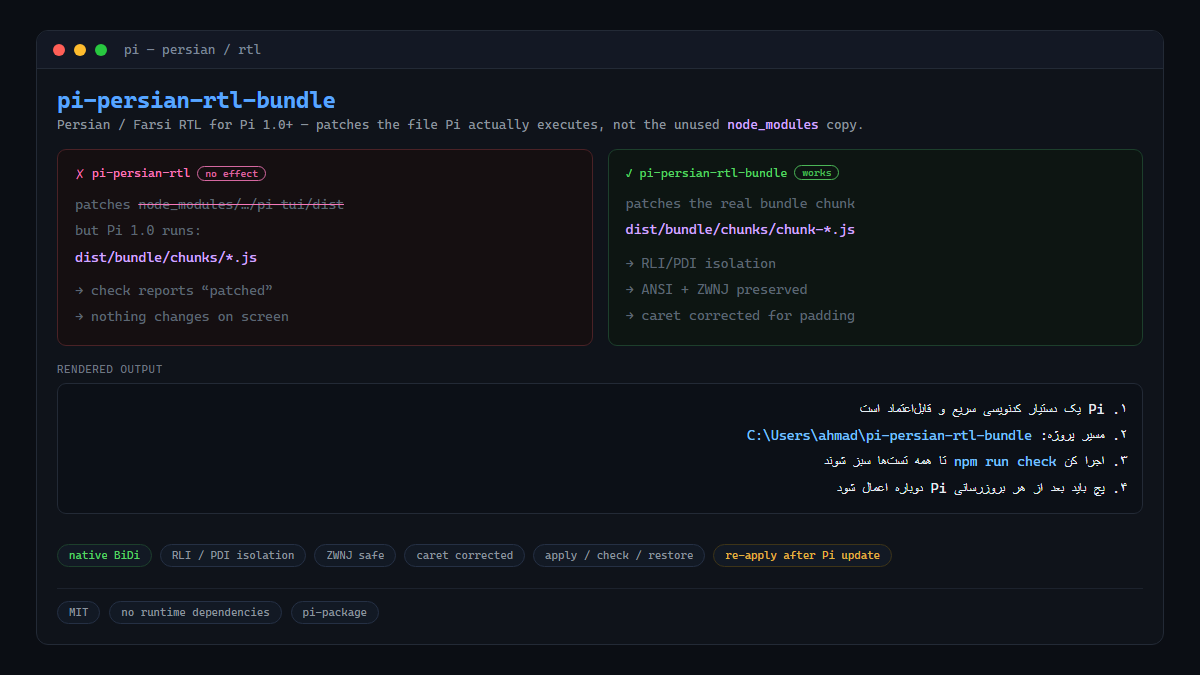
Persian/Farsi RTL support for Pi 1.0+ that patches the file Pi actually executes.
This is a working replacement for pi-persian-rtl
v0.1.1, which patches node_modules/@earendil-works/pi-tui/dist — a file Pi 1.0
never loads. See REPORT-UPSTREAM.md for the full
diagnosis.
Why this exists
Pi 1.0.0 ships a self-contained Bun bundle:
bin  ->  <pkg>/dist/bundle/cli.js
         -> dist/bundle/cli-runtime.js
         -> dist/bundle/chunks/*.js
All of @earendil-works/pi-tui is inlined into one chunk
(chunk-*.js, the one exporting TuiMainScreen, Editor, visibleWidth, …),
and nothing under dist/bundle/ imports @earendil-works/pi-tui from
node_modules.
So a patch against node_modules/@earendil-works/pi-tui/dist is dead code. It
applies cleanly, the file on disk really does change, and Pi's behaviour does
not change at all. pi-persian-rtl check even reports patched: ..., because
it inspects the file it patched rather than the file Pi runs.
This package patches the bundled chunk instead.
Install
npm install -g pi-persian-rtl-bundle      # or run it via npx
npx pi-persian-rtl-bundle doctor
npx pi-persian-rtl-bundle apply
Or install it as a Pi package, which also registers the extension that re-applies the patch at startup:
pi install npm:pi-persian-rtl-bundle
Either way, restart Pi — the patch rewrites the bundle on disk, so it only takes effect in a new process.
Commands
pi-persian-rtl-bundle apply      Patch the files Pi actually runs (idempotent)
pi-persian-rtl-bundle check      Report whether the LIVE runtime path is patched
pi-persian-rtl-bundle restore    Undo the patch (in place)
pi-persian-rtl-bundle doctor     Show every discovered target
Useful flags: --json, --force (restore from backup), --bundle-dir PATH,
--tui-dist PATH.
apply writes a one-time backup next to the patched file:
chunk-2KTBZM5G.js.pi-persian-rtl-bundle.bak
restore reverses the patch in place using exact reverse swaps, so it does
not clobber a newer Pi build. It only falls back to the backup with --force.
Modes
| Env var | Values | Default | Effect |
|---|---|---|---|
PI_PERSIAN_RTL_MODE |
native | visual | off |
auto-detected | See below. |
PI_PERSIAN_RTL_ALIGN |
right | left |
right |
Right-align Persian-first lines. left adds no padding. |
PI_PERSIAN_RTL_CARET |
on | off |
on |
Correct the caret column for padding + RTL mirroring. |
PI_PERSIAN_RTL_TERMINAL_BIDI |
true | false |
unset | Force the terminal-capability probe for auto mode. |
Which mode do I need?
This is the part that bites everyone, so it is detected rather than assumed.
| Mode | Use when | Renders |
|---|---|---|
native |
The terminal implements the Unicode Bidirectional Algorithm | logical order + RLI/PDI isolation; the terminal reorders |
visual |
The terminal does not implement BiDi | application-side reorder, colour preserved |
off |
You want pi to leave output alone | unchanged |
Getting this wrong is visible either way: native on a BiDi-less terminal shows
the text reversed, and visual on a BiDi-capable terminal double-reverses
it.
Auto-detection. With no explicit PI_PERSIAN_RTL_MODE, the mode is chosen
from the terminal:
WT_SESSION/WT_PROFILE_IDset (Windows Terminal), orprocess.platform === "win32"→visual- everything else →
native
Windows Terminal does not implement BiDi — microsoft/terminal#538
has been open in the Backlog since 2019 — and neither does conhost, so on
Windows native would leave text reversed. Override the probe with
PI_PERSIAN_RTL_TERMINAL_BIDI=true|false, or just set the mode explicitly.
Native mode
- keeps text in logical Unicode order — never reverses it;
- wraps RTL-first lines in RLI/PDI (
U+2067/U+2069) so mixed Persian/English/URLs/code stay stable; - preserves ANSI colors and styles;
- keeps ZWNJ and Persian digits intact;
- right-aligns Persian-first lines.
Visual mode
- reorders graphemes in-process so a BiDi-less terminal shows correct RTL;
- preserves ANSI colour by carrying the escape state with each grapheme;
- is an approximation for mixed lines: Latin runs stay intact, Persian runs are reversed, but a line interleaving both can still be imperfect.
The caret and alignment problem
Pi's render order is:
render() -> renderLayoutFrame() -> extractCursorPosition() -> applyLineResets()
Two consequences, both handled here:
1. The line is already full width. Pi's layout frame
(renderLayoutFrame → paintBox) pads every line out to the terminal width
before applyLineResets runs. A naive columns - visibleWidth(line) padding
is therefore always 0, which is why a first attempt at this produced no
right-alignment at all. The trailing padding is relocated to the front
rather than added, so a bare line and a frame-padded line produce identical
output.
2. The caret is computed before padding is applied. So padding shifts the
text out from under the caret. Additionally, an RTL paragraph mirrors glyph
order, so a logical caret at index k lands at visual column total - k:
logical 0 (before the first char) -> right edge of the content
logical n (after the last char)   -> left edge of the content
extractCursorPosition() is patched too, so the caret is computed as
pad + (total - logical) for RTL-first lines. Set PI_PERSIAN_RTL_CARET=off if
your terminal disagrees, or PI_PERSIAN_RTL_ALIGN=left to remove padding
entirely.
This is an approximation: terminals do not expose their BiDi layout, so lines mixing Persian with Latin words can still place the caret imperfectly.
Text selection
Dragging over Persian text highlights the characters you dragged over, not a mirrored copy of them.
Pi applies the selection highlight in applySelection() before
applyLineResets() reorders the line. The highlight therefore landed on the
logical characters at the dragged screen columns, and the reorder then carried
those characters to the opposite side — the highlight appeared mirrored.
Because the reordered line is exactly the mirror of the logical line, the column
mapping inverts as lineWidth - 1 - col. Only the highlight call site is
patched: the copy path (getActiveSelectionText()) reads previousScreen, which
already holds the reordered lines, so its raw column mapping is correct and
mirroring it again would break copying.
Compatibility
| Pi version | Runtime layout | Status |
|---|---|---|
| 1.0+ | dist/bundle/chunks/*.js |
primary, tested |
| < 1.0 | @earendil-works/pi-tui/dist |
best-effort, only used when no bundle is found |
The legacy path is only touched when no runtime bundle exists, so it cannot
conflict with pi-persian-rtl on a modern install.
Development
npm test     # 39 tests, including a probe that loads the real patched chunk
npm run check
The integration tests read your actual installed Pi bundle and will skip
cleanly if no Pi install is present. One test writes a temporary probe file
beside the real chunks (so relative imports resolve) and deletes it in a
finally block.
Notes
- Patching Pi's own bundle is inherently fragile: a Pi update replaces the
chunk and the patch must be re-applied.
checktells you the current state. - After a Pi update, re-run
apply. - Removing
pi-persian-rtlis recommended — it patches an unused file and itscheckcommand is misleading. It is harmless to leave installed.
License
This project is not affiliated with Pi or with pi-persian-rtl. It patches
another program's bundle, which is inherently unsupported. See
CONTRIBUTING.md before sending patch changes.