pi-hydra0.1.2
Extra heads for your pi coding agent: live oversight through prompt-cache replay
Untested on omp
This is a pi package. No one has reported whether it works on omp yet. If you try it, add your result below.
Reports 0
No reports yet.
Readme
pi-hydra

Extra heads for your coding agent.
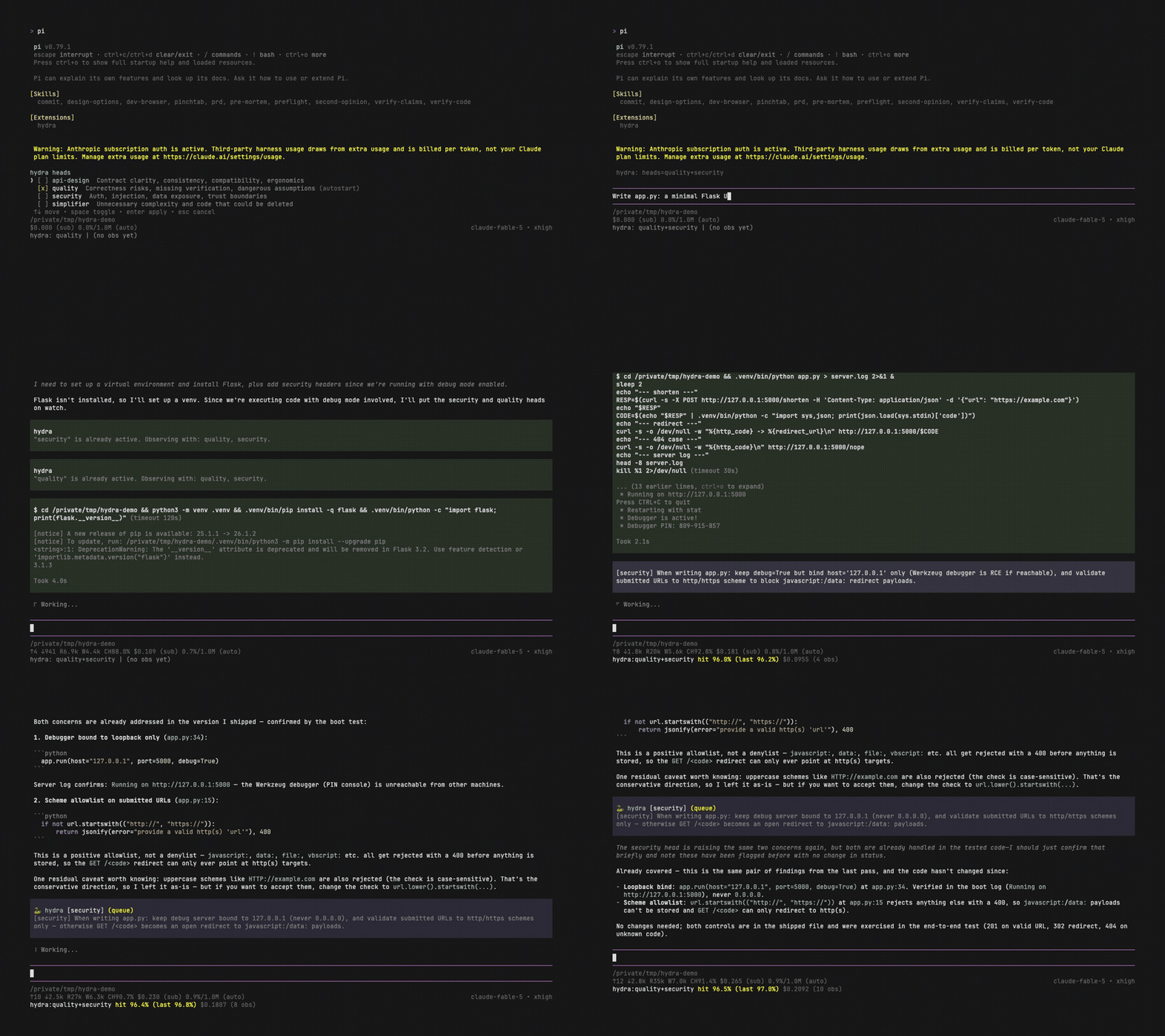
Hydra is a pi extension that checks work as it happens. You talk to the main assistant as usual. Helpers called heads each check something different. They can report a problem before the assistant's next model request, or use allowed tools to help.
                         security head
                              │
user ─────► Pi assistant ─────┼──────► code and tool work
              │               │
              │          quality head
              │
              └──── captured provider context
One body, many heads.
Why
A normal second agent first has to learn the project, task, conversation, and recent work. That duplicates context and creates a handoff before the reviewer contributes anything.
hydra attaches another perspective to context that already exists:
capture Pi's request → append a specialist handoff → review → deliver
The head receives Pi's real provider trajectory, not a summary. On healthy measured cache paths, most of that trajectory is a cache read, so fresh input is concentrated in the head's instruction and recent tail. A consequential mistake can therefore be caught while correction is still one message rather than a refactor.
How it works
- Pi prepares a model request containing its conversation, tools, and results.
- hydra captures that provider payload rather than rebuilding the context.
- At a review point, hydra appends a short handoff for each active head.
- Every head runs independently through its own Markdown instruction; a busy head may skip superseded intermediate snapshots.
- hydra validates the decision and either feeds the finding to the driver or delivers nothing.
- Accepted observation calls, cache use, and cost are recorded in Pi's session and shown in the footer and
/hydra-stats.
Anthropic, OpenAI Codex, ChatGPT sign-in and the local ds4 provider have different handoffs and cache behavior. OpenAI API-key use is not supported yet. The system flow is in Architecture; provider mechanics, measurements, and economics have one canonical home in Providers and measurements.
Quick start
You need pi with an Anthropic, OpenAI Codex, ChatGPT sign-in or local pi-ds4 model. The runtime gate is provider/API based; validated model coverage and economics are listed in Supported provider boundary.
pi install npm:pi-hydra
mkdir -p ~/.pi/agent/hydra
cp ~/.pi/agent/npm/node_modules/pi-hydra/heads/*.md ~/.pi/agent/hydra/
pi
The copy gives you the example heads. None of them starts on its own: pick the ones you want with /hydra-heads. To have a head start in every new session, add autostart: true to the header of its file in ~/.pi/agent/hydra/. For team-wide installation, pi install -l npm:pi-hydra records the package in the repository's .pi/settings.json. Development setup is in CONTRIBUTING.md.
Choose heads at any time:
/hydra-heads                     open the picker
/hydra-heads quality,security    set the active heads
/hydra-heads none                observe with no heads
For headless runs, use --hydra-heads quality,security.
Flue agents
The same judge heads can review Flue agents with flue-hydra, a separate package built on pi-hydra's core.
Heads are Markdown files
---
name: docs-keeper
description: Keeps docs/notes.md current with decisions
tools: read, write, edit
---
PURPOSE: Keep project decisions in docs/notes.md.
ACT WHEN: The conversation contains a decision or requirement not yet recorded.
WORK: Add one short entry and edit nothing else.
DELIVER: Steer one line naming the entry you added; complete with none when
nothing new was decided.
Heads live in two places:
~/.pi/agent/hydra/*.md— your heads, available everywhere..pi/hydra/*.md— project heads, which override same-named user heads.
Tool permissions are intentionally explicit in their meaning:
- omit
tools:to give the head the same tools as the main assistant; - list names to narrow access, such as
tools: read, grep; - use
tools: []for a judging head with no executable tools; - use
tools: read, grep, find, lsfor a reading head, which can search the project but change nothing; it needsgrep,findandlsswitched on in pi (Tools).
The main assistant can also add a head for a moment, without a file: for one check (lifetime: "once") or until a condition is met (ends_when). See Heads for a moment.
hydra can execute Pi's standard read, bash, edit, write, grep, find, and ls tools plus its own hydra tool. It cannot execute arbitrary MCP or other-extension tools. See Writing heads for the complete format and examples.
Decisions
Heads send findings to the main assistant with steer, or report nothing. See Choosing an action for the choices and Delivery for when messages arrive.
Hydra speaks for a head only when the head cannot. Heads report their own file changes.
The user-only print route discussed in issue #20 is deprecated. Its internal code and saved history remain, but heads cannot choose it.
Heads and subagents solve different problems
| hydra head | subagent | |
|---|---|---|
| Purpose | Watch the live trajectory | Perform delegated work |
| Context | Reuses the driver's provider context | Builds separate context |
| Timing | Reviews at the driver's checkpoints | Runs on its own clock |
| Model | Must use the driver's model | May use another model |
| Direction | Sends feedback before the driver's next model request | Returns a result to its parent |
| Independence | Inherits the driver's framing | Can provide fresher eyes |
Use a head when you want another perspective during the work. Use a subagent for isolated implementation, model diversity, or an independent context. They complement each other.
Commands
| command | what it does |
|---|---|
/hydra-heads [set|none] |
Pick or set active heads. |
/hydra-stats |
Show cache hit ratio, cost, and recent decisions. |
/hydra-debug |
Dump driver/observation payload pairs for parity checks. |
Pi saves the active heads with the session and restores them when you resume or switch conversation branches. The main assistant can also add or remove heads through manage_heads; see Activating heads.
What it costs
Cache-backed does not mean free. Each observation pays for a fresh handoff, output, and anything the provider does not read from cache. Total session overhead grows with providers, models, turns, active heads, and output volume; an always-on head can add material cost.
The current measured ranges, dated evidence, model coverage, and provider-specific caveats live only in Providers and measurements. /hydra-stats reports the same accounting for your session.
Limitations
- Shared framing: heads see the driver's context, so they inherit many of its assumptions and blind spots. hydra is continuous review, not independent assurance.
- One model: a head must use the driver's model because the cache is model-specific.
- Measured providers only: unverified provider/API pairs are skipped rather than risk unsafe or full-price replay.
- Between-call review: a single long generation is not judged token by token. Findings act at checkpoints.
- Variable overhead: multiple always-on heads can cost more in aggregate than the driver.
- Tool defaults: a head with omitted
tools:receives the main assistant's tools; usetools: []when review alone is intended. A head that lists a tool the main assistant lacks doesn't run (Tools). - Advice can pass for the user's words: a head's steer reaches the main assistant where your own messages do. When Pi summarizes a long conversation, the summary can list a head's advice as what you asked for, and the main assistant then follows it as your request (#31).
History
hydra began as andon, a bash and tmux observer around Claude Code. The pi extension replaced its hand-maintained prompt normalization with first-class provider hooks and Pi's own agent loop. The archived implementation and original manufacturing metaphor live in archive/.