pi-dmail1.1.0
D-Mail — model-driven context folding for Pi.
Untested on omp
This is a pi package. No one has reported whether it works on omp yet. If you try it, add your result below.
Reports 0
No reports yet.
Readme
D-Mail
Model-driven context folding for pi. The agent folds its own finished steps away and replaces them with a summary it writes.
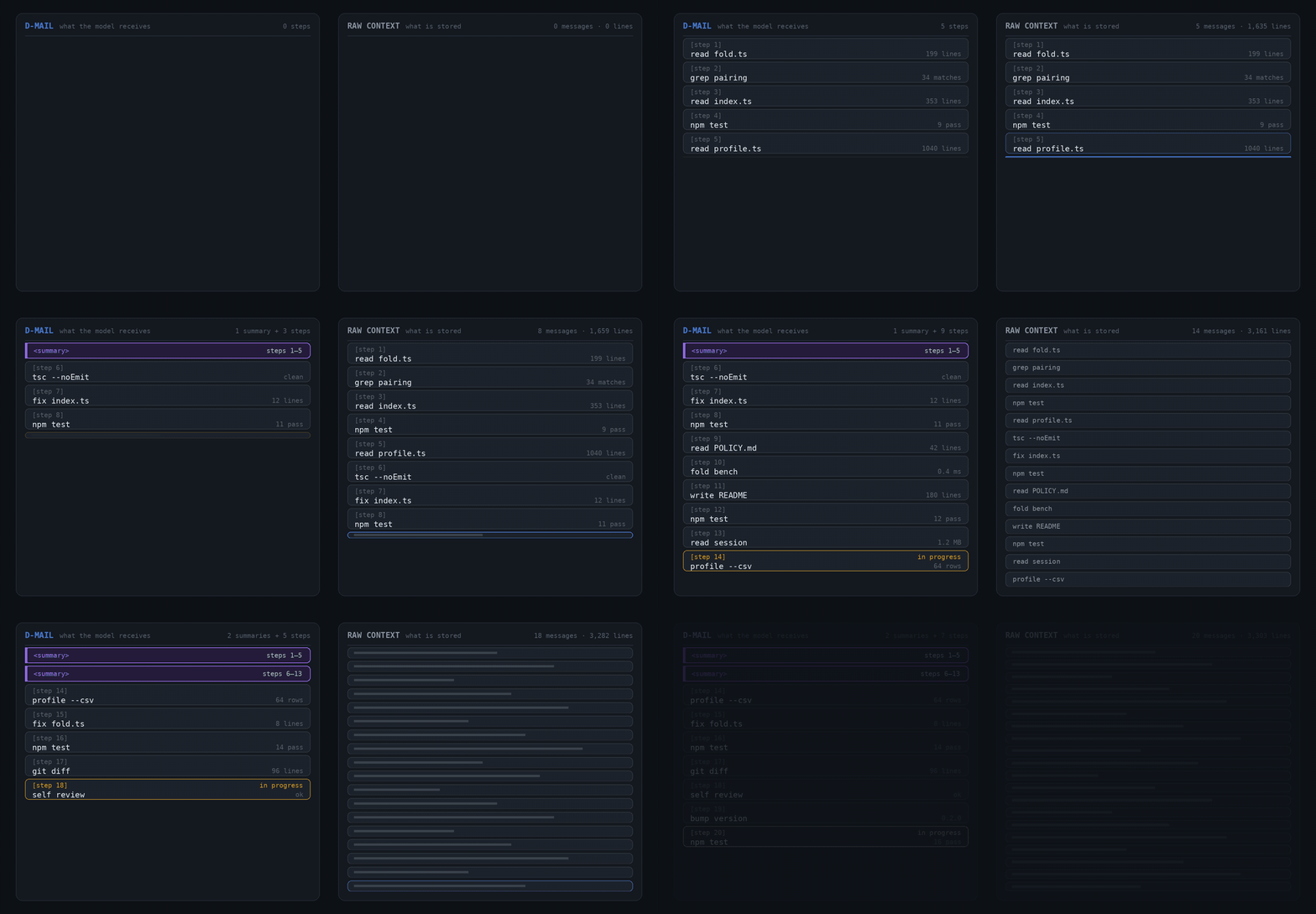
Both panes are the same conversation. On the left, a fold collapses a finished range into one summary chip, so the sent context stays lean. On the right, the stored transcript keeps every step and never shrinks.
The problem
Long conversations get compacted when they hit a size threshold. Compaction cuts by recency, never by usefulness, so dead weight competes for space with material that matters. The model is the one thing in the loop that actually knows which steps it is done with — and pi gave it no way to say so.
How it works
D-Mail adds one tool, send_dmail(fromStep, summary). The agent sees a [step N] marker before each
assistant turn, and calling the tool records that everything from fromStep up to the last completed
step is finished with, and that summary replaces it. A context hook replays those records on every
request, so the agent is sent the summary instead of the transcript.
The step the agent is currently in is never folded, so it passes the earliest step it is done with, not the current one. The end of the range is resolved once, at call time, and frozen: a fold cannot quietly swallow every step that follows it. Numbers come from the branch, so a step keeps its number even after it is folded away — but markers are only emitted for steps still in view.
The idea is borrowed from Moonshot AI's
Kimi CLI, whose
SendDMail tool folds finished messages out of its own context into a self-written summary. Ours folds
a range of steps; theirs rewinds to a checkpoint.
Install
# permanent
pi install git:github.com/ptdat11/pi-dmail

# or try it without installing
pi -e git:github.com/ptdat11/pi-dmail
Then run /reload in pi, or restart it. Managed installs can be inspected and undone with pi list,
pi update git:github.com/ptdat11/pi-dmail, and pi remove git:github.com/ptdat11/pi-dmail.
Forking? A git package clones the repository root as the extension directory, and there is no subdirectory support.
index.tsmust stay at the top level, alongsidefold.ts,profile.ts, andPOLICY.md.
Using it
You rarely invoke D-Mail directly — the agent calls send_dmail when it decides a stretch of transcript
is finished. What you get is a status badge and two commands:
| Surface | What it does |
|---|---|
Blue D-MAIL ON / red ⚠ D-MAIL OFF badge |
Whether folding is active, shown in the footer. |
/dmail |
Toggle folding for the session. Also /dmail on, /dmail off, /dmail status, /dmail fold, /dmail price. |
/send-dmail |
Alias of /dmail fold: opens the picker to pin where the agent folds (/send-dmail 2 pins a start without one). Refused when folding is off, send_dmail isn't an active tool, or nothing is in view. |
--dmail-disabled |
Force folding off for one session, overriding settings (/dmail turns it back on). |
dmail.enabled in settings.json |
Default mode for new sessions (false starts them off). |
Turning folding off is a real escape hatch, not a cosmetic switch. The tool is withdrawn, the agent's folding instructions are withheld, and fold records stop being applied — so anything folded earlier comes back into context as the raw transcript. Reach for it if a summary turns out to have dropped something.
Choosing the default mode
New sessions start with folding on. To start them off, set the one key D-Mail owns in
~/.pi/agent/settings.json (global) or <project>/.pi/settings.json (per project):
{
  "dmail": {
    "enabled": false
  }
}
Project settings override global ones. Anything else — key absent, unparseable JSON, or a non-boolean
value — means on. --dmail-disabled overrides both, and /dmail overrides everything for the current
session. The /dmail toggle is deliberately session-local; only the starting mode is read from settings.
Fold ladders and timing
When a fold happens is the agent's call, and it is deliberately not scripted — the mandatory folds in the
injected policy are a floor, not a schedule. Four habits shape the timing, and all four are spelled out in
POLICY.md so the agent states them rather than improvising them:
- Fold large and rare, not small and frequent. A summary replaces a finished stretch on every subsequent request, so one fold that removes a large range pays back far more than several small ones — and each fold moves the cut point forward, so small folds spend their savings chasing it. Fold big finished ranges at natural seams; let the small stuff ride until it forms one.
- Re-fold stale ladders. Folds stack: each one sits behind the summaries of the ones before it, and a long session becomes a ladder of rungs. When a rung has gone stale — superseded, contradicted by what came later, or already compressed once — re-fold it in place, collapsing the old summary together with its finished neighbours into one fresh one. Ladders are re-folded, not appended to; summaries are replaced, never accumulated.
- Preview before you commit. Every fold result carries an advisory line, and
send_dmail'spreviewparameter prints the same figures without folding: predicted tokens removed, predicted savings per request, how many requests it takes to break even, and whether the context headroom absorbs the summary./dmail price [step] [summary…]is the read-only command form of the same check. These numbers are advisory — a prediction from the session's own cache behaviour, not a promise — but they are the cheap way to see a cut before making it. - The user can pin the cut point.
/dmail fold(alias/send-dmail) opens a picker listing candidate cuts with their headline figures, so you choose where the ladder rung goes instead of waiting for the agent (/send-dmail 2pins a start without the picker). A pinned cut wins; the agent folds from there.
The ladder only spans pi's current compaction window. Records written before the last compaction boundary
are skipped rather than replayed — counted, not erased (folds skipped: N), and the ladder restarts above
the boundary — so a ladder never spans a compact. Details under Why it's safe below.
Why it's safe to let a model decide
Three properties, stated plainly, because they are what make this safe:
- Non-destructive. Folding changes what is sent, never what is stored. Session entries and files are untouched, so folding too much costs a re-read, not data.
- Uncached. There is no fold state to lose. Records live in the session and are replayed from it, so
folding survives
--resumeand survives/reloadmid-session. Only the starting mode comes from settings; a new session starts fromdmail.enabled, which defaults to on. - Bounded damage. A fold that no longer resolves is skipped, not applied partially. And a fold can
never separate an assistant message from the tool results that answer it — that is a hard provider
error, so
fold.tsrefuses any range that would cause it.
Folding also stays out of pi's way: records are read from the active branch, then split by the current
view's compaction boundary. A fold on an abandoned branch, or written before the boundary of the last
compaction, is never replayed — and it is counted, not erased: the fold result reports
folds skipped: N whenever N is greater than zero, so a skip is always explainable. The records
themselves are never rewritten.
Measuring the effect
profile.ts is an offline profiler. It replays one session and, for every request actually made,
compares what the provider charged against what the context would have cost with and without folding.
node profile.ts <session> [--last N] [--json] [--csv]
node profile.ts --list [query] [--all] [--deep] [--json]

# via npm — note the `--`, otherwise npm eats the arguments
npm run profile -- 01a0a7b8 --csv
<session> is a .jsonl path, a path relative to the sessions root, or any unambiguous id prefix
(01a0a7b8). --list lists sessions for the current directory, --all widens that to every project
under the sessions root, and --deep also counts their requests, folds, and prompt tokens.
Prompt size and cache split are measured from the persisted usage of each assistant message. The
folded and raw message lists are reconstructed with the same foldContext the extension uses, so their
difference is the genuine effect of folding. The absolute estimate is a characters/4 heuristic that
ignores the system prompt and tool schemas — trust the folded-vs-raw delta, and treat overhead as a
drift check. $saved values folded-away tokens at rates derived from the session's own usage/cost pairs
(no price table), as a range rather than a point, since the raw counterfactual's cache behaviour is not
observable. Output spend is unaffected, so prompt-side spend is printed as the ceiling on any saving.
Notes
- The agent's folding policy lives in
POLICY.mdand is appended to the system prompt. PointDMAIL_POLICYat a different file to use your own; if the file is missing, a short built-in fallback keeps the tool discoverable. send_dmailrefuses a step that has already been folded out of view, and refuses the step the agent is currently in — there is nothing finished to fold yet.- Tests:
npm testruns node's built-in runner over everytest/**/*.test.ts— the fold algebra (including the era split that counts orphaned records), the replay/refold wiring, the result renderer, orphan-visibility acceptance, the harness smoke tests, the policy injection (ladder guidance present when on, absent when off), the profiler, and thesettings.jsondefault-mode reader. - Release gate:
npm run verify:e2e(ormake verify-e2e) is the hand-runnable end-to-end seam verification — it spawns a real localpi --mode rpcwith a keyless fixture provider, builds a session with a genuine fold record through the realsend_dmailtool, forces a compact, and asserts the compaction summary derives from the fold summaries (folded narrative present, dropped detail absent). It needs no network, prints one PASS/FAIL line per assertion plus a finalRESULT: PASS|FAIL, and is wired intomake releaseas a release step — deliberately not intonpm test/CI.
License
MIT — see LICENSE.