pi-context-guard-jev0.3.1
Pi extension that removes tool output the agent no longer needs from its context. The Jev classifier keeps the needed lines verbatim; stale small outputs, unrelated old exchanges and old screenshots become one-line notes. Everything can be recalled.
Untested on omp
This is a pi package. No one has reported whether it works on omp yet. If you try it, add your result below.
Reports 0
No reports yet.
Readme
pi-context-guard-jev
A Pi extension that removes tool output your agent no longer needs
from its context. The Jev classifier decides which lines to keep. Kept lines are copied verbatim, and the
model can recall anything that was removed.
Install
pi install npm:pi-context-guard-jev
Requires Pi ≥ 1.0.3 and an OpenRouter credential (OPENROUTER_API_KEY or /login). Once it is ready, the
footer shows 🛡 0 saved.
What it removes
| Item | Rule | The model then sees |
|---|---|---|
| Large tool output (≥ 4k chars) | Jev keeps the chunks the work still needs | The kept lines, verbatim, and one line per removed stretch |
| Small tool output (400–4k chars) | Jev: is it still needed? | A one-line note |
| Earlier exchange about another task | Jev: is it still relevant? | A one-line note on its prompt |
| Image in a tool result | After 3 turns (no Jev call) | The result's text and a one-line note |
The extension runs when a run finishes. In long runs it also runs mid-run, once enough old output has piled
up. An edit makes the next request rewrite part of the prompt cache, so mid-run edits and edits to earlier
exchanges wait until the smaller context pays for that. It leaves alone images you send, results of edit
and write, and the last two exchanges before your current prompt.
Example
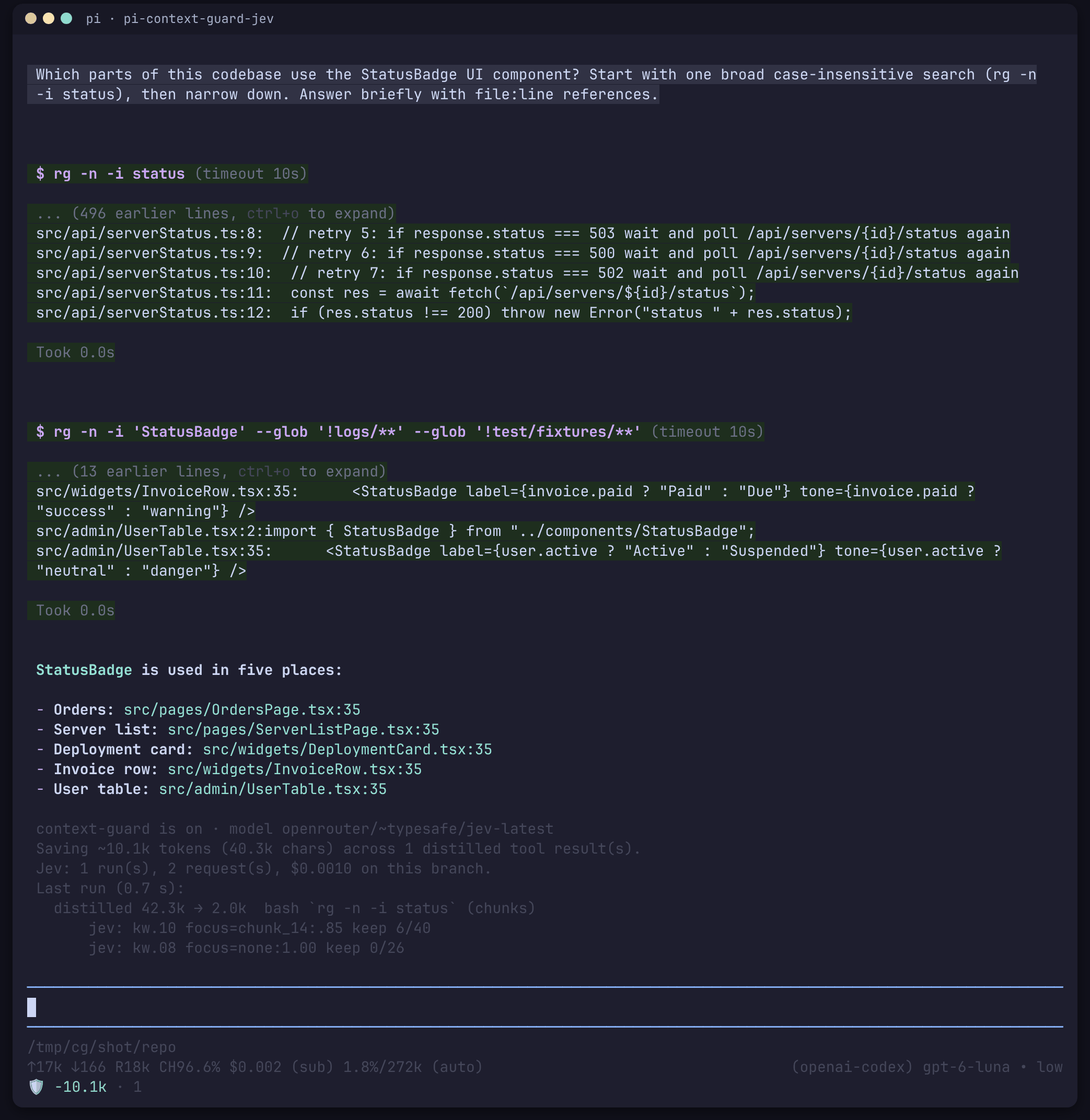
The agent ran rg -n -i compact dist docs (50 KB) to find where Pi decides to auto-compact. After the
run, the output that later requests carry starts like this:
[context-guard] Distilled the output of bash `rg -n -i compact dist docs`: kept 141 of 431 lines (15.1k of 50.4k chars); the rest was judged not needed for the answer. Full output: recall({"entryId":"1704787f"}).
[… 79 lines omitted: matches in dist/core/tools/grep.js, dist/core/session-manager.js, dist/core/export-html/template.js, dist/core/export-html/template.css, dist/core/sdk.js and 5 more …]
dist/core/compaction/compaction.d.ts:25:    /** Extension-specific data (e.g., ArtifactIndex, version markers for structured compaction) */
dist/core/compaction/compaction.d.ts:28:export interface CompactionSettings {
dist/core/compaction/compaction.d.ts:33:export declare const DEFAULT_COMPACTION_SETTINGS: CompactionSettings;
dist/core/compaction/compaction.d.ts:54:/** Estimate projected context without trusting usage captured before a later edit or compaction. */
dist/core/compaction/compaction.d.ts:57: * Check if compaction should trigger based on context usage.
dist/core/compaction/compaction.d.ts:59:export declare function shouldCompact(contextTokens: number, contextWindow: number, settings: CompactionSettings): boolean;
[… 44 lines omitted: matches in dist/core/compaction/compaction.d.ts, dist/core/compaction/branch-summarization.d.ts, dist/core/compaction/index.d.ts, dist/core/session-manager.d.ts, dist/core/cache-stats.js and 2 more …]
…
With the matches it kept, the model then answered which compaction settings a user can change and their
defaults correctly, without recall.
Small outputs, old exchanges and images leave one line each:
[context-guard] Omitted the output of bash `npm test` (1.2k chars): judged no longer needed. Full output: recall({"entryId":"…"}).
[context-guard] Omitted an earlier exchange judged unrelated to the current work: "which API clients retry on 503?" (6 messages, ~2.2k tokens). Full exchange: recall({"entryId":"…"}).
[context-guard] Removed 1 image from this output (1280×960; ~1.6k tokens), 4 turns old. recall({"entryId":"…"}) shows it again.
Results
Context size of the next request, with the guard on and off:
| Task | Model | On | Off |
|---|---|---|---|
Code search (50 KB rg), then a follow-up question |
Claude Sonnet 5.5 | 15.5k | 28.2k |
| The same | GPT-6 Luna | 11.5k | 34.3k |
| Reading a 164 KB file, then a question about a detail | GPT-6 Luna | 9.2k | 35.3k |
| Failing test log, then "now fix it" | GPT-6 Luna | 5.7k | 7.5k |
| Autonomous run fixing 10 bugs (peak over the run) | GPT-6 Luna | 45k | 68–88k |
| Six screenshots, then a question about one of them | Claude Sonnet 5.5 | 9.4k | ~14.1k |
Every follow-up was answered correctly, and every task was finished. The screenshot row's "off" value is the request before the images were removed. Jev costs $0.0003–0.007 and takes 0.6–2 s per pass. These are single runs, not a benchmark. Details: docs/RESULTS.md.
Use
It works on its own; there is nothing to call.
- Footer:
🛡 −4.2k · 3means about 4.2k tokens are kept out of context right now, by 3 edits. After a compaction,🛡 0 · Σ−79kshows the total saved in the session. /guard: shows every decision of the last pass, with Jev's probabilities./guard offand/guard onare saved for later sessions./guard reloadre-reads the settings.recall: the model calls it when it needs something removed: the whole original, lines that match a regex, or a line range. You can also ask for it ("recall the full test log").- Undo: use
/treeto go back to before an edit; the original is still in the session file.
Configure
Optional. Put the settings in ~/.pi/agent/context-guard.json:
{
  "excludeTools": ["edit", "write", "bash"],
  "imageKeepTurns": 5,
  "historyExchanges": 0
}
| Key | Default | Meaning |
|---|---|---|
enabled |
true |
Master switch (/guard on and /guard off write it) |
excludeTools |
["edit", "write"] |
Tools whose output is never touched |
imageKeepTurns |
3 |
Remove images from tool results after this many turns; 0 turns this off |
pruneExchanges |
true |
Omit earlier exchanges about other tasks |
midRun |
true |
Also run during long runs, not only at the end |
historyExchanges |
3 |
Earlier exchanges sent to Jev as context; 0 sends none |
model |
openrouter/~typesafe/jev-latest |
Classifier model |
All settings: docs/REFERENCE.md.
Privacy
Jev runs on OpenRouter and TypeSafe. Each pass sends them your prompt, the agent's answer or progress
notes, short excerpts of earlier messages, and the text of the tool outputs being judged. That text can
include source code and logs. Images, edit and write results, and outputs under 400 chars are never
sent. Turn the extension off with /guard off. The full list of what is sent:
docs/REFERENCE.md.
Trade-offs
- The first request after an edit costs more. The prompt cache has to be rewritten from the edit onward. In short sessions you gain context room, not a lower bill.
- Lossy by design. A follow-up that goes somewhere new may need
recall(the model sees what was removed and how to get it back). - It adds 0.5–2 s after a run, or mid-run while a checkpoint runs (at most 8 s).
More
- docs/REFERENCE.md: every setting, status, command and
recallparameter - docs/RESULTS.md: measured runs, including where it does not help
- docs/DESIGN.md: how it works
- docs/CACHE.md: prompt-cache costs on Anthropic and OpenAI
- docs/JEV.md: the Jev questions and threshold choices
- docs/TESTING.md: unit and live tests
MIT license.