pi-codemode-guard0.1.5
Pi extension that compiles LLM-written codemode scripts into pi's codemode syntax: tolerant argument shapes, markdown fences, @options/@exec pragmas, IIFE wrappers, JSON tool-call programs, missing await, bare tool calls, and the OpenCode / Cloudflare age
Untested on omp
This is a pi package. No one has reported whether it works on omp yet. If you try it, add your result below.
Reports 0
No reports yet.
Readme
pi-codemode-guard
English | 简体中文
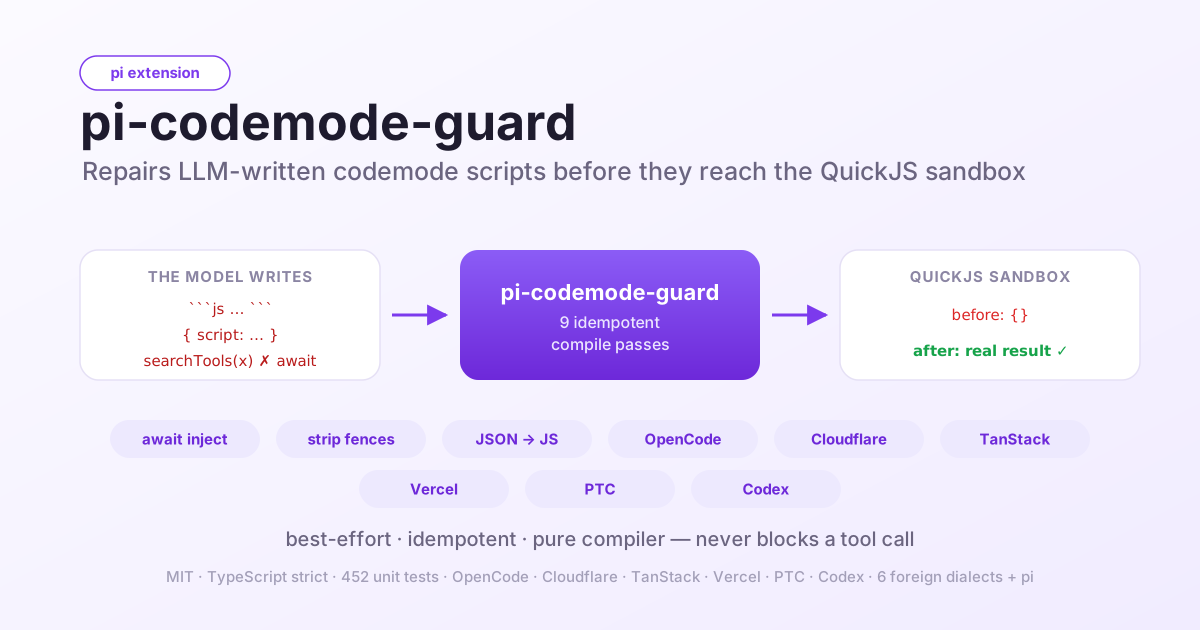




In one sentence: a best-effort, idempotent compiler that turns broken codemode tool calls from any LLM into the exact JavaScript pi's QuickJS sandbox expects — without forking codemode.
pi-codemode-guard is an open-source (MIT), TypeScript extension for the
pi AI coding agent. codemode is pi's
tool for running one model-written JavaScript script that calls pi's other
tools inside a QuickJS sandbox — and many models write that script wrong.
The guard repairs the script before it reaches the sandbox: it inserts
missing await, strips markdown fences, converts JSON tool-call programs into
real JavaScript, normalizes @options: / @exec: pragmas, unwraps async IIFEs,
and translates the OpenCode, Cloudflare agents, TanStack AI, Vercel AI SDK,
DeepSeek Harness PTC, and OpenAI Codex code mode dialects — so AI-generated
agent scripts run instead of silently failing.
Typical model mistakes: a markdown fence around the script, a JSON tool-call
program instead of JavaScript, a wrong field name (script instead of code),
a relaxed @options: line, an async IIFE wrapper, or a forgotten await — and
an unawaited tool call is silently JSON-serialized as {}.
Before → after
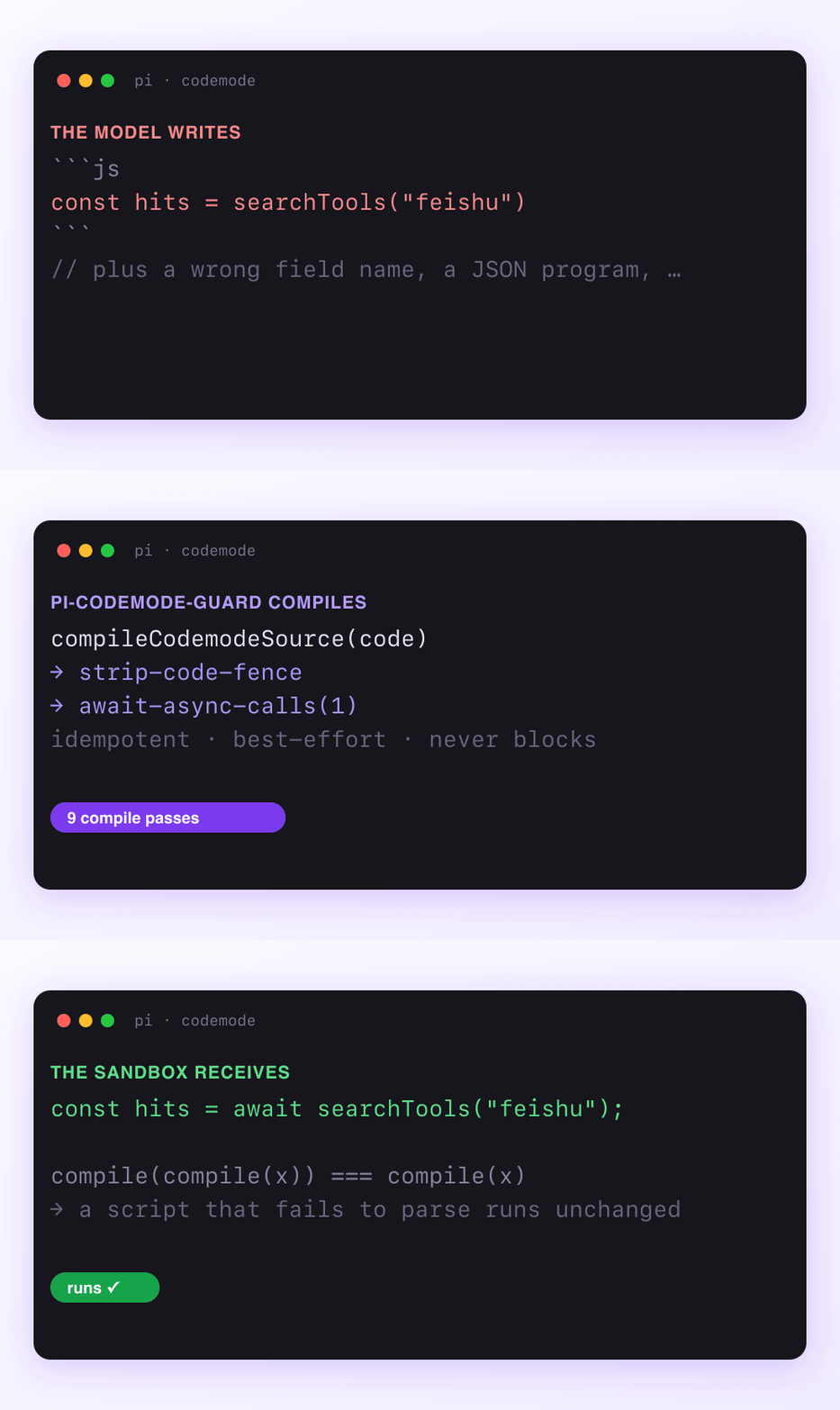
Real output of compileCodemodeSource, the compiler every codemode call
runs through:
Markdown fence + missing await — the feishu: {} bug (pi issue
#10555). The model
writes:
```js
const hits = searchTools("feishu")
```
The sandbox receives:
const hits = await searchTools("feishu")
JSON tool-call program. The model writes:
[{"tool":"read","args":{"path":"package.json"}}]
The sandbox receives:
const _result0 = await tools.read({"path":"package.json"});
return _result0;
Another dialect. The model writes (OpenCode):
const r = await tools.orders.lookup({ id: 1 });
Resolved against pi's live tool catalog, the sandbox receives:
const r = await tools.orders_lookup({ id: 1 });
Compile any of these again and nothing changes: every pass is idempotent, and a script that does not parse is returned unchanged with a warning — a guard bug can never block a tool call.
Install in one command (it registers pi's codemode tool itself):
pi install npm:pi-codemode-guard
Other sources (git, local checkout, one-session pi -e), the security note,
and the pi ≥ 1.1.0 startup warning: see Install.
Why
Real failures from pi sessions and the pi tracker:
- Missing
awaiton async helpers.const hits = searchTools("feishu")printedfeishu: {}because the pending promise was serialized. Pi fixed the description for this (await searchTools(...), commit269121616, issue #10555); the guard fixes the scripts. - JSON tool-call programs. Models that cannot write JavaScript emit
[{"tool":"read","args":{"path":"package.json"}}], which pi validates as a string only if it is wrapped, and then fails to run. - Markdown fences. The pi docs explicitly say "raw JavaScript source, not JSON and not a markdown code fence"; models ignore that.
What it does
Two hooks, installed automatically:
- Argument normalization (
prepareArguments). Pi validates tool arguments before any execution hook, so the guard adds a shim to the codemode tool definition. It accepts a raw string, the common field aliases (script,source,javascript,input, …), nested source objects ({ code: { language, content } }), a single JSON tool call, and JSON tool-call programs. - Script compilation (the
tool_callevent). The validatedcodeis compiled in place bycompile.ts.
Compile passes
| Pass | Before | After |
|---|---|---|
strip-code-fence |
```js\nconst x = 1;\n``` |
const x = 1; |
normalize-options-line |
/* @options: {'maxOutputTokens': 2000} */ |
// @options: {"max_output_tokens": 2000} |
normalize-options-line |
// @exec: {"yield_time_ms": 10000, "max_output_tokens": 1000} |
// @options: {"max_output_tokens": 1000} (+ a yield_time_ms warning) |
normalize-options-line |
// @options: {"timeout_ms": 1000} after the first line |
moved to the first line (+ duplicates removed) — pi ≥ 1.2.0 fails the call otherwise |
compile-json-program |
[{"tool":"read","args":{"path":"a"}}] |
const _result0 = await tools.read({"path":"a"});\nreturn _result0; |
tanstack-typescript |
const city: string = "London"; |
const city = "London"; |
vercel-typescript |
const c: string = "London"; |
const c = "London"; |
ptc-typescript |
let total: number = 0; |
let total = 0; |
strip-typescript |
const n: number = 1; (no dialect claimed it) |
const n = 1; |
unwrap-iife |
(async () => { … })(); |
… |
translate-statements |
one statement-based pass over every dialect construct | OpenCode/Cloudflare/TanStack/Vercel/PTC/Codex constructs translated independently |
opencode-dialect |
await tools.orders.lookup({…}) |
await tools.orders_lookup({…}) |
cloudflare-dialect |
await codemode.lookupOrder({…}) |
await tools.lookupOrder({…}) |
tanstack-dialect |
external_getWeather({…}) |
tools.getWeather({…}) |
vercel-dialect |
await tools["web-search"]({ q }) |
await tools.web_search({ q }) |
ptc-dialect |
await tools["my-tool"]({ q }) |
await tools.my_tool({ q }) |
codex-dialect |
yield_control() / Codex-only helpers |
left in place with a warning |
bare-tool-calls |
search({ q }) (a known tool name) |
tools.search({ q }) |
await-async-calls |
const hits = searchTools("x"); |
const hits = await searchTools("x"); |
rewrite-tool-identifiers |
tools["mcp__dev-radius__search"](…) |
tools.mcp__dev_radius__search(…) |
Every pass is independent, idempotent, and best-effort. A script that does not
parse is returned unchanged with a warning, so a guard bug can never block a
tool call. A JSON tool-call program is compiler-generated JavaScript: it skips
statement translation and runs only await-async-calls and
rewrite-tool-identifiers on the result.
Translation is statement-based: a snippet may mix dialects, and each
construct is repaired by its shape rather than by one dialect detected for the
whole snippet. The per-dialect pass ids above are reported for attribution; a
single compile can list several of them at once (plus translate-statements).
Dialects
The compiler detects which codemode dialect a script is written in, but
translation no longer depends on that single answer: translateCodemode parses
the source once and translates each statement by its shape, so OpenCode,
Cloudflare, TanStack, Vercel/PTC and Codex constructs in one snippet are all
repaired. Detection is still used to pick the TypeScript-stripping pass, to
disambiguate the two constructs OpenCode and PTC share (Object.keys(tools) and
unresolved bracket names), and to report dialect in the interop contract.
detectCodemodeDialect(code, { hadOptionsLine, hadExecLine }) returns pi,
opencode, cloudflare, tanstack, vercel, ptc, codex, or unknown with
the signals it found; the context flags restore the @options / @exec signal
the options pass removed. OpenCode-exclusive signals are
$codemode, a tools.<ns>.<tool> path (Pi tools are always single-level), and
Object.keys(tools). Cloudflare signals are a codemode.<tool> / codemode.search
platform call and the bare async () => { … } program wrapper. TanStack signals
are a bare external_<tool> binding reference (never a tools.external_<tool>
member access). Vercel signals (vercel:tools.<name>) are TypeScript source
(acorn cannot parse it) that references tools and carries no
OpenCode/TanStack/Cloudflare signal — TanStack (external_) and OpenCode
($codemode / nested tools.<ns>.<tool>) take priority. DeepSeek Harness PTC
signals are ptc:ToolCallError and ptc:import(), plus ptc:Object.keys(tools)
only when acorn cannot parse the TypeScript; OpenCode's structural signals
($codemode / nested tools.<ns>.<tool>), TanStack, and Cloudflare take
priority, but PTC's own signals outrank the generic Object.keys(tools) shape
that OpenCode also uses. Codex signals are the @exec pragma and the Codex-only
helpers (yield_control, notify, generatedImage, audio); they outrank
Pi's own helper signals because a Codex script also uses ALL_TOOLS/models.
Vercel remains the generic TypeScript fallback, so a PTC program with none of
these signals is still compiled correctly as vercel.
When the dialect is opencode,
@opencode-ai/codemode
programs are translated. compileOpencodeDialect runs before the await
pass:
OpenCode (@opencode-ai/codemode) |
Pi codemode |
|---|---|
tools.orders.lookup({…}) |
tools.orders_lookup({…}) — resolved against the live catalog |
tools.context7["resolve-library-id"]({…}) |
tools.context7_resolve_library_id({…}) |
tools.mcp.dev.radius.search({…}) |
tools.mcp__dev_radius__search({…}) (fuzzy name match) |
await tools.$codemode.search({ query, namespace, limit, offset }) |
an await searchTools(...) shim returning { items: [{ path, description, signature }], remaining, next } |
Object.keys(tools) |
ALL_TOOLS.map((t) => t.name) |
Object.keys(tools.<ns>) |
the ALL_TOOLS name list filtered by the namespace prefix (plain and mcp__ spellings) |
for...in tools.<ns> |
not rewritten — warns and points at ALL_TOOLS.map((t) => t.name) |
return value, console.log, Promise.all, top-level await |
already valid Pi — left untouched |
Tool-path resolution needs Pi's live catalog, so the extension passes
pi.getAllTools().map((t) => t.name) into the compiler. Exact separators
(., __, _, /, -, each also tried under the MCP mcp__ prefix) are tried first, then a fuzzy match that normalizes
both sides (mcp.dev.radius.search ↔ mcp__dev-radius__search). A path with no
catalog match is flattened deterministically and reported in warnings.
console.log maps to Pi's <console_output> block and OpenCode's { ok, value }
envelope is dropped (Pi surfaces the return value directly); both are
compatible in the OpenCode → Pi direction, so no rewrite is needed.
When the dialect is cloudflare,
@cloudflare/codemode
programs are translated. unwrap-iife removes the async () => { … } wrapper
first, then compileCloudflareDialect rewrites the namespaces:
| Cloudflare agents | Pi codemode |
|---|---|
codemode.lookupOrder({…}) |
tools.lookupOrder({…}) — the default namespace is stripped |
state.readFile("/path") |
tools.state_readFile("/path") — named provider, resolved against the live catalog |
await codemode.search("query") |
an await searchTools(...) shim returning Cloudflare's { results: [{ path, connector, method, description, kind }], total, truncated } |
await codemode.describe(path) |
an await describeTool(...) shim returning { path, description, types } |
codemode.run(name) / codemode.step(name, fn) |
no Pi equivalent — left unchanged with a warning |
Math.*, JSON.*, console.*, Promise.*, searchTools, … |
never treated as a provider namespace |
Cloudflare names tools with sanitizeToolName (hyphens/dots → _, invalid
characters stripped, digit-leading names prefixed with _, reserved words
suffixed with _), which differs from Pi's toCodemodeIdentifier. The catalog
is therefore also keyed by the Cloudflare spelling, so codemode.delete_() maps
back to tools.delete() and codemode._3d_render() to tools._d_render().
Provider namespaces are only rewritten when the catalog confirms them, and names
bound by the script itself (const state = {…}) are never touched. An
unresolved provider is also left unchanged — but it only warns when the
detected dialect is cloudflare (could not resolve Cloudflare provider `state.readFile` …); any other dialect stays silent unless the trailing
segment is a live Pi tool, in which case it hints `foo.read` is not a Pi tool path; Pi has a tool `read` — call `tools.read(...)` (translate.ts),
so performance.now() and foo.bar() warn about nothing. Positional
provider arguments (state.readFile("/path")) are preserved as written. Two
known limitations: a statement-form program that uses only named providers (no
codemode.* call, no async-arrow wrapper) detects as unknown (detection is
catalog-free), and export default async () => {} is left alone — unwrap-iife
only unwraps a lone expression statement.
When the dialect is tanstack, @tanstack/ai-code-mode
programs are translated. The code is TypeScript, so tanstack-typescript runs
first (unwrap-iife runs after, in case the model wrapped its code), then
compileTanstackDialect rewrites the bindings:
| TanStack AI code mode | Pi codemode |
|---|---|
{ typescriptCode: "…" } |
{ code: "…" } (via the typescriptCode argument alias) |
external_getWeather({…}) |
tools.getWeather({…}) — resolved against the live catalog |
external_my_tool({…}) with tool my-tool |
tools.my_tool({…}) (Pi's toCodemodeIdentifier rule) |
return value, console.log, Promise.all, top-level await |
already valid Pi — left untouched |
The binding prefix is stripped and the rest resolved through Pi's catalog the same way OpenCode namespace paths are; an unresolvable binding is flattened identically to OpenCode (and warned about) so it at least parses.
When the dialect is vercel, @ai-sdk/code-mode
programs are translated. The envelope field is { js: "…" } instead of Pi's
{ code } (js is already accepted as an argument alias) and the program runs
as the body of an async function (top-level await/return work). The code is
TypeScript, so vercel-typescript runs before unwrap-iife, then
compileVercelDialect rewrites the bracket access:
| Vercel AI code mode | Pi codemode |
|---|---|
{ js: "…" } |
{ code: "…" } (via the js argument alias) |
await tools["web-search"]({ q }) |
await tools.web_search({ q }) — resolved against the live catalog |
const c: string = "London"; |
const c = "London"; — TypeScript stripped via sucrase |
tools.getWeather({ location }) |
tools.getWeather({ location }) (unchanged) |
Raw tool names that are not valid JS identifiers keep bracket access in Vercel;
compileVercelDialect maps them to Pi's identifier against the live catalog,
flattening (and warning about) any name it cannot resolve — the same fallback
OpenCode uses. A plain-JavaScript Vercel program parses, so vercel-dialect
does not run: its exotic bracket access is still resolved against the catalog
by rewrite-tool-identifiers, but without the unresolved-name warning. This dialect has no searchTools / ALL_TOOLS / codemode.*
helpers; tool discovery is embedded in the tool description, so nothing is
shimmed.
When the dialect is ptc,
@deepseek-ai/dsh-ptc-runtime-node
programs are translated. DeepSeek's PTC mode tool is
run_code({ description, code }) — the argument shim reads only code (or an
alias field), so the extra description is ignored, leaving Pi's { code } —
and code is the body
of an async TypeScript function (erasable TypeScript only), so top-level
await/return work. The code is TypeScript, so ptc-typescript runs before
unwrap-iife, then compilePtcDialect rewrites the calls:
| DeepSeek PTC | Pi codemode |
|---|---|
{ code, description } |
{ code } (description ignored) |
await tools["web-search"]({ q }) |
await tools.web_search({ q }) — resolved against the live catalog |
Object.keys(tools) |
ALL_TOOLS.map((t) => t.name) |
const c: string = "London"; |
const c = "London"; — TypeScript stripped via sucrase |
ToolCallError |
no equivalent — a warning is emitted |
await import("node:fs") |
unavailable in Pi — a warning is emitted |
Host functions are exposed as a global tools object whose names are
arbitrary strings (the model writes await tools.name(args), or quoted access
tools["my-tool"](args) for exotic names); compilePtcDialect maps them to
Pi's tools.<identifier> against the live catalog. ToolCallError (PTC's
rejection for failed tool calls, carrying .toolName) and await import(...)
(the way PTC reaches Node APIs) have no Pi equivalent — a failed Pi tool call
rejects with a plain Error, and Pi's QuickJS sandbox has no import,
fetch, or Node APIs — so both emit a warning. Those two are PTC-specific;
everything else the sandbox lacks — timers (setInterval/clearInterval),
Intl, structuredClone, TextEncoder/TextDecoder, URL/URLSearchParams,
crypto, fetch, process, require, Buffer, and host globals such as
Atomics, WebAssembly, AbortController, Headers, Request, Response,
localStorage, window, document — warns too, through the shared runtime
rows in UNSUPPORTED_GLOBALS (dialect/signals.ts), each leaving the call in
place with a suggested Pi alternative. An absent global warns only when
nothing resolves: a reference the live catalog confirms as a tool —
fetch({q}) with a tool fetch, crypto.read with a tool crypto_read —
rewrites instead and stays silent. console.log(...) and return are PTC's
output channels and are Pi-compatible.
OpenAI Codex code mode (codex-rs/code-mode-runtime)
OpenAI Codex
runs its exec tool as raw JavaScript in a fresh V8 isolate. Its program API is
close to Pi's, so most of a Codex script is already valid:
| Codex | Pi codemode |
|---|---|
exec({ code: "…" }) |
codemode({ code: "…" }) |
await tools.mcp__ologs__get_profile({…}) |
unchanged — Codex's normalize_code_mode_identifier is exactly Pi's toCodemodeIdentifier |
text / image / store / load / exit |
unchanged |
ALL_TOOLS as { name, description }[] |
unchanged |
// @exec: {"yield_time_ms": 10000, "max_output_tokens": 1000} |
// @options: {"max_output_tokens": 1000} — yield_time_ms is dropped with a warning |
audio / generatedImage / notify / yield_control / setTimeout / clearTimeout |
no Pi equivalent — left in place with a warning |
The only translation is the pragma and the Codex-only helpers; the codex
dialect exists so a Codex script is reported and its boundaries are surfaced.
What it deliberately leaves alone
- Missing
awaitinside a non-async function (inserting one is a syntax error). - Members of
Promise.all/allSettled/race/anyand promises chained with.then/.catch/.finally. - Envelope shapes that already failed pi validation before the arguments hook.
Known limitations
- Statement-form Cloudflare programs that use only named providers (no
codemode.*call, no async-arrow wrapper) reportdialect: unknown— detection is catalog-free — so the interopdialectis inaccurate, and, because the detected dialect is notcloudflare, such a program gets no provider diagnostic at all unless the trailing segment happens to be a live catalog tool (the`foo.read` is not a Pi tool pathhint). The provider rewrite still runs:translate.tsapplies the Cloudflare rule to every statement, catalog permitting. - A tool-handle property access (
tools.read.length) is preserved only when the live catalog confirms the first segment, and detection is catalog-free — so the contract still reportsdialect: "opencode"for such a source. The rest of the chain is never validated: an unresolvedtools.<tool>.<property>(tools.read.zzz) is left exactly as written — no rewrite, no warning — and fails at runtime inside pi's helpful tools proxy. - Non-erasable TypeScript: sucrase compiles
enum/namespaceinto running JavaScript, where DeepSeek's erasable-only PTC reference would reject them. - Identifier collisions (
web-search/web_search): resolution is deterministic (the written raw name wins) and emits no warning, but both map to the sametools.web_search. - Dynamic bracket access (
tools[expr], a non-literal property) is never rewritten, silently. ALL_TOOLSentries are{ name, description }objects; model code that treats them as strings (e.g.ALL_TOOLS.filter(n => /x/.test(n))) is not normalized (observed in real sessions).
Install
pi-codemode-guard is a Pi package: it
ships a pi.extensions manifest and the pi-package keyword, so installing it
with the pi CLI registers the codemode tool itself. It is published to npm as
pi-codemode-guard.
# from npm (recommended)
pi install npm:pi-codemode-guard

# from git
pi install git:github.com/tychenjiajun/pi-codemode-guard

# from a local checkout
pi install ./pi-codemode-guard

# try it for one session without saving it to settings
pi -e npm:pi-codemode-guard
pi list shows configured packages; pi remove <source> removes one and
pi update --extensions reconciles installed packages; pi config enables or
disables individual resources, including pi's built-ins. Personal installs are
written to ~/.pi/agent/settings.json — add --local (or -l) to write a
project-scoped declaration to .pi/settings.json instead, which pi reads only
after project trust is granted.
Extensions and packages run inside the pi process with your operating-system permissions and can inspect prompts, tool calls, and session history. Review third-party source before installing it — including this one.
It works both with the CLI's built-in codemode extension (which it replaces) and
in SDK sessions that add createCodemodeExtension().
Startup warning on pi ≥ 1.1.0. Registering a tool named
codemodemakes pi leave out its replaceable built-incodemodeextension and printExtension … registers tool `codemode`, so built-in extension `codemode` was not loaded. The guard is that replacement —codemodestill works — but to silence the message, disable the built-in copy: add"extensions": ["-builtin:codemode"]to~/.pi/agent/settings.json(or uncheckcodemodeunder Built-in inpi config). If the guard is later removed, re-enable the built-in socodemodekeeps working.
How it stays compatible
The built-in codemode tool is registered by an extension that pi marks
replaceable (builtin: true, replaceable: true in the CLI), and
reimplementing it would lose models, store() persistence, and
codemode.mode. Instead the guard runs the canonical
createCodemodeExtension() factory through a small pi proxy whose
registerTool adds the argument shim and a compile receipt. The proxy spreads
the canonical definition, so the tool keeps parameters === codemodeSchema,
reachesTools, prepareLoadout, defaultActive: false, and all of its other
original options — pi 1.2.0 relies on reachesTools (not on the old
isCodemodeTool helper, removed in 1.2.0) to decide whether a replacement
codemode can reach MCP tools.
Built on pi
The guard is an ordinary extension — a
TypeScript module whose default export is a factory that receives ExtensionAPI
and registers capabilities for the current runtime. It uses two of the documented
integration points, and nothing else:
pi.registerTool()— re-registers the canonicalcodemodetool through a proxy that addsprepareArgumentsand the render receipt.pi.on("tool_call")/pi.on("tool_result")— compiles the validatedcodein place, then stampsdetails.piCodemodeGuardon the result.
It follows the package contract too:
| Package contract | How this package complies |
|---|---|
| Manifest | "pi": { "extensions": ["./src/index.ts"], "image": "./assets/preview.svg" } |
| Gallery eligibility | the pi-package keyword is present, and pi.image supplies the gallery preview |
| Host packages | @earendil-works/pi-coding-agent and @earendil-works/pi-tui are peerDependencies with a "*" range and are never bundled |
| Runtime dependencies | acorn and sucrase are real dependencies, installed with the package |
| No build step | pi loads the TypeScript entry through jiti, so the published tarball ships the source as-is |
| Lifecycle | the factory only registers — it starts no processes, sockets, watchers or timers, so a session-less load is safe, and compilation keeps no state beyond a bounded pending-call map |
Interop contract
Compiled calls publish details.piCodemodeGuard (see contract.ts):
interface PiCodemodeGuardDetails {
  version: 1;
  originalCode: string; // what pi validated
  compiledCode: string; // what the sandbox received
  passes: string[];     // e.g. ["opencode-dialect(2)", "await-async-calls(2)"]
  parsed: boolean;
  dialect: "pi" | "opencode" | "cloudflare" | "tanstack" | "vercel" | "ptc" | "codex" | "unknown";
  warnings: string[];
}
Read it with readPiCodemodeGuardDetails(details). The shape is versioned and
additive-only; consumers must fall back to the inline content for versions they
do not understand.
FAQ
What is codemode in pi?
codemode is pi's tool for writing one JavaScript script that calls pi's other
tools in a single step. The script runs as the body of an async function inside
a QuickJS sandbox (no Node, filesystem, network, or timers); only its output is
returned to the model. Correct input is exactly { code: <raw JavaScript> }.
Why does my codemode call return an empty {}?
Because the script contained an un-awaited promise (typically
searchTools(...) or a models.* call). The pending promise is
JSON-serialized as {}, so the tool silently returns nothing. The
await-async-calls pass inserts the missing await automatically.
What model mistakes does pi-codemode-guard fix?
Markdown code fences, JSON tool-call programs, field-name aliases (script,
source, javascript, …), relaxed /* @options: … */ lines, redundant async
IIFE wrappers, stray TypeScript annotations outside any dialect, missing await
on async helpers, tools["a-b"](…) indexing,
and OpenCode / Cloudflare / TanStack AI / Vercel AI SDK / DeepSeek Harness PTC /
OpenAI Codex
code mode dialect tool
paths and namespaces — each an independent, idempotent compile pass.
Can a guard bug break my script?
No. Every pass is best-effort: a script that does not parse is returned
unchanged with a warning instead of throwing, and each pass can be skipped
independently. compile(compile(x)) === compile(x) is guaranteed by the test
suite.
Does it replace pi's built-in codemode tool?
It re-registers the canonical createCodemodeExtension() factory through a
small proxy, keeping the original schema, models, store() persistence, and
codemode.mode — so it coexists with, rather than forks, the built-in tool. It
replaces the built-in registration, so disable the built-in copy
("extensions": ["-builtin:codemode"]) if you want pi to stop warning about
the replacement.
Development
pnpm install
pnpm test        # 456 unit tests
pnpm typecheck
pi -e .          # load this checkout as an extension for one session
Layout and design notes live in AGENTS.md and
CONTEXT.md. Pi's own documentation:
Extensions ·
Pi packages.
License
MIT