pi-cc-steer0.1.10
Claude Code-style mid-turn steering for pi: messages typed while the agent works go in together at the next tool boundary, framed for the model, editable with up or esc.
Untested on omp
This is a pi package. No one has reported whether it works on omp yet. If you try it, add your result below.
Reports 0
No reports yet.
Readme
pi-cc-steer
Talk to pi while it works, the way you talk to Claude Code.
Messages you type while pi is working reach the model framed the way Claude Code frames them: "the user sent this while you were working — respond to it once your current task is done". They go in together after the current tool batch, or right away with Ctrl+Enter or Esc, which interrupt the current step the way Claude Code does: one dim "Interrupted" line, not an error. Your transcript keeps your plain text, and ↑ pulls queued messages back into the editor while they wait.
See it
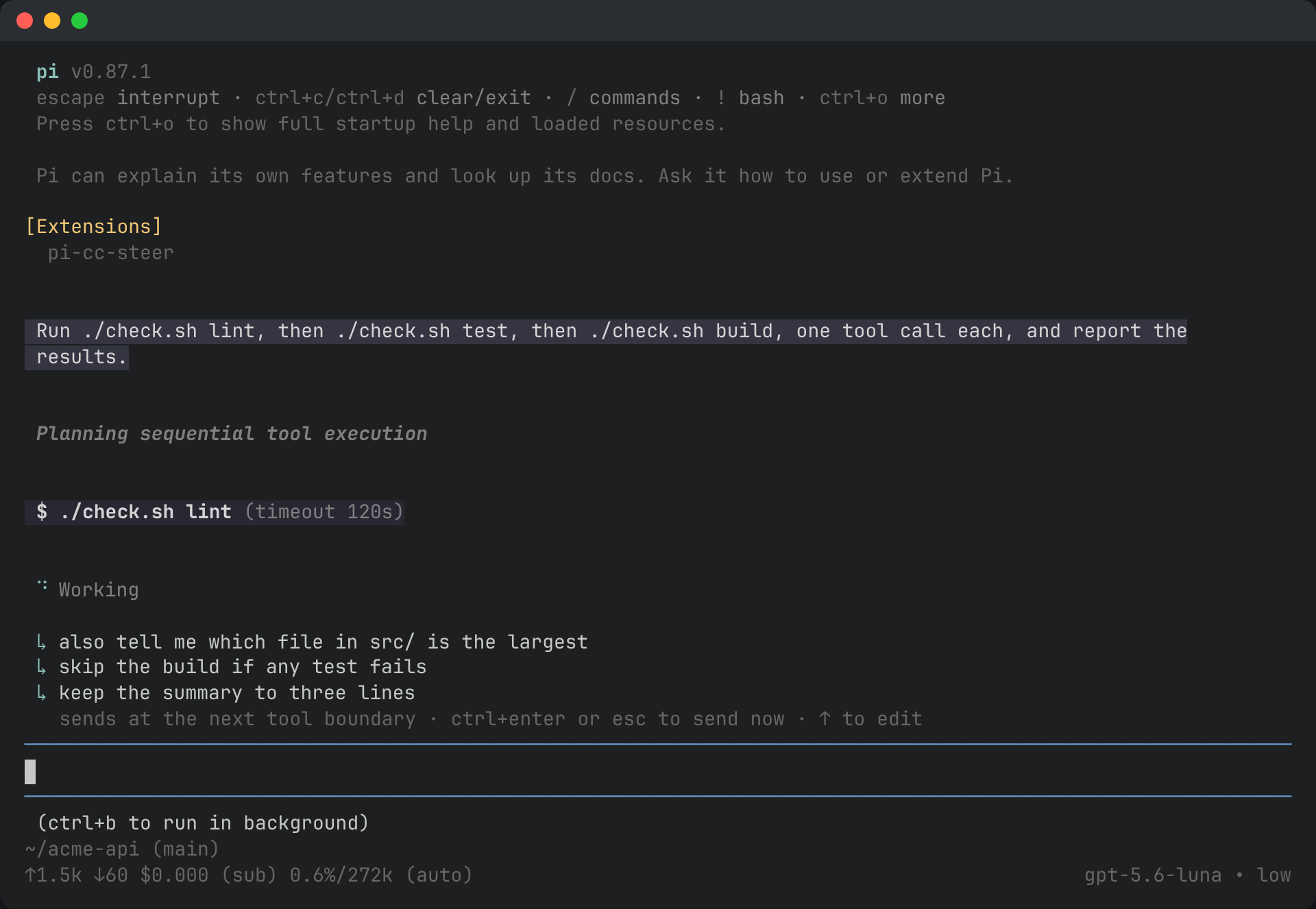
1 · Typed while the agent works. Three messages wait above the editor while ./check.sh lint runs.
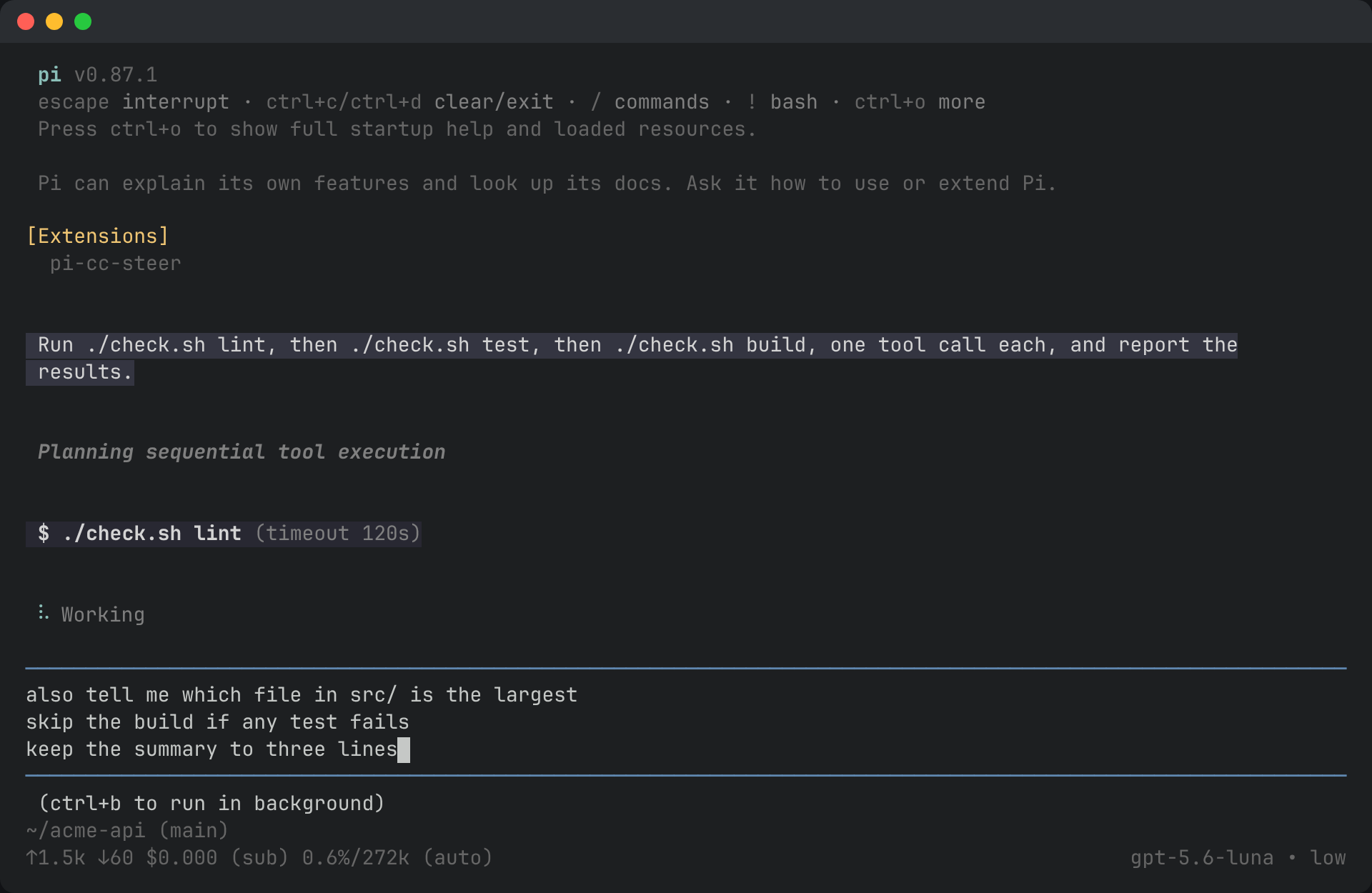
2 · ↑ to edit. The waiting messages come back into the editor; the agent keeps working.
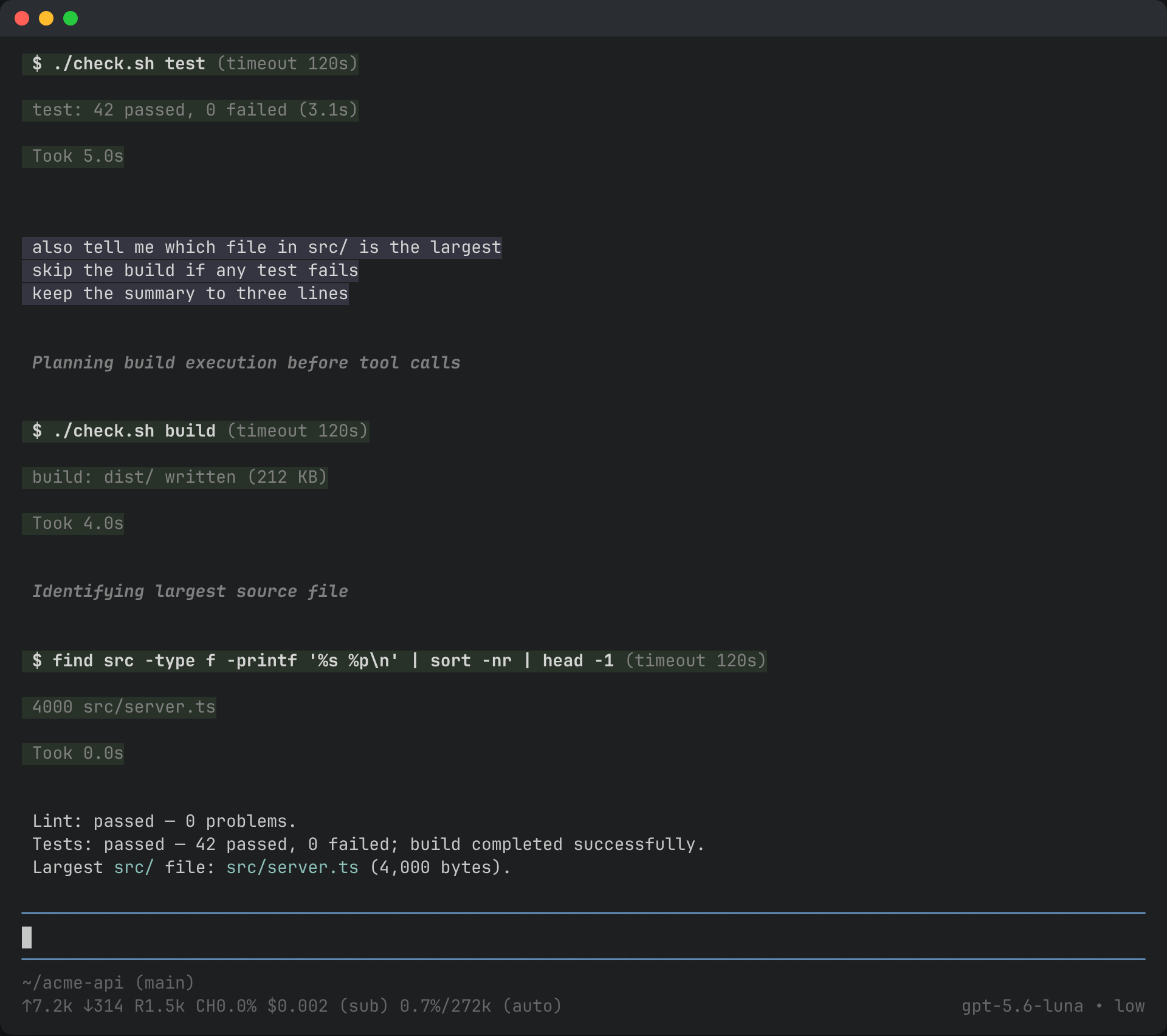
3 · Delivered together. When lint finishes they go in as one message. The model plans "test execution before
build", then ends with the three-line summary that was asked for, including the largest file.
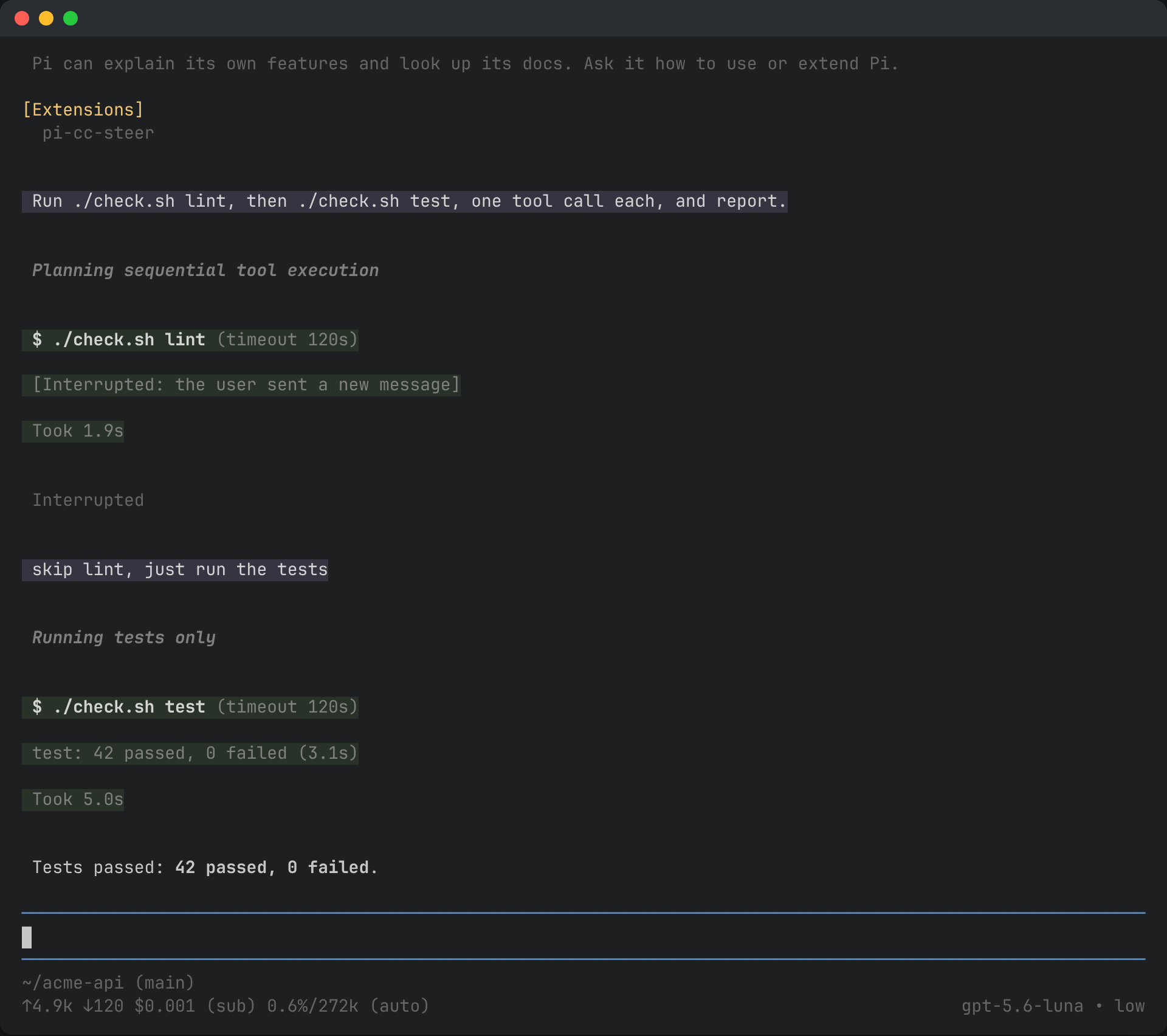
4 · Send now. A message queued while lint runs, then Esc: the command stops and reads "interrupted", one dim
Interrupted line appears, and the new instruction runs straight away.
Do you need it?
Much of this is already in pi, so check the native settings first:
- Batching: set Steering mode to
allin/settings. Everything you queued then arrives at the next tool boundary instead of one message per model call. - Editing: Alt+↑ (Alt+Q on Windows) pulls every queued message back into the editor without stopping the run.
If that is all you want, you don't need this extension. What pi-cc-steer adds on top:
- The framing. Natively the model gets your raw text, with nothing telling it that it interrupted work in progress. pi-cc-steer tells it the messages arrived mid-task and to respond once its current task is done, which is what Claude Code tells it. The framing is added only to what the model sees; your transcript keeps what you typed.
- Only your typing changes. Setting
steeringMode: "all"also batches messages that other extensions queue. pi-cc-steer leaves pi's default alone and batches only what you type. - Send now. Ctrl+Enter, or Esc while messages wait, interrupts the current step and delivers everything queued, plus whatever you've typed, at once. As in Claude Code the interruption shows as one dim "Interrupted" line rather than an error: a cut-off command shows its output and "interrupted", a cut-off reply keeps what it had written, and the model is told it was interrupted. Natively pi can only abort (Esc), show the abort as an error, and hand your queued text back to resend. See Known limits for the cases that still show pi's red error.
- Plain ↑ to edit, as in Claude Code, alongside pi's Alt+↑. This is convenience, not a new capability.
Install
pi install npm:pi-cc-steer          # every session
pi install -l npm:pi-cc-steer       # this project only
Or straight from GitHub: pi install git:github.com/panbergco/pi-cc-steer.
Then /reload, or start a new session. It needs no settings change and works with pi's default steeringMode.
How it works
| You do | What happens |
|---|---|
| Press Enter while the agent works | The message waits above the editor as ↳ your text. Nothing is sent yet. |
| Keep typing, pressing Enter each time | Each message joins the wait list. |
| The agent finishes its current tool batch | The whole list goes in as one message in the same request as the tool results, framed for the model as mid-task input. |
| The agent finishes a reply without calling a tool | The list starts the next turn as an ordinary prompt, without the framing. |
| Ctrl+Enter while the agent works, or Esc while messages wait | Whatever you've typed joins the queue, the current step is interrupted, a dim Interrupted line appears, and everything queued starts the next turn at once. A cut-off command shows its output and [Interrupted: the user sent a new message]; a cut-off reply keeps what it had written. The model is told it was interrupted. Where the terminal can't send Ctrl+Enter, use Alt+S. Also works during a manual /compact. |
| ↑ (cursor on the first line) or Alt+↑, while messages wait | Text messages come back into the editor, ahead of whatever you'd typed. Edit them and press Enter to queue them again. Messages carrying images stay queued. |
| Esc with nothing waiting | Interrupts the run, as usual. |
| The run is interrupted some other way while messages wait (another extension, a command) | Seen at the end of the turn: their text comes back into the editor instead of being sent, as pi does with its own queue. Attached images are dropped with a warning (pi drops them too); paste them again. |
/command or !shell while the agent works |
Left to pi, exactly as without the extension. |
Under the hood it uses only public pi extension APIs:
- the
inputevent takes mid-turn messages into the extension's own queue; turn_endsends the queue as one message withsendUserMessage(…, { deliverAs: "steer" });- the
contextevent adds the framing to that message for the model only. A framed message is identified by its timestamp and text, so the same words sent at another time are not framed, and a framed message reads the same in every later request; - send-now aborts the run;
tool_resultandmessage_endrelabel an error as an "interrupted" hand-off only while a send-now is in progress, the run's abort signal is set, and the error is an abort message, andagent_settled(or the end of a cancelled/compact, noticed once pi has stayed idle) sends the queue as the next prompt. The dimInterruptedmarker is a session entry, so no model ever sees it, compaction summaries included; - a wrapped editor handles Ctrl+Enter, Esc and ↑, and still wraps any custom editor another extension installed first.
The logic lives in steer.ts, which has no pi imports and is covered by npm test. index.ts connects it to pi;
index.test.ts drives its handlers with a stub pi, and the rest is tested by driving real pi sessions.
Compared with Claude Code
The behaviour is modelled on Claude Code's handling of messages typed while it works. No Claude Code code is included, and the text the model sees is original.
| Claude Code | pi default | pi, steeringMode: "all" |
pi-cc-steer | |
|---|---|---|---|---|
| When mid-turn messages are delivered | after the current tool batch | after the current tool batch | after the current tool batch | after the current tool batch |
| How many at once | all | one | all | all |
| Send now, interrupting the current step | Ctrl+Enter (2.1.x) or Esc | Esc, then resend | Esc, then resend | Ctrl+Enter or Esc (or Alt+S) |
| How the interruption shows | one dim "Interrupted" line | red error lines | red error lines | one dim "Interrupted" line |
| Model is told they arrived mid-task | yes | no | no | yes |
| Your transcript shows your plain text | yes | yes | yes | yes |
| Pull them back to edit without stopping the run | ↑ | Alt+↑ | Alt+↑ | ↑ or Alt+↑ |
| Messages queued by other extensions | not applicable | one at a time | batched too | left at pi's default |
| Slash commands typed mid-turn | held, run one by one afterwards | run by pi | run by pi | run by pi |
| Queued images restored when editing | yes | no | no | no, they stay queued |
The small differences that remain:
- One message, not several. Claude Code adds each queued message to the conversation separately. pi-cc-steer sends one message containing all of them, joined by line breaks. The model sees the same text in the same order.
- Images. pi's editor API cannot re-attach images, so ↑ leaves messages that carry images in the queue. They are still delivered with the batch.
- Framing words. Claude Code tells the model to address the message after completing its current task; pi-cc-steer gives the same instruction in its own words. For a send-now it instead says the previous step was stopped and to address the message now.
- Esc with nothing queued. In both, Esc interrupts. In Claude Code anything you queue afterwards still runs next; here the interruption is pi's own, with pi's red error line.
Known limits
- Cases that still show pi's red error on send-now: the interruption lands while pi is starting a tool (before the tool runs), or during an automatic retry wait (pi reports the retry as cancelled). A reply cut while the model was writing a tool call is deliberately left to pi's own abort handling, so its tool card closes properly.
- A cut-off tool keeps only what its final error carries. pi's bash tool keeps its final output (truncated if long) and a reference to the full-output file; a custom tool that streamed output and then reports only "Operation aborted" shows just the note.
- Interruptions it cannot see. An interruption from something other than send-now is only noticed at the end of a turn. One that lands during a retry wait, or while pi is settling, is not seen, and the queue is then sent.
- Nothing is persisted. Queued messages live in memory, as pi's own queue does:
/reload, exit or switching sessions drops them. If pi refuses the queued prompt (no model, no API key), pi shows its error and the text is not put back. - Timing during compaction or retry. A message typed while pi retries waits for the next tool batch to finish;
native steering can sometimes reach the very next request. During a manual
/compact, Enter uses pi's own compaction queue. - Races with other extensions. A batch is recognised by its text when it arrives. Another extension sending the same text at the same moment (or, for a batch with images, text that starts the same way) can take its framing, and if pi refuses a send-now prompt, its unused record can later frame an identical message you type. If another extension rewrites a batch's text on its way in, that batch reaches the model unframed, as it would in native pi.
- Older sessions. Sessions from 0.1.0–0.1.3 keep their framing records, which match by text alone. Sessions from
0.1.4 (GitHub only) stored the
Interruptedmarker as a message: it is kept out of requests, not out of compaction summaries. - Editors. An extension that replaces the editor after pi-cc-steer loads removes its keys; a modal (vim-style) editor loses Esc while messages wait.
Works with
Editor add-ons such as status bars and footers, because it wraps whatever editor is already installed.
It does not combine with other extensions that take over mid-turn input, such as pi-queue-steer or pi-queue-picker. Use one or the other. pi-queue-steer is the richer choice if you want a visible, reorderable queue with separate steering and follow-up lanes. pi-cc-steer is the smaller one (about 400 lines) if you want Claude Code's behaviour and nothing else.
Only interactive input is queued. RPC mode, print mode and messages sent by other extensions are never queued, though the framing of an earlier batch still applies to every request that carries it.
Development
npm install && npm test    # steer.test.ts (pure logic) and index.test.ts (the pi handlers, driven with a stub pi)
pi -e ./index.ts           # try it in one session without installing
License
MIT