pi-batch-permissions0.2.0
Make your agent safer with configurable permissions: one approval for a whole chain of tool calls, each labeled safe/caution/dangerous by a cheap model of your choice.
Untested on omp
This is a pi package. No one has reported whether it works on omp yet. If you try it, add your result below.
Reports 0
No reports yet.
Readme
pi-batch-permissions
Make your agent safer with configurable permissions.
One approval for a whole chain of tool calls. A cheap classifier model labels
every call safe, caution, or DANGEROUS, says what it does, and when
something is dangerous, says why. You see the full chain, you approve once,
the agent runs. No more approving commands one at a time.
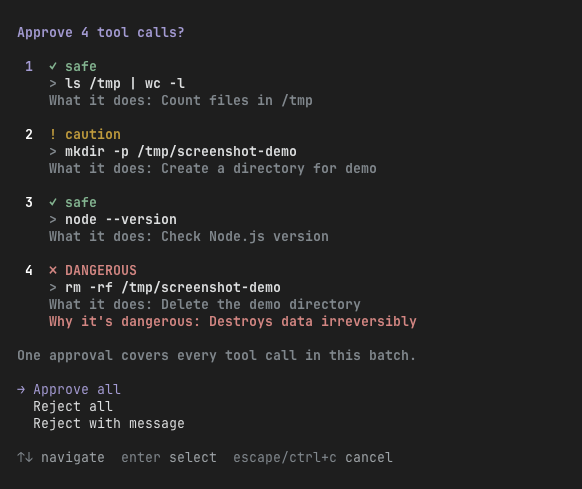
Three choices: Approve all, Reject all, or Reject with message. The
message goes straight back to the agent as the rejection reason, so it knows
why and can adjust instead of blindly retrying.
You decide which tools are gated (default: bash), which mode you run in,
and what the labeller calls dangerous. Your rules, your machine.
Install
pi install git:github.com/mikesposito/pi-batch-permissions
Try it once without installing:
pi -e git:github.com/mikesposito/pi-batch-permissions
Local development: symlink the checkout into your extensions directory, or load it per run.
ln -s /path/to/pi-batch-permissions ~/.pi/agent/extensions/batch-permissions
pi -e /path/to/pi-batch-permissions
No runtime dependencies. The package manifest declares the host-provided pi packages as peers.
Three modes, one key
Press alt+b to cycle. The status bar always shows where you are:
perm:all, perm:auto, perm:off. The choice persists.
all: every chain asks once. The default.auto: no dialog unless something isDANGEROUS. Labels decide what runs silently, so pair it with a good policy file.off: no gating, no classifier calls, no cost.
Headless modes (print, JSON) have no dialogs: only safe calls auto-run,
everything else is blocked with a reason.
Calls made through nested execution (codemode scripts) never appear in an assistant message, so they are approved one at a time as a fallback.
Your policy decides what is dangerous
The labels come from the classifier model. You steer the model with a plain
markdown file: ~/.pi/agent/batch-permissions/policy.md.
- Write plain sentences. No syntax to learn.
- Everything you write is appended to the labeller's instructions as your policy, overriding the built-in defaults.
- Re-read before every batch. Edits apply immediately, no reload.
- Ships as a header-only template that is ignored until you add rules.
Example:
# My policy

- Treat every docker command as dangerous: my machine has stateful containers.
- Treat `npm test`, `yarn build`, and `git status` in ~/dev/my-project as safe.
- Treat `git push` to origin main as dangerous; feature branches are caution.
- Treat any command that writes outside /tmp as dangerous.
One limit: policy shapes the model's labels. With no model configured, a built-in regex fallback labels calls and the policy file is not consulted.
Configure
~/.pi/agent/batch-permissions/config.json (not in this repo):
{
  "model": "litellm/DeepSeek-V4-Flash",
  "timeoutMs": 20000,
  "mode": "all",
  "tools": ["bash", "write", "edit", "mcp__slack__*"]
}
tools: what gets gated. Exact names (read,write,edit,mcp__github__create_issue) or prefix patterns (mcp__slack__*for a whole server,*for everything). Non-bash calls are shown to the labeller as tool name plus arguments, truncated to 500 characters.model: the labeller. Pick one with/batchmodel, or pass it directly:/batchmodel litellm/gpt-4o-mini. Fast and cheap works well; the prompt is tiny. Without a model, or if the call fails or times out, the regex fallback takes over.timeoutMs: give up on the labeller after this long and fall back.
Both config files are seeded as templates on first load. An older
single-file ~/.pi/agent/batch-permissions.json is migrated automatically.
Fresh installs get a one-time notice to run /batchmodel.
Test
node smoke.mjs