pi-anon-export0.1.1
Pi extension that exports agent sessions as anonymized JSONL or HTML, matching /export's paths and formats: redacts secrets from your shell rc files, strips or flags screenshots, verifies the result, zips a whole project. Fully offline.
Untested on omp
This is a pi package. No one has reported whether it works on omp yet. If you try it, add your result below.
Reports 0
No reports yet.
Readme
pi-anon-export




English | 简体中文
A pi extension that exports your agent sessions as anonymized JSONL or HTML — locally, with nothing ever leaving your machine. Use it when you want to share a session transcript (for a bug report, a colleague, or a public gist) without leaking API keys, tokens, cookies, emails, or embedded screenshots.
Install
pi install npm:pi-anon-export
Or try it for one invocation without installing:
pi -e npm:pi-anon-export
Usage
/anon-export [path]     export the CURRENT session, anonymized — like /export:
                        `.jsonl` writes JSONL, anything else writes HTML
/anon-export-zip        export ALL sessions of the current working directory's
                        session folder, redacted and packed into one zip
Flags (both commands)
Arguments are shell-like and values are validated: an empty value is an error for every flag (--out "" cannot silently mean "the current directory"), and a quoted value may start with dashes (--secret "--abc123x") while --out --no-images is still rejected as a missing value.
| Flag | Effect |
|---|---|
--no-images |
Strip embedded image data blocks (replaced with [IMAGE_REMOVED]). Without it, images are kept byte-exact and counted for manual review. |
--level fast|full |
Redaction depth. Default: full. |
--pii conservative|aggressive |
aggressive adds the upstream personal-name and street-address patterns. Needs --level full (they over-redact prose and code, so they are opt-in); --level fast together with --pii aggressive is rejected instead of silently doing nothing. |
--out <dir> |
Directory override. For /anon-export, write <dir>/<session-file>.jsonl there instead of following /export's exact-path mode. For /anon-export-zip, put the archive there (default: the current directory). |
--secret <lit|file> |
Add an extra literal secret. If the value is a readable file path, it is read as one secret per line. Repeatable. |
--env-file <path> |
Env file to scan instead of the default shell rc files. Repeatable. |
Arguments are shell-like: quotes group values (--secret "value with spaces"), and --flag=value works for values that themselves start with --. A missing value is an error, so --out --no-images can never create a directory named --no-images.
Output paths
With no --out, the command follows /export exactly:
/anon-export→<APP_NAME>-session-<session-file>.htmlin the current directory (pi's HTML export;APP_NAMEis normallypi)./anon-export report.jsonl→ anonymized JSONL at that exact path (parent directories are created, like/export)./anon-export report.html(or any other non-.jsonlpath) → anonymized HTML at that exact path.
HTML is generated from already-redacted JSONL through pi's own exporter (the system prompt and active-tool metadata are redacted with the same pipeline), so it keeps the same layout and theme as /export while containing none of the original secrets. The current-branch selection is also the same: JSONL contains the live session branch, not every branch in the file.
The suite has two commands so a path never doubles as a mode:
/anon-export --out <dir>→<dir>/<session-file>.jsonl/anon-export-zip→./pi-anon-export-<timestamp>.zip(or<--out>/pi-anon-export-<timestamp>.zip) — one timestamp for the whole run. Sessions are fed to the zip compressor as they are redacted (the archive is written to a per-run<name>.<pid>-<random>.partfile, then renamed), so a project's whole redacted set is never buffered in memory and two runs in the same millisecond cannot interleave. Duplicate entry names are rejected, and an unparseable/empty session is reported instead of shipping as a 0-byte file.
Output is created with private permissions (0700 directory, 0600 files, 0600 archive, enforced even when a stale file or .part already exists). If a session still contains a known secret after redaction, its output is quarantined instead of written under the normal name: <target>.UNSAFE, <session-file>.jsonl.UNSAFE for --out, or pi-anon-export-<timestamp>-UNSAFE.zip, and an unattended run exits non-zero. An output path that resolves to the source session — including through a symlink or hard link — is refused instead of overwriting the live transcript, and an empty or unparseable session is reported as skipped rather than shipped as a 0-byte file. Zip mode writes into the current directory by default — if that directory is a git working tree, the report says so; keep the archive out of commits. A killed run can leave its <name>.<pid>-<random>.part file behind (already-redacted bytes, no cleanup sweep); delete those by hand.
The command reports the number of exported sessions, the output path, the redaction counts (secrets replaced, images removed/flagged, dropped lines, and anonymizer categories), any notes about ignored inputs, and the result of the post-redaction verification pass. When there is no TUI (print/JSON mode) the report goes to stderr, so machine-readable stdout stays clean.
Examples
/anon-export                                  # HTML, named like /export
/anon-export report.jsonl                     # anonymized JSONL at that path
/anon-export report.html                      # anonymized HTML at that path
/anon-export-zip --no-images
/anon-export --level fast --out /tmp/shareable --secret "my-personal-token"
/anon-export --env-file ./.env --env-file ~/.zshrc
Redaction levels
Every export runs the same base pipeline, per JSONL line:
- Parse or drop (fail-safe). Lines that are not valid JSON, or are not JSON objects, are discarded and counted (
dropped_lines) — broken lines are never passed through verbatim. - Media handling. A string longer than 256 characters is treated as an embedded image/audio/video payload only when the bytes or the surrounding object say so: a media carrier key (
b64_json,imageData,image_data,audioData,videoData,fileData,contentBytes), adata/base64/blobvalue whose parent declares a mediatype/mimeType/mediaType, adata:image/…URL under any key, or a recognisable container magic (iVBOR,/9j/,R0lGOD,UklGR,GkXf,ftyp). A declared MIME type only covers the payload-ish key it sits next to, and text-based media types (image/svg+xml,text/*,*json) are always redacted as text, because their bytes are prose. With--no-imagessuch a payload becomes[IMAGE_REMOVED]; otherwise it is kept byte-exact and counted (images_flagged). Kept payloads are never rewritten — not even by the anonymizer — because any edit corrupts the image. Plain text under adatakey ({"type":"tool-result","data":"csv,…"}) is not a payload: it goes through normal redaction instead of being exempted (and--no-imagesno longer deletes it). - Literal secret replacement, in one pass. Every occurrence of a discovered secret becomes
[REDACTED_<NAME>]. Secrets come from:export NAME=.../declare -x NAME=...lines in your shell rc files (~/.zshenv,~/.zprofile,~/.zshrc,~/.zlogin,~/.bash_profile,~/.bashrc,~/.profile) — or the files you pass with--env-file. Files are scanned in the order a shell sources them, so the value you actually get wins, and a variable defined twice with different values produces a name-only warning (never a value). The variable name must containKEY,TOKEN,SECRET,PASS,PWD,COOKIE, orCREDENTIAL;- every
--secretyou pass (literals or files, one secret per line; BOM/CRLF tolerated). Values are read the way a POSIX shell reads them, so a secret is never silently truncated: quoted segments run to their matching closing quote and concatenate with unquoted runs (a#inside quotes is part of the value,\"is unescaped), an unquoted value ends at shell whitespace (#is kept when it starts a word:pa#ss123),\-continued lines are joined first, indented lines inside anifblock are scanned,NAME+=valueregisters both the appended text and the resulting full value, and an unterminated quote keeps the remainder. Values shorter than 5 characters are refused; values that could match inside a[REDACTED_…]marker (e.g.REDACT) are refused too. Both cases produce a value-free note naming the actual reason — a long secret that merely contains[REDACTED_is redacted normally. Each value is matched in its NFC and NFD spellings as well, so a composed rc-file secret is still found in a decomposed session. Replacement is a single longest-first pass, so overlapping secrets are fully covered and inserted markers are never re-scanned.
Then, depending on the level:
fast— stops here. Only structural drops, image policy, and literal secrets. Paths, usernames, emails, and timestamps are not touched.full(default) — additionally runs every remaining leaf value through an anonymizer (emails →redacted-<hash8>@example.com, home-path usernames, code-host URLs, API keys, JWTs, bearer tokens, credential URLs, query-string secrets, private-key blocks, SSN/phone/IP) with a stateful, consistent mapping across the whole export run, so the same input always maps to the same output within one export.--pii aggressiveadds personal-name and street-address patterns. There is no size cutoff: a megabyte-sized tool output gets the same passes, with guards that stay linear per match (a 1 MiB git log full of addresses takes ~0.1 s).
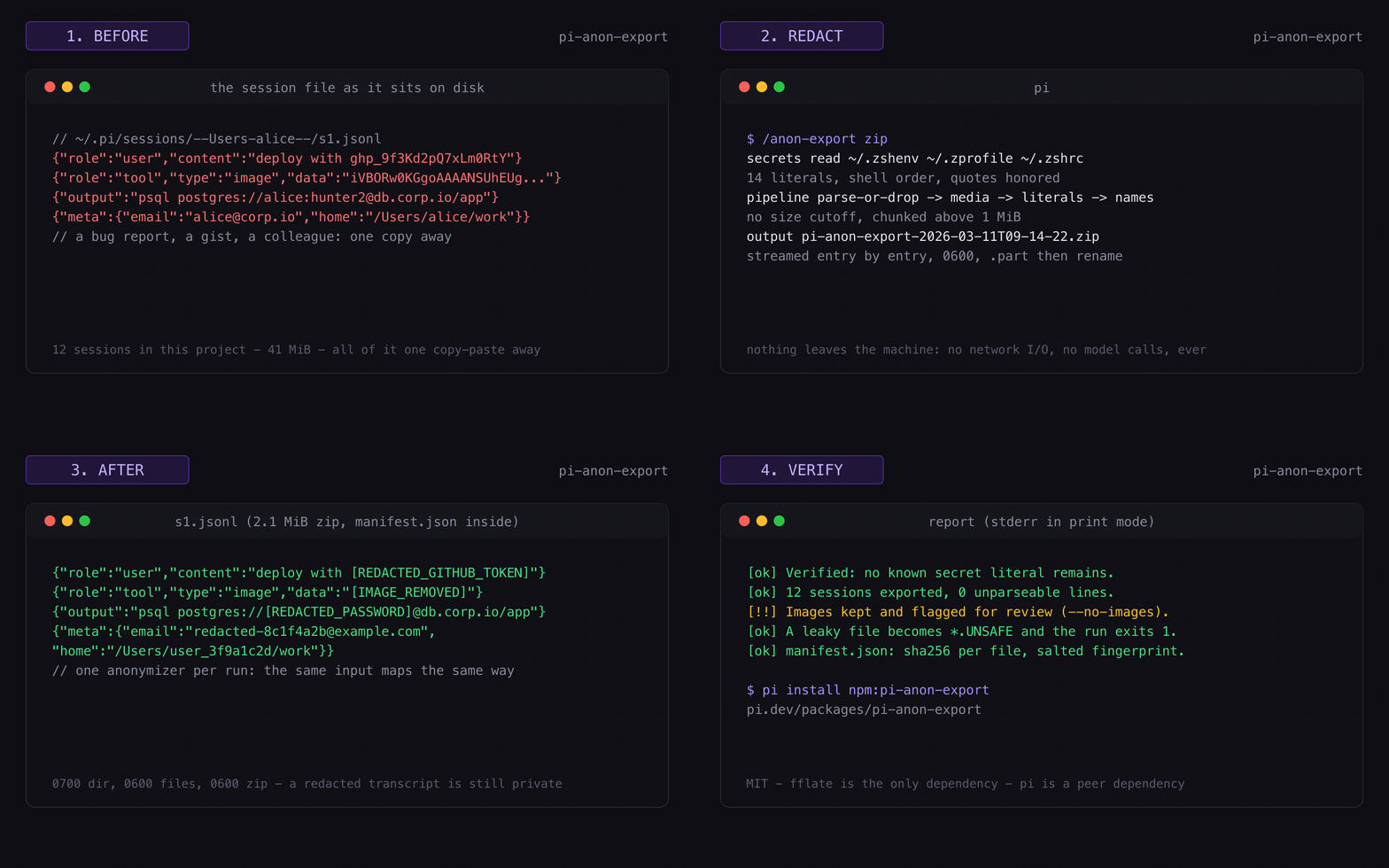
Every export then runs a verification pass per file, before the file gets its shareable name: it re-scans for every known secret literal (raw and JSON-escaped) and reports Verified: no known secret literal remains — or a loud ✖ VERIFICATION FAILED. Anything that fails is written as *.UNSAFE / -UNSAFE.zip and the run exits non-zero in print/JSON mode, so a script cannot mistake a leaky export for a clean one.
The zip mode adds a manifest.json with, per file: the source name, the sha256 of the redacted content (computed from the exact bytes written into the archive), and its per-file redaction counts. It also carries verification.residualSecrets (must be 0) and verification.secretSet, a salted fingerprint of the secret set that was applied — no values, and a fresh salt per run, so two exports are not linkable to each other. The fingerprint is a consistency check (it is not a secrecy guarantee; the salt travels in the manifest). Skipped-file entries in the manifest are sanitized: only the basename is kept (pi's session directory names embed the local username and project path) and fs error messages are rewritten so they cannot reintroduce an absolute path.
⚠️ Disclaimer: anonymization is best-effort
Anonymization is a best-effort heuristic, not a guarantee. Review every export manually before publishing or sharing it. Secrets that don't match the naming heuristics, novel identifiers, or PII patterns the anonymizer doesn't know about can survive redaction. The author assumes no liability for information that remains in an exported file.
Known by-design behaviors (all documented in extensions/lib/anonymize.ts):
- Text segments containing
/are treated as paths and theiruser@host-shaped parts are kept (matches the upstream Teich guards); URL userinfo (https://user@host/…) is also kept. - Public git remotes, reserved example domains, systemd units (
x@y.service), and package versions (lodash@4.17.21) are preserved. - Backslash-separated strings like
dir\name@foo.comare over-redacted (the email-shaped tail is replaced): false positives are preferred over leaks. - Usernames in code-host URLs (
git:github.com/<user>/…,git@github.com:<user>/…,https://github.com/<user>) are rewritten only after that username has been seen in a home path or as an email local part. - Images are kept by default and flagged for manual review; use
--no-imagesto strip them. Screenshots are not OCR'd or redacted, so a known secret that appears inside a kept image payload cannot be replaced — the verification pass catches it and quarantines the export as*.UNSAFE. - Media payloads are recognised by evidence, not by key name alone: a >256-character value under a media carrier, with a declared media
type/mimeType, adata:URL, or a known container magic. Anything else is treated as text (redacted, kept, never deleted), so an unrecognised payload can survive--no-images— but it is never exempted from redaction. - The anonymizer's own base64-media replacement (
redactBase64Media) is only reachable when the anonymizer is used standalone./anon-exportowns the image policy, so that branch never rewrites an exported image. - Secret discovery is deliberately narrow: only
export NAME=valuelines in the shell rc files above (or--env-filefiles).NAME=valuewithoutexport, a project.env,~/.aws/credentials,~/.npmrc,~/.netrcand Windows PowerShell profiles are not read unless you pass them with--env-file; pass values you care about with--secretas well. - Personal names and street addresses are only redacted with
--pii aggressive; SSN, phone and IP are always redacted at thefulllevel. - The anonymizer is heuristic: it knows common credential shapes, not your employer's internal ID format.
- Verification can only check the secrets it was given: when the secret set is empty the report says so explicitly instead of claiming success.
- Code comparisons (
password == "x",=>) are never treated as assignments — the source mangled them — so a literal on the right-hand side of a comparison is not redacted. - Email addresses with a non-ASCII domain (IDN) or a leading dot in the local part are not recognised, and an address glued to a preceding word character (
...alice@x.io) is left alone. Addresses with_in the domain,+tags, ports and surrounding punctuation are recognised. The local part is bounded to the RFC limit (64 chars), which is also what keeps the guard linear on address-dense text. - A credential URL whose password was inserted without escaping (
postgres://user:pa/ss#x@host) is covered for the common database/mail schemes; on other schemes the password stops at the URL authority, so the unescaped tail can survive. Conversely, a URL with no credentials (https://host:8080/path?a=b@c.io) is never mistaken for one. - Code comparisons (
password == "secret",api_secret=>x) are not assignments, so the right-hand literal is not redacted; YAML/INI comment values (password: # TODO) are left intact. - A backslash-continued line is joined the way a shell joins it (never inside a comment or single quotes);
declare -x/exportare supported,typesetis not.
FAQ
Does anything leave my machine?
No. The extension performs no network I/O at all — no telemetry, no uploads, no model calls. It reads session and env files, writes the export, and stops.
How is this different from copying the JSONL out of the session directory?
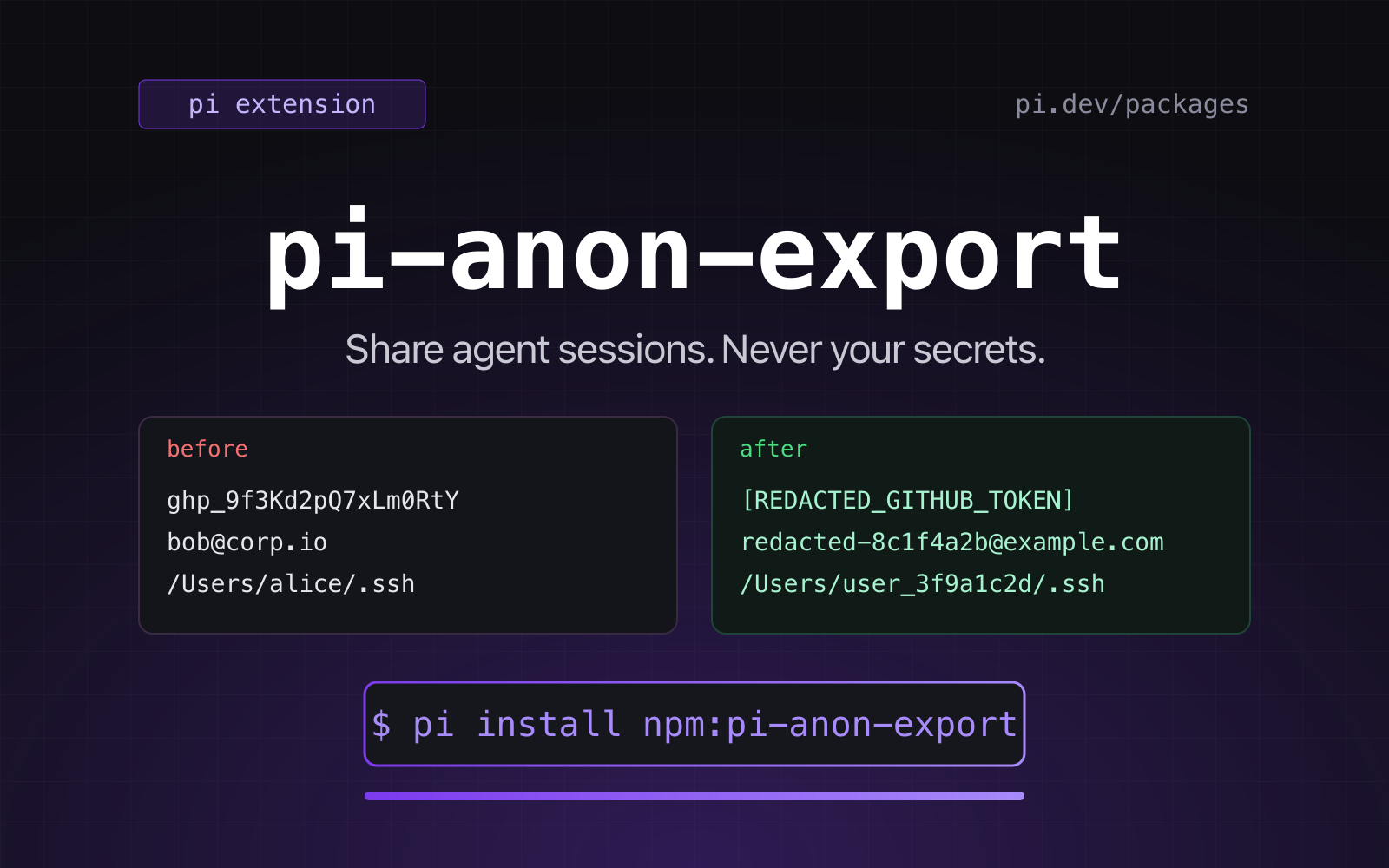
~/.pi/sessions/--<path>--/*.jsonl contains everything your agent ever saw: shell rc secrets, employee emails, home paths, base64 screenshots. /anon-export re-writes it leaf by leaf (secrets → [REDACTED_<NAME>], emails → redacted-<hash8>@example.com, home paths → user_<hash8>), drops unparseable lines, and then re-scans the result for every known secret before it hands you a shareable name.
What happens if redaction fails?
The file is not written under its normal name: it becomes <session>.jsonl.UNSAFE (or pi-anon-export-<timestamp>-UNSAFE.zip) and an unattended run exits non-zero. A script cannot mistake a leaky export for a clean one.
Which secrets does it find?
Literal values of export NAME=value lines whose name contains KEY, TOKEN, SECRET, PASS, PWD, COOKIE or CREDENTIAL, from ~/.zshenv, ~/.zprofile, ~/.zshrc, ~/.zlogin, ~/.bash_profile, ~/.bashrc, ~/.profile — or from files you pass with --env-file. On top of that the full level recognises common credential shapes (API keys, JWTs, bearer tokens, credential URLs, private-key blocks) and PII (emails, SSN/phone/IP, home paths); --pii aggressive adds personal names and street addresses. Project .env files, ~/.aws/credentials, ~/.npmrc and ~/.netrc are not read unless you point --env-file at them.
Does it work with screenshots and images?
Images are kept byte-exact by default and counted for review, because any rewrite corrupts them. Pass --no-images to replace every recognised media payload with [IMAGE_REMOVED]. Text-based media types (image/svg+xml, text/*, *json) are always treated as text and redacted.
Can I share the zip safely?
The zip carries a manifest.json with a sha256 per file, the per-file redaction counts, and verification.residualSecrets (must be 0). Skipped-file entries are sanitized to basenames, so the manifest does not reintroduce your home directory or project path. Still read the export before publishing it — anonymization is best-effort, not a guarantee.
Why does the export directory warn me about git?
Zip mode writes into the current directory by default. If that directory is a git working tree the report says so, because committing a transcript is one git add -A away; add the archive (or the export directory) to .gitignore.
Does it support very large sessions?
Yes. There is no size cutoff: a megabyte-sized tool output gets the same passes, and the guards stay linear per match (a 1 MiB git log full of addresses takes ~0.1 s). Zip mode streams each session into the archive as it is redacted instead of buffering the whole redacted set.
Privacy: fully local
This extension performs no network I/O at all. It reads your session files and env files, writes results under the output directory, and does nothing else. No telemetry, no uploads, no model calls. The only runtime dependency is fflate (pure-JS zip), used locally in zip mode.
Session location
Exported sessions are located the same way pi itself locates them:
ctx.sessionManager.getSessionDir()/getSessionFile()inside a running session (these already honor--session-dir,PI_CODING_AGENT_SESSION_DIR, and thesessionDirsetting);- otherwise the pi agent dir from
getAgentDir()(which honorsPI_CODING_AGENT_DIR) plussessions/--<path>--/, where<path>is the cwd with the leading slash stripped and/,\,:replaced by-.
Relative session dirs are resolved against the session cwd, never against process.cwd().
For developers: the anonymizer contract
extensions/lib/anonymize.ts exposes the extension point used by the full level:
export interface Anonymizer {
  anonymizeValue(value: unknown): unknown; // stateful, consistent within one instance
  readonly counts: Record<string, number>;
}
export function createAnonymizer(options?: { aggressivePii?: boolean }): Anonymizer;
One Anonymizer instance is created per export run and shared across all files, so mappings stay consistent. counts accumulates lifetime counts on the instance; redactSessionJsonl snapshots them per call and reports deltas, so per-file counts in the manifest are genuinely per file.
extensions/lib/secrets.ts offers createSecretMatcher() (single-pass, longest-first literal replacement) and computeSecretFingerprint() (salted, length-prefixed, order-independent).
Development
pnpm install
pnpm run check   # tsc --noEmit
pnpm run smoke   # offline smoke tests: pipeline, secrets, args, zip, end-to-end handler,
                 # plus scripts/hypothesis-smoke.ts (adversarial regression cases)
pnpm test        # check + smoke
The smoke tests are hermetic: --env-file points at fixtures/, and every export goes to a temp directory, so your real ~/.zshrc and sessions are never read.
Links
- Package page: https://pi.dev/packages/pi-anon-export
- 中文说明 (Chinese README): https://github.com/tychenjiajun/pi-anon-export/blob/main/docs/README.zh-CN.md
- pi packages documentation: https://pi.dev/docs/latest/packages
- Issues and bug reports: https://github.com/tychenjiajun/pi-anon-export/issues
- The upstream anonymizer this ports: https://github.com/TeichAI/teich
License
Dual-licensed, because this package embeds a port of an Apache-2.0 project:
- MIT — everything original in this package (see
LICENSE). - Apache-2.0 —
extensions/lib/anonymize.ts, a modified TypeScript port ofTeichAI/teichsrc/teich/anonymize.py(seeLICENSE-APACHE; the file header lists every deviation as required by Apache-2.0 §4(b)).
extensions/lib/secrets.ts is an independent implementation: only the
publicly documented approach of badlogic/pi-share-hf
(env-file literal-secret redaction) was reused — that project ships no
license, so no code was taken from it.
The pi API types are consumed at
runtime as a peerDependency; pi is MIT and no pi source is bundled here.