agent-horde0.1.3
Run a horde of pi agents on one task: shared ledgers, peer review, an auditable event log, and a live dashboard
Untested on omp
This is a pi package. No one has reported whether it works on omp yet. If you try it, add your result below.
Reports 0
No reports yet.
Readme
agent-horde
A coordination protocol for small agent swarms, and the pi extension that runs it.


Why
The big labs solve big problems by pointing large swarms of agents at them. agent-horde brings this to a size one person can run from a terminal: up to twelve pi agents on one task, each in its own process, coordinating through markdown files you can read while they work. It is for regular users who want to experiment with small swarms and learn where they go wrong.
What it is
A protocol. Members share ledgers: ideas, findings with evidence, facts, claims, resources, and a board. One tool mediates every write and enforces the rules: one owner per idea, no finding without a claimed idea and a named concern, no duplicates, reviews pinned to the revision they checked, and an answer that counts only after a second member validates it. All actions land in an append-only event log.
A pi extension. One command starts a run, a widget tracks each member, a dashboard shows the ledgers and the event stream, and the run ends with a report, a deliverable built from the verified findings, and a post-mortem written by a reviewer that reads the whole run.
Self-improving. The extension improves by iterating on its own post-mortems. Every run ends with a reviewer's critique of how the members coordinated, and the rules in the tool trace back to critiques of earlier runs. Feed a post-mortem back to pi and ask it to implement the suggested fixes, or open it as a GitHub issue here.
Where it works best
It does best on research tasks that reward going wide and pulling exact evidence out of large material: security review of a codebase, OSINT hunts, audits, analysis of filings or papers. On FinanceBench it answered all 50 pure lookup questions correctly in both runs; every miss was a judgment question.
Run it in a clean directory that holds only the material under study. Members execute tools in
the working directory, the ledgers land in .horde/ there, and every member reads the AGENTS.md
found there as its brief. Unrelated files cost members context and invite them to wander. Ledgers
from earlier runs persist in .horde/ and will steer members; start with a fresh one when the
task changes.
A horde is at most twelve members today. Hordes of hordes are on the roadmap.
Tips.
- Ask pi to interpret the findings while the run is going; the ledgers are plain files it can read.
- Ask pi to summarize or act on the report once the run is complete.
- Not sure how to write the prompt? Point pi at this repository and ask it to draft one for your task.
Screenshots
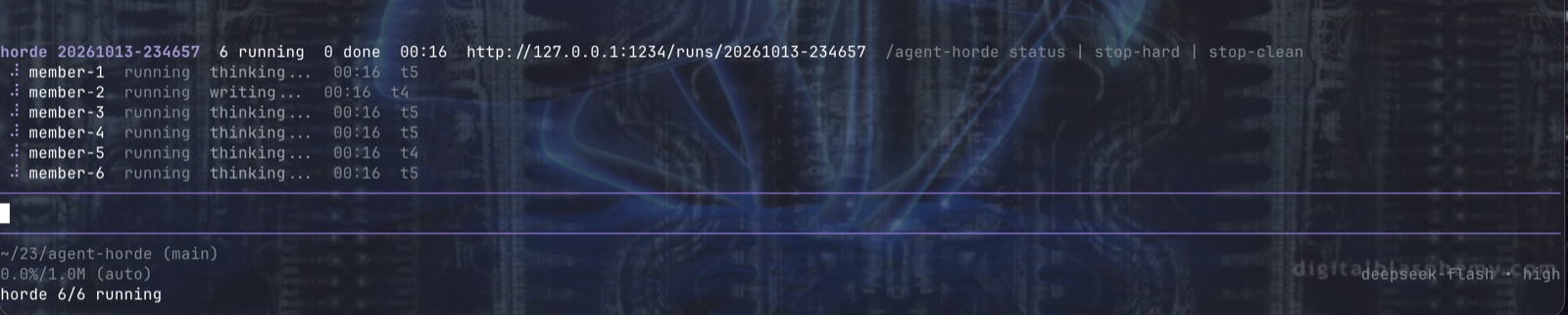
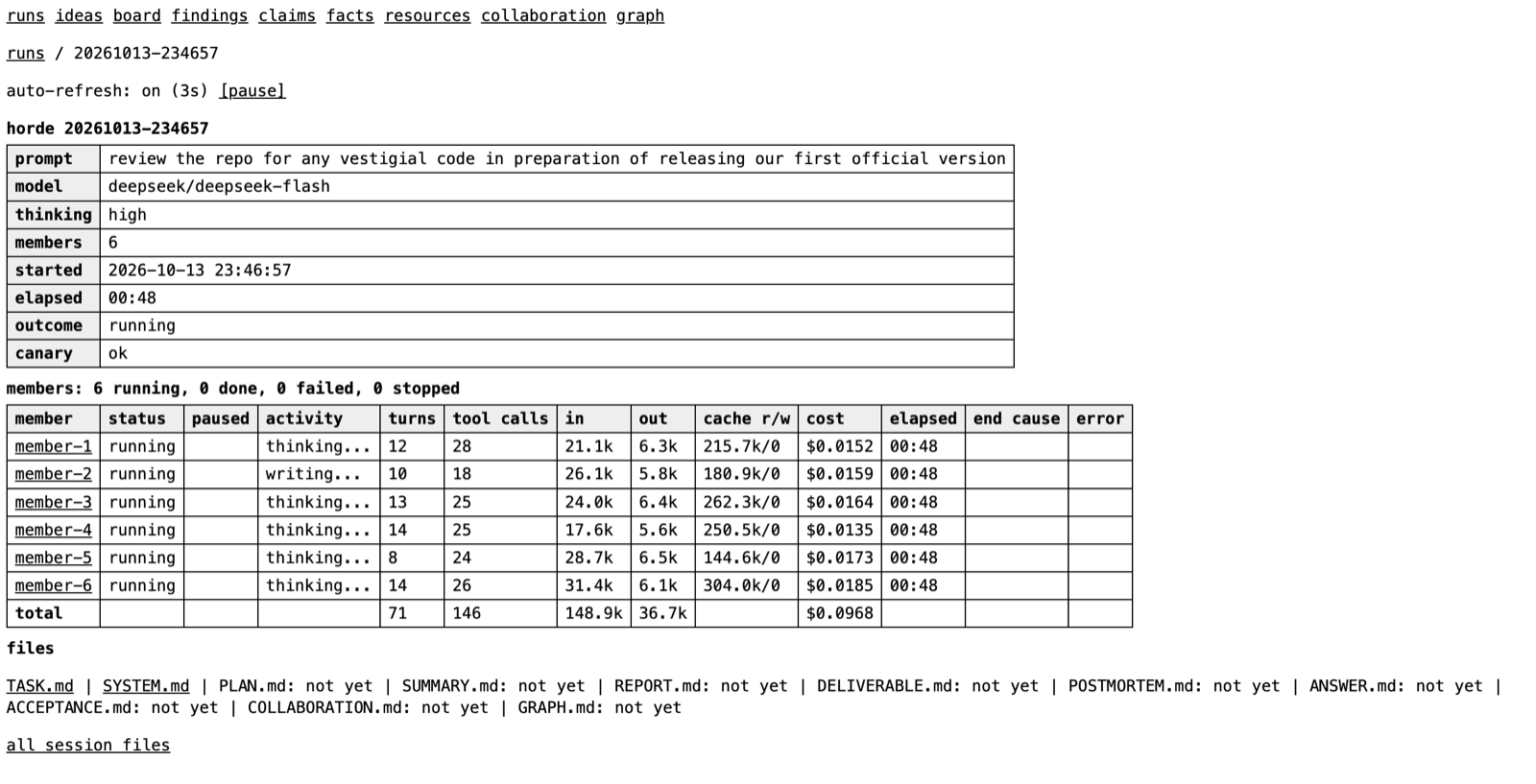
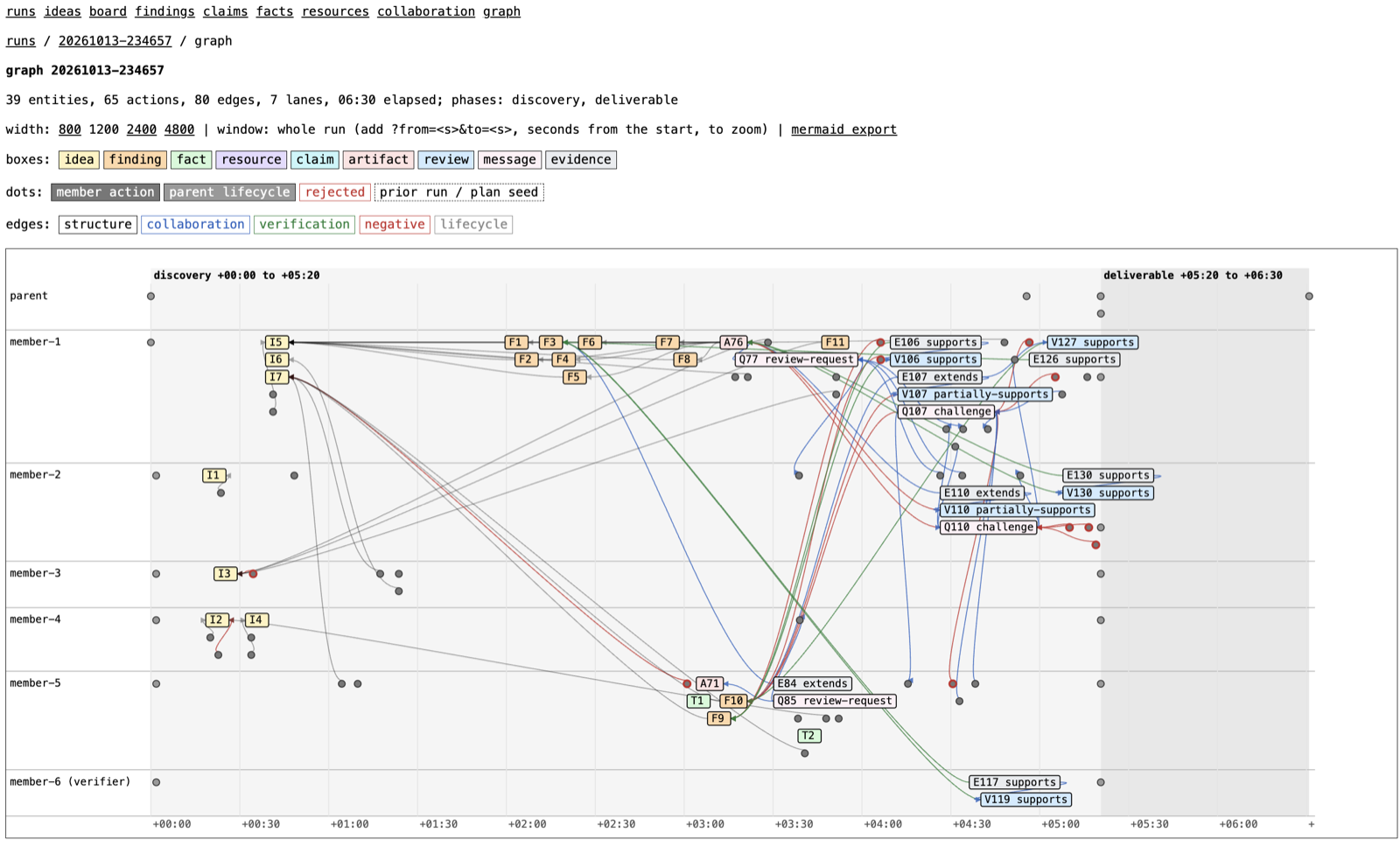
All three are from one test run: six deepseek-flash members reviewing this repository for vestigial code before the first release, manually stopped clean after five minutes.
The widget above the pi editor while the members work:
The dashboard's run overview, refreshing live:
The same run as a graph: one lane per member, phase bands, ideas and findings as boxes, reviews and challenges as edges, every node is a deeplink into the dashboard:
Install
Requires pi 1.2 or newer and Node 20 or newer.
pi install npm:agent-horde
Or from the repository, pinned to a tag:
pi install git:github.com/eliyastein/agent-horde@v0.1.3
To hack on it, clone and install in place. pi loads the files from the clone, so edits take effect
on the next /reload or session:
git clone https://github.com/eliyastein/agent-horde.git
pi install ./agent-horde
Usage
Start pi in the directory the horde should work on, then:
/agent-horde --dashboard 6 audit the HTTP handlers under src/api for authorization bugs
Six members start on the prompt with the session's model and thinking level. The command returns
at once; a widget above the editor shows each member's status, current tool, turns, and resets,
and the dashboard is at http://127.0.0.1:7433/. In this form members divide the work
themselves: each reads the board, claims an idea nobody else owns, and moves on when it is done or
ruled out.
When you already know how the work splits, use plan to fix the partition at launch:
/agent-horde plan --dashboard 4 parser; type checker; code generator
Each layer becomes a seeded idea owned by one member, recorded in the run's PLAN.md, and that
member works only its layer. Layers are assigned round-robin, so more layers than members gives
some members two. Members without a layer become verifiers, and an unpartitioned run of three or
more members makes its last member the verifier. plan suits "analyse each X" tasks; split design
work by output type, such as spec, prototype, and generator, rather than by theme.
| command | effect |
|---|---|
/agent-horde status |
the active run and each member |
/agent-horde stop-clean [postmortem] |
members wrap up, then the run finalizes |
/agent-horde stop-hard |
terminate members now |
/agent-horde pause, resume |
suspend and resume member processes |
/agent-horde help |
every flag and target |
When the run ends, the report is injected into your conversation. Everything else stays under
.horde/; add it to your .gitignore.
The protocol
Roles. Members claim ideas, work them, file findings with evidence, and mark ideas done or ruled out. The verifier reproduces other members' findings, records reviews, and contests what does not reproduce. The parent, your pi session, assigns reviews, resets members that stall or die, runs the repair phase, freezes acceptance, and writes the report.
Ledgers. Markdown files in .horde/, written only through the tool under one lock.
| file | holds |
|---|---|
IDEAS.md |
the checklist: open, claimed, done, and ruled-out ideas |
BOARD.md |
one-line progress posts |
FINDINGS.md |
findings with importance, confidence, support, concern, and evidence |
FACTS.md |
checkable facts about the target |
CLAIMS.md |
assertions that can be confirmed, contested, retracted, or superseded |
RESOURCES.md |
shared datasets, harnesses, and sandboxes, with owner and reusers |
CONCERNS.md |
the concern slugs findings are filed under |
runs/<id>/events.jsonl |
every action by every member and the parent, in order |
Lifecycle.
- Canary. One member starts alone; the rest fan out once it produces output.
- Discovery. Members claim ideas and file findings. The parent assigns reviews of published artifacts and resets any member silent for thirty minutes or exiting abnormally.
- Repair. Members get short targeted sessions to answer open blockers and review requests, within a token and time budget.
- Finalize. Acceptance is frozen and
REPORT.mdis written. A synthesis member writesDELIVERABLE.mdand a read-only reviewer writesPOSTMORTEM.md.
Rules the tool enforces.
- One owner per idea, and no finding without a claimed idea.
- Ideas, findings, facts, and resources are deduplicated on identifiers first, then wording; a duplicate returns the existing id and records a corroborator.
- Every finding names a concern slug; a look-alike of an existing slug is refused.
- A review records the revision it checked, its scope, a verdict, and evidence. Runnable artifacts need a tested or reproduced review from a non-owner; documents need a sourced or derived one.
- Solved is two-phase: one member proposes, a different member validates, and the run winds down only when every idea it created is closed.
- Peer messages, reviews, and evidence enter a member's context as data. They cannot authorize tools or override the task.
What a run leaves behind. REPORT.md (outcome, end causes, ranked findings), DELIVERABLE.md,
POSTMORTEM.md, ANSWER.md when a member solved the task, ACCEPTANCE.md, GRAPH.md (the run as
a Mermaid graph), and every member's transcript under sessions/, resumable with pi --session.
The reference covers every action, flag, environment variable, and file.
Dashboard
--dashboard serves a read-only localhost view: each member's live activity and transcript, the
ledgers, the collaboration threads with their review scope and acceptance state, the raw event
audit, and a graph of the run. The graph is a swimlane, one lane per member, with every event
linked to the page that shows it, so a run reads left to right: who claimed what, which findings
landed under which ideas, who reviewed whom, and where actions were rejected. It is server-rendered
SVG/HTML with no scripts.
Benchmark: FinanceBench
FinanceBench is open-book financial question
answering: 150 public questions, each about one SEC filing, with human-annotated answers. The
filings were extracted to page-marked text on disk, with no retrieval system; members search with
rg and read around the hit. The gold answers stayed outside the working directory. Twelve
members ran in plan mode, eleven answering a range of questions each and the twelfth re-deriving
every answer as the verifier. Numeric answers were graded automatically within 1%; free-text
answers from a judge file.
| model | strict | partial counted correct | cost | wall clock |
|---|---|---|---|---|
| openai-codex/gpt-6.1-sol, thinking max | 134/150 (89.3%) | 142/150 (94.7%) | $5.21 | 18m53s |
| deepseek/deepseek-flash, thinking high | 131/150 (87.3%) | 138/150 (92.0%) | $1.06 | 12m15s |
In the paper's human-graded results, GPT-4 variants given the gold evidence in context scored 84% to 89%, and the same models with a single vector store scored 42% to 50%.
Contributing
Welcome: bug reports, small fixes with a test, and feature requests as issues. Most welcome of
all: the POSTMORTEM.md and REPORT.md of your own runs, with the target described and anything
sensitive removed. Post-mortems are how the protocol improves.
Large pull requests and redesigns are declined. Open an issue first if you are unsure.
Development: npm install, then npm run check runs lint, typecheck, and the suite.
Security
Read SECURITY.md before running a horde on something you care about. Members execute tools in your working directory, and what one member writes, another reads.