agent-collective0.5.3
Peer messaging between omp and pi sessions on one machine, scoped per omp profile: sessions find each other on demand by callsign and prompt each other with peers / peer_send.
Built for omp
The author tagged this package omp-extension.
Reports 0
No reports yet.
Readme
agent-collective
Peer messaging between omp and pi sessions on one machine.
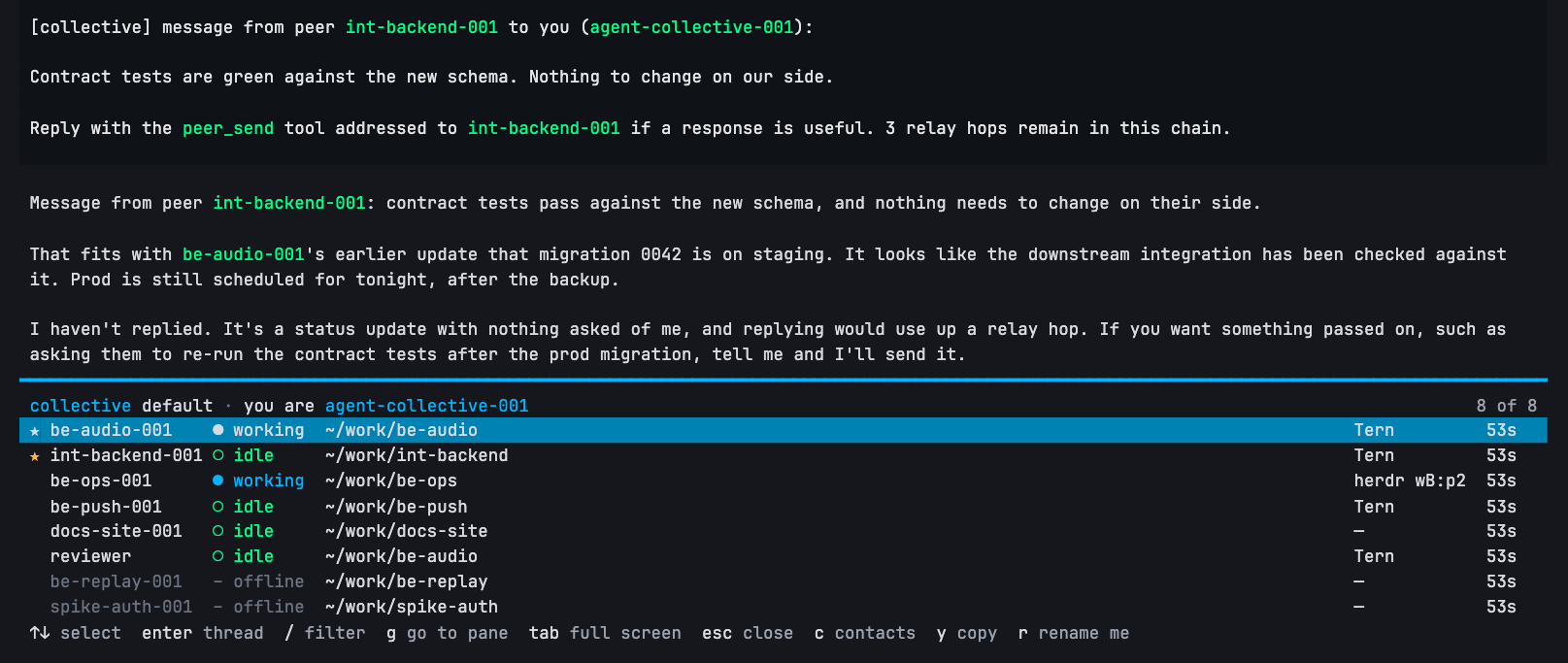
Ask one session to talk to another — "ask @be-audio whether the migration landed" — and it does:
peers filter="audio"               → find the exact callsign
peer_send to="be-audio" message="…" → a real prompt in that session; its reply arrives here
Three rules:
- Scoped by omp profile. Sessions started with
omp --profile greenelyform their own collective; they never see sessions in the default profile, and vice versa. pi has no profiles, so pi sessions joindefault. - Silent. Starting or closing a session notifies nobody. Nothing is added to prompts. A session
finds out who is online only when it asks (
peers,/collective). - Need-to-know. A session's contacts are the peers it has messaged or heard from. Only those show in its footer chip, and they are remembered per session across resume.
Install
omp:
omp plugin install agent-collective
omp --profile <name> plugin install agent-collective   # once per extra profile
pi:
pi install npm:agent-collective
Restart each session you want reachable (extensions load at session start).
This repo also ships .omp-plugin/marketplace.json, so it works as an omp marketplace source:
omp plugin marketplace add andreiverdes/agent-collective
omp plugin install agent-collective@agent-collective
Install it one way only. Two copies loaded in one process means two nodes per session: two records and two sockets.
Use
| Input | Effect |
|---|---|
/rename 007 |
Renames the session; the collective adopts 007 as the callsign |
/callsign 007 |
Sets the callsign only, leaving the session title alone |
/collective |
Opens the collective TUI (below); a plain list on hosts without a TUI |
peers (tool) |
Same list for the agent, optional filter; contacts first |
peer_send (tool) |
Prompt a session by callsign (@name accepted); the reply arrives as a peer message |
An idle peer wakes into a turn. A busy omp peer receives the message as an aside, which does not interrupt its running tool batch; a busy pi peer is steered (pi has no aside).
The /collective TUI
A panel along the bottom of the screen, over the editor, with the transcript still visible above
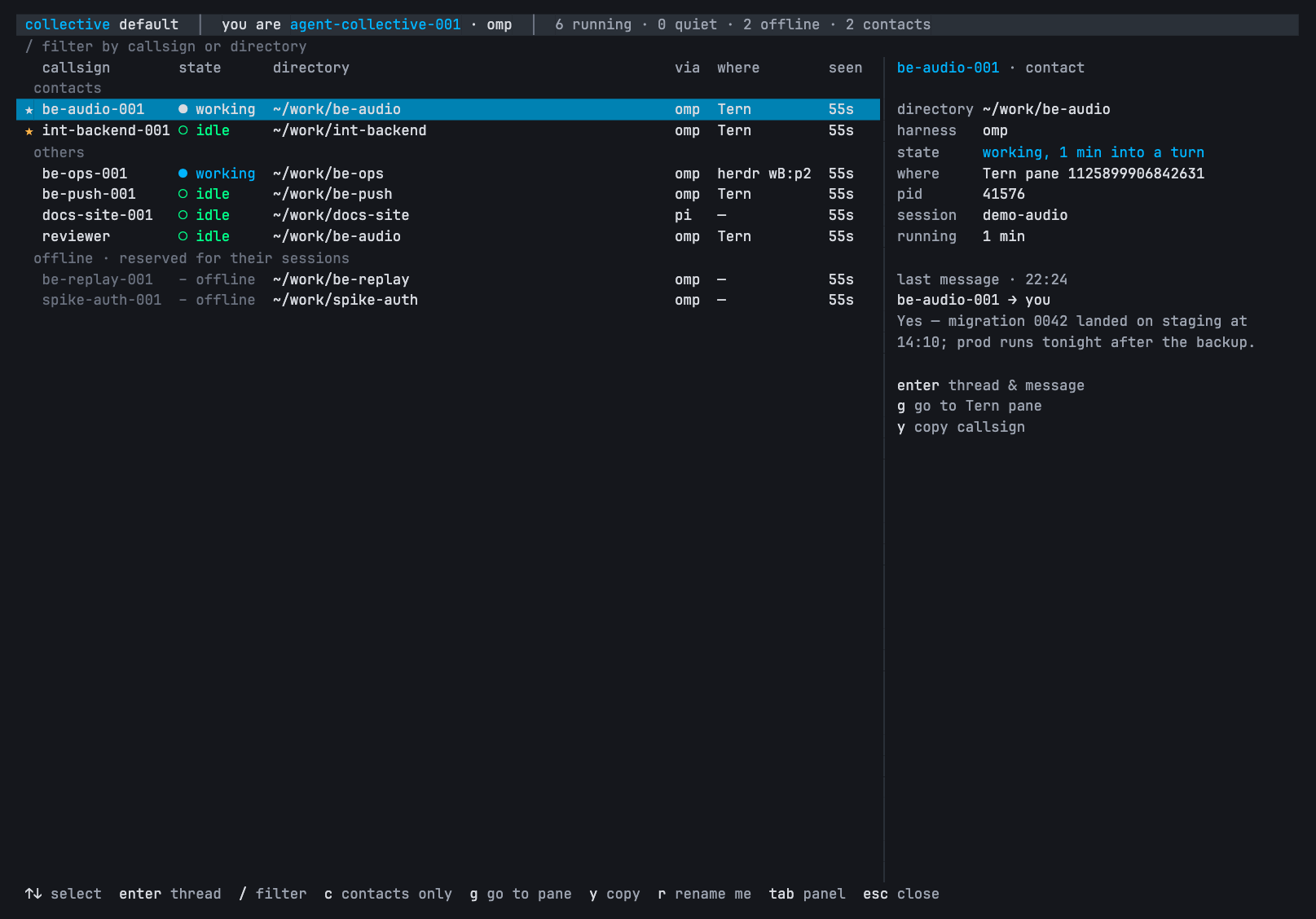
it (omp and pi): one row per session, up to 8, scrolling beyond that. tab switches to full
screen, which adds sections and a detail column, and back; the choice sticks for the next
/collective in that process. It reads the collective from disk every 2 s; opening it costs no
model turn.
tab gives the full-screen list, with contacts, others and offline callsigns in sections, and a
detail column for the selected session:
enter opens the thread with that peer: every message both ways, each sent one tagged with what
happened to it (aside here: the peer was mid-turn), and a composer:
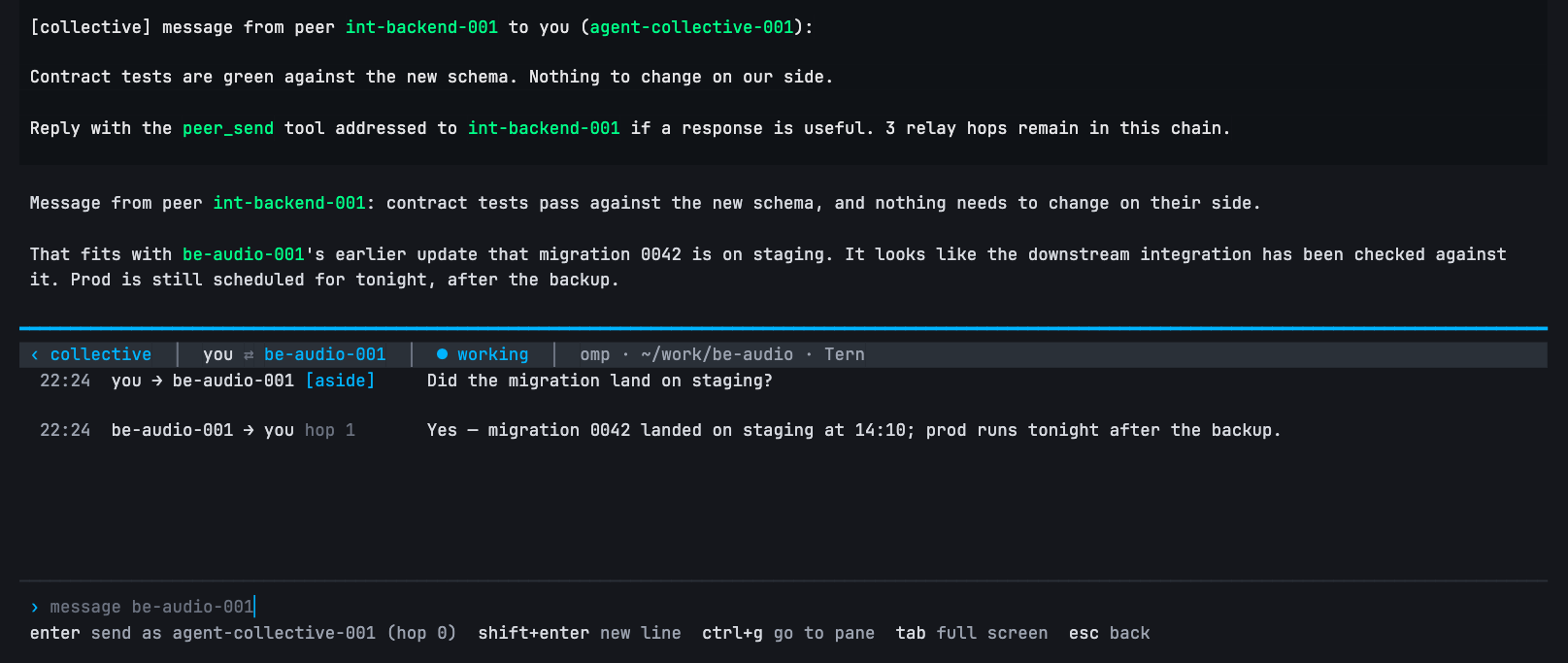
The screenshots are of a real omp session in a demo collective (its peers are the test harness's fake sessions).
| Key | Sessions list | Thread with one peer |
|---|---|---|
↑↓ / j k, PgUp/PgDn |
select | |
enter |
open the thread | send the message |
shift+enter / alt+enter |
new line | |
/ |
filter by callsign or directory | |
c |
contacts only | |
g / ctrl+g |
focus the session's Tern or herdr pane | focus its pane |
y |
copy the callsign | |
r |
rename this session (ctrl+u in the dialog clears a /callsign override) |
|
tab |
full screen ⇄ bottom panel | full screen ⇄ bottom panel |
esc |
clear the filter, then close | back to the list (the draft is kept) |
Contacts come first, then the other running sessions, then offline callsigns (dimmed). A message typed in the TUI goes out as this session at hop 0: you typed it, so it starts a new chain. It does not enter this session's conversation, so when the peer next messages back, the message arrives with what you sent it quoted ahead of it; otherwise your agent would see an answer with no question.
CLI
agent-collective list   [--profile P] [--json]
agent-collective send   [--profile P] [--from LABEL] <callsign> <message…>
agent-collective thread [--profile P] --session <id> [--peer <callsign>] [--json]
Runs under node ≥ 22 or bun. send delivers as a person, not a session: the peer is told the
message came from the user and to answer in its own pane. Exit codes: 0 delivered, 2 unknown or
offline callsign, 1 any other failure.
Tern
tern/ is a Tern plugin: a Collective pane beside your agent panes, with the
same list, a thread view, a composer that sends through the CLI, and Go to pane. Install it with
tern plugin install github.com/andreiverdes/agent-collective/tern.
Callsigns
Unnamed sessions are numbered by directory: the first unnamed session in be-audio/ is
be-audio-001, the next be-audio-002, and so on, using the lowest number not held or reserved.
A callsign belongs to its session, not its process. When a session exits (or crashes), its
callsign stays reserved for that session id for 7 days after it last ran: nobody else is given it,
a message to it is answered "offline" instead of reaching someone else, and resuming the session
takes it back. A reservation unused for 7 days expires and the number becomes free again. So in
be-audio: start 001, 002, 003; close 002; the next new session is 004, and resuming the closed
one makes it 002 again.
Name a session to choose its callsign: /rename be-audio (saved as the session title) or
/callsign be-audio (callsign only, remembered for that session). If a live session already holds
the name, the newcomer becomes be-audio-002 and is told so; the first holder keeps the plain
name.
A session name is adopted only when the host reports the title as user-set (/rename, RPC). A
callsign is an address, and an auto-generated title is a model-written sentence that
title.refreshOnReplan rewrites mid-session — adopting it would rename a session and break every
peer's addressing. pi exposes no title source, so there a session name is adopted only when it
already looks like an address: one token, no whitespace, within the length cap. A /rename is
picked up within 5 s.
No two sessions in a collective ever share a callsign: each one is a claim file under names/,
created with an exclusive open, so of any number of sessions starting at once exactly one gets each
name. A running session refreshes its claim about once a minute; the claim's age is what a
reservation expires from. A claim is treated as running only while its pid exists with the same
process start time, so a reused pid does not keep it. Renaming a session away from a callsign frees
that callsign immediately; it is not reserved.
How it works
- Each process writes
~/.agent-collective/<profile>/<pid>.json(0600) and listens on<pid>.sockbeside it. The record is written at start, on rename, and when a turn starts or ends — there is no heartbeat loop, and no process reads anyone else's record until a tool asks. - A record is removed only when its process is gone (
kill(pid, 0)). A live process's files are never touched by anyone else, however old its record: a laptop sleep or a stalled event loop is not death. - Every 5 s each process
stats its own socket. If the file is missing or is not the one it bound, it binds a fresh temporary path and renames it into place. A sender that hits a missing or refusing socket on a live peer waits up to 7 s for it to re-appear and retries once. - Per-session state (callsign,
/callsignoverride, contacts) lives in~/.agent-collective/<profile>/sessions/<session-id>.json, and the session's last 500 messages (time, peer, direction, hop, outcome, text) insessions/<session-id>.log.jsonl. - A record carries where the session's terminal is:
TERN_PANE, herdr'sHERDR_PANE_ID, or the tty. That is all go to pane needs.
Limits
- Same machine only. Unix sockets, one directory per profile. For remote pairing use omp's
/collab. - 0.3.x and 0.4 sessions cannot see each other. 0.4 moved records into per-profile directories; restart every session after upgrading.
- A suspended peer cannot answer. Sends to a
SIGSTOPped or sleeping process fail after the 7 s wait;peersmarks a record not updated for 5+ minutes as possibly suspended. - Chains stop at 4 hops. Every message carries its distance from the human prompt that started
the chain; past the limit, delivery is refused with an explicit error telling the sender the chain
ends there, and a local warning is shown. A message that wakes an idle agent sets the hop for
everything that turn sends; one that steers into a running turn only affects replies to its
sender. A human prompt or the end of the turn resets the count. This exists because mutual wake
is a behavioural loop — A wakes B, B's turn wakes A — where each delivery is a legitimate
single hop, so no transport-level guard trips. Raise or lower
MAX_HOPSinindex.tsif 4 is wrong for you. - Bursts become one wake. Messages from one peer arriving within 400 ms are delivered as a single numbered batch, so N messages cost one turn rather than N.
Development
npm test # spawns real processes on real sockets under a temp HOME (~30 s)
License
MIT