@underactive/pi-inceptionlabs-provider0.1.1
Inception Mercury 3 provider for Pi, with in-transcript diffusion playback
Untested on omp
This is a pi package. No one has reported whether it works on omp yet. If you try it, add your result below.
Reports 0
No reports yet.
Readme
Inception for Pi
Adds Inception's mercury-3 diffusion model to Pi. While a response streams,
the assistant message shows the answer resolving out of noise instead of
growing token by token.
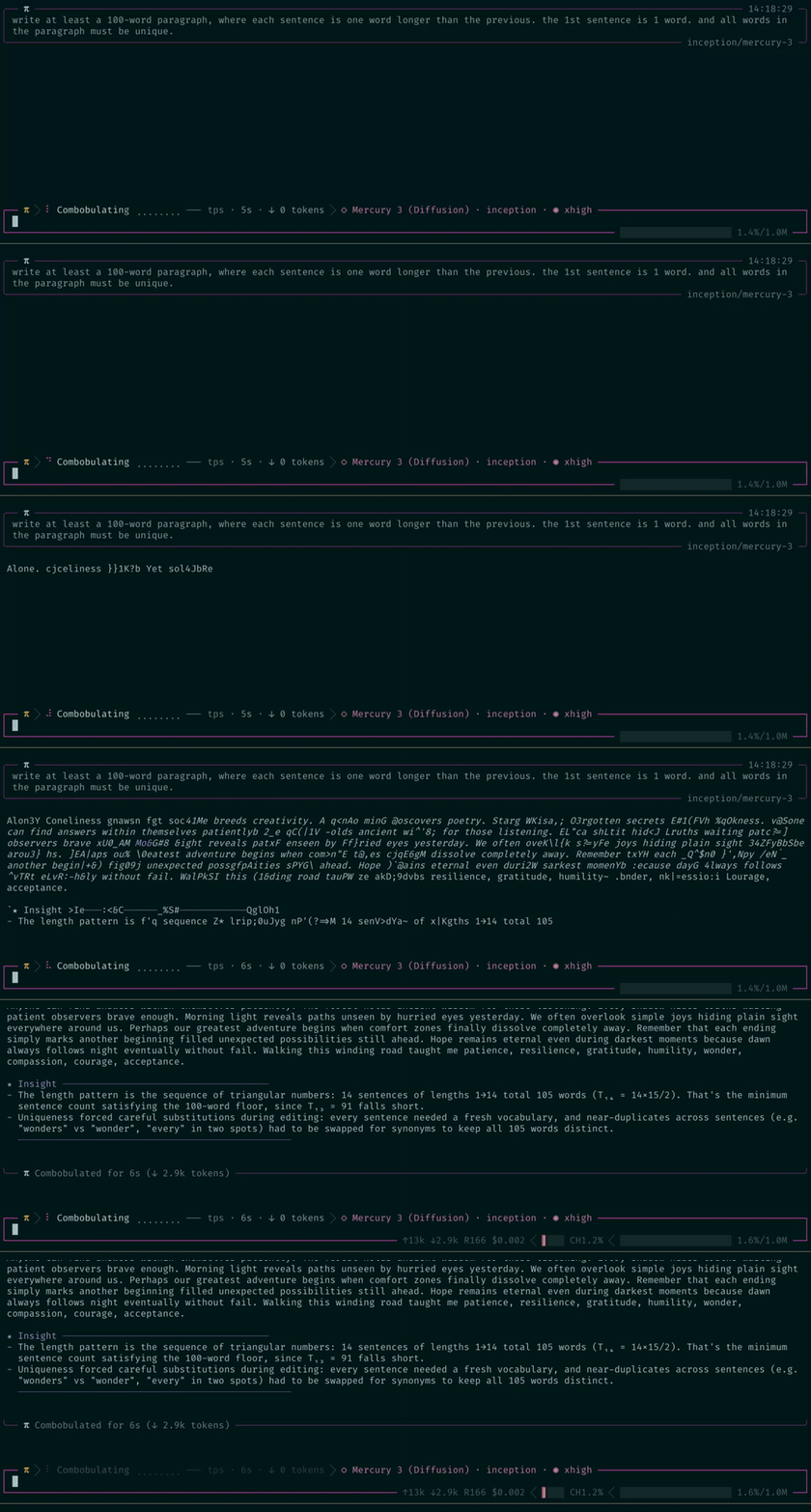
Slowed down ~5x to show the denoising effect.
Requires Pi 1.4.0 or newer and Node 22.19+.
Setup
1. Get an API key
Create an account at platform.inceptionlabs.ai and generate a key under Dashboard > API Keys.
2. Install the package
pi install npm:@underactive/pi-inceptionlabs-provider
This adds the package to ~/.pi/agent/settings.json. Add --local to install
it only for the current project (.pi/settings.json). To try it for one session
without installing:
pi -e npm:@underactive/pi-inceptionlabs-provider
3. Add your key
In Pi, run:
/login inception
Pi prompts for the key and stores it in ~/.pi/agent/auth.json, scoped to the
inception provider. It is kept separate from your other provider credentials.
Or set it in your environment before starting Pi:
export INCEPTION_API_KEY="your-key"
If an interactive session starts with Mercury 3 selected and no key, the extension
shows a warning pointing to /login inception.
4. Select the model
Pick Mercury 3 (Diffusion) with /model, or start with it directly:
pi --model inception/mercury-3
Configuration
| Variable | Default | Effect |
|---|---|---|
INCEPTION_API_KEY |
none | API key, if not set with /login inception |
INCEPTION_DIFFUSION_FRAME_MS |
60 |
Minimum time each diffusion frame stays on screen; 0 disables pacing |
INCEPTION_DIFFUSION_MAX_HOLD_MS |
2000 |
Total time frames may be held per response before they show at network speed; 0 disables holds |
Update and remove
pi update --extensions
pi remove npm:@underactive/pi-inceptionlabs-provider
Diffusion playback
Requests set stream: true and diffusing: true. Each frame Inception sends is
the complete answer so far, with regions that are still being decoded shown as
noise. The extension writes each frame into the streaming assistant message,
replacing the previous frame, so the transcript shows the answer resolving from
noise instead of growing token by token.
Inception emits frames in bursts: several frames per decoded block arrive in the
same millisecond, and short answers arrive all at once. Rendered at network speed
the noisy frames would be invisible, so each frame is held on screen for at least
60 ms. Set INCEPTION_DIFFUSION_FRAME_MS to change the hold (0 disables it).
Holds total at most 2 s per response by default (INCEPTION_DIFFUSION_MAX_HOLD_MS), after which frames show at network speed.
Pacing is skipped in print and JSON mode, where nothing is rendered.
Only the final frame is committed: intermediate frames never enter the session
file, conversation history, or model context. Extension hooks see the raw
provider events; provider_stream_event receives every original frame. Tool
calls, usage, and errors use Pi's normal OpenAI transport, including retries
and cancellation. Cancelling a response ends any pending hold immediately.
Mercury 3 supports text input and tool calling. Pi thinking levels map to Inception's instant/low/medium/high reasoning efforts. In diffusing mode the API does not stream reasoning, so higher levels add silent delay before the first frame. Registered prices are the documented launch rates ($0.10 input, $0.01 cached input, $0.35 output per million tokens); these are estimates and can change. Other Mercury models and non-chat endpoints are not registered.
Development
To run a local checkout instead of the published package:
pi -e /absolute/path/to/pi-inceptionlabs-provider/index.js
Inside Pi the extension needs no installed dependencies: it imports only module specifiers Pi resolves for extensions. For local tests, install the development dependencies and run:
npm install
npm test
nvm use                # Node 22.19, the minimum supported version
npm run check          # tsc --noEmit on the JSDoc types, ESLint, Prettier check
npm run format         # apply Prettier
npm run test:coverage  # tests with Node's built-in coverage report
If this checkout has a node_modules symlink to a Pi installation, remove only
the symlink before installing with rm node_modules (do not add -r or a
trailing slash).
Tests use mocked HTTP streams: byte-split Unicode and SSE framing, coalesced
events, unterminated final events, keep-alive comments, multi-line data: fields,
frame replacement, repeated and content-less finish chunks, empty output, raw
event instrumentation, tool calls, usage, malformed and truncated streams,
bodyless HTTP responses, default global fetch, requests aborted before they start,
failing transports, configurable pacing holds, missing-key warnings, and
control-character stripping. No API credentials are required.
Sources
License
MIT