@srnoob2570/omp-ollama-cloud0.1.3
oh-my-pi plugin: Ollama Cloud catalog + official pricing + live streaming stats
Built for omp
The author tagged this package oh-my-pi.
Reports 0
No reports yet.
Readme
omp-ollama-cloud
oh-my-pi (omp) plugin that registers the Ollama Cloud provider with the model
catalog from
srnoob2570/ollama-cloud-catalog
(official rate card, thinking efforts), adds a live streaming-stats widget
(tok/s, TTFT), and fetches real account quota from ollama.com's usage API
for omp's /usage surfaces.
Ported from @srnoob2570/opencode-ollama-cloud.
omp ships its own /model command, so that one is not ported.
Install
omp plugin install @srnoob2570/omp-ollama-cloud
For development:
omp plugin link /path/to/omp-ollama-cloud
The plugin only supplies models and pricing; omp resolves the credential
itself. Set OLLAMA_CLOUD_API_KEY, or run omp /login and pick Ollama
Cloud.
Models
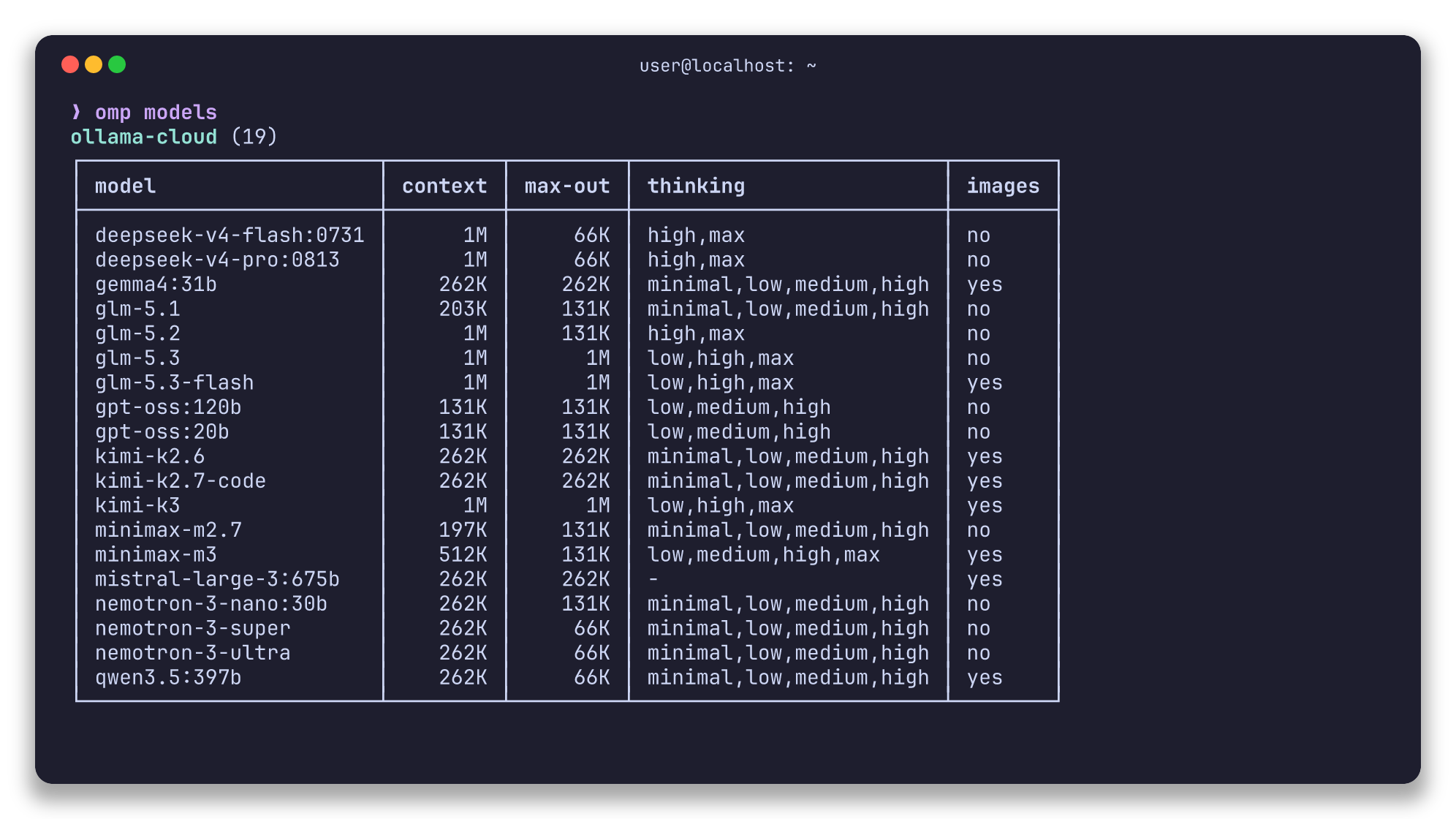
The plugin replaces omp's built-in discovery list for ollama-cloud with
the published catalog, so omp models shows the real lineup: context and
max-output limits, thinking efforts, and image support per model.
What it does
- Registers the
ollama-cloudprovider throughpi.registerProvider, withfetchDynamicModelsfed by the published catalog artifact. The catalog's models replace omp's built-in discovery list for this provider. - Attaches each model's official rate card (USD per 1M tokens) from the
artifact, so the cost counter,
/usage, and omp-stats show real spend. These are the off-peak rates Ollama Cloud publishes; the cache-read rate maps tocost.cacheRead. - Renders one line below the editor,
42.3 tok/s · TTFT 812 ms, from omp's ownAssistantMessagetiming (duration,ttft); it never touches the wire. TPS is total output tokens over total stream time. Ollama Cloud flushes output in bursts, so a decode-only window would report burst speed, sometimes 500+ tok/s. TTFT is the simple mean per step. Only main-conversation ollama-cloud assistant steps count. Subagents run in their own runners, and title generation, auto-thinking, and compaction never reach the main runner as assistant messages. - Probes the npm registry once per boot (npm installs only; dev checkouts are skipped). When a newer release exists, a second widget line names the version and the install command. The plugin never mutates its own install.
- Fetches the account's real quota from
GET https://ollama.com/api/usageand feeds omp's normalized usage pipeline:/usagein the TUI and ACP sessions, the status-line footer (polled every 5 min), recorded usage history (omp usage --history), and credential health checks. Session and weekly windows render as percent bars with per-model request notes; a nonzero four-week activity cost adds a USD row. omp resolves the credential itself (stored login key orOLLAMA_CLOUD_API_KEY). The plugin sends the key only as a Bearer header to a pinned origin. It re-verifies the fetch target ashttps://ollama.com/api/usageimmediately before every call, ignoresparams.baseUrlredirections, and never logs or persists the key. Every consumed response field is validated before use, and nothing from the response is executed or written to disk. - Adds
/ollama-recost, a one-shot sweep over every saved session file under~/.omp/agent/sessions(nested subagent transcripts included). It re-prices the$0ollama-cloud lines from the rate card, then drops omp-stats' incremental offsets so the dashboard's next sync re-parses the files (its upsert updates the cost columns). The offset reset covers every session file, including files that needed no rewrite, because a file can be fully priced while its dashboard rows were synced from an older snapshot, and re-parsing is idempotent. Reports files rewritten and requests re-priced.
Usage surfaces
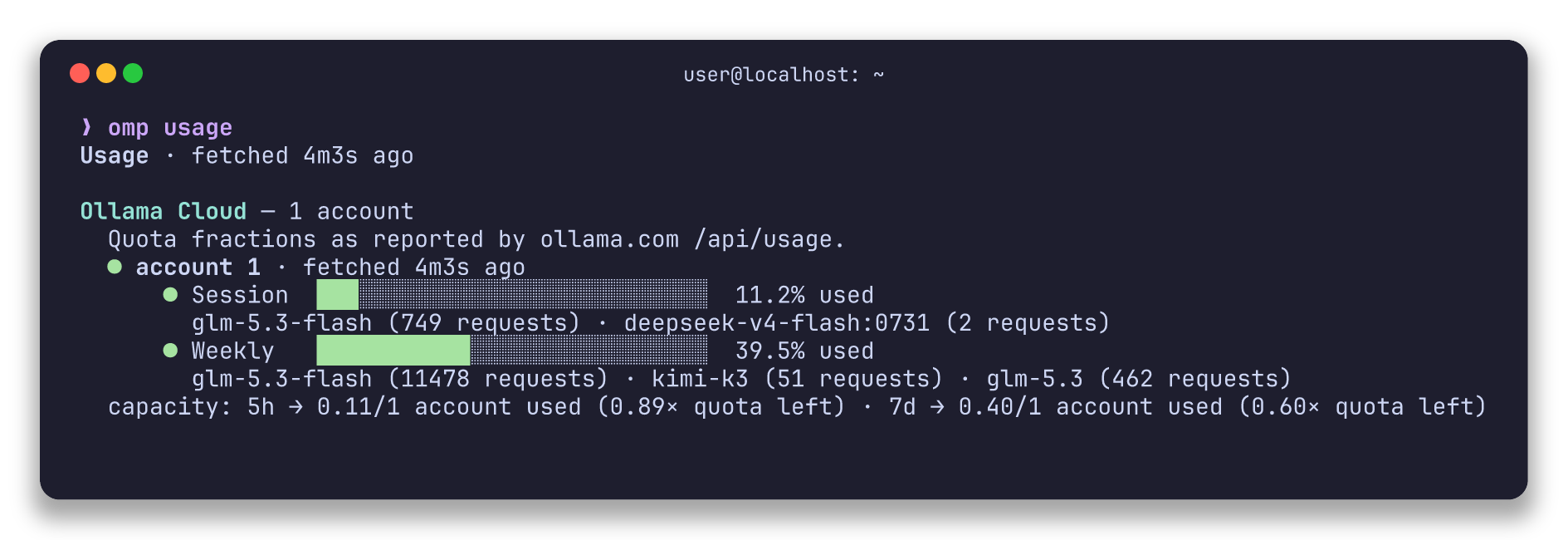
The omp usage CLI command prints the account's quota windows with
per-model request counts. It reads what an open omp session has already
fetched, so the numbers only appear while an omp window is open and has
queried the usage at least once. With no live session it shows the
built-in stub's "no limits reported". Use omp usage --history instead;
it works from the recorded snapshots alone.
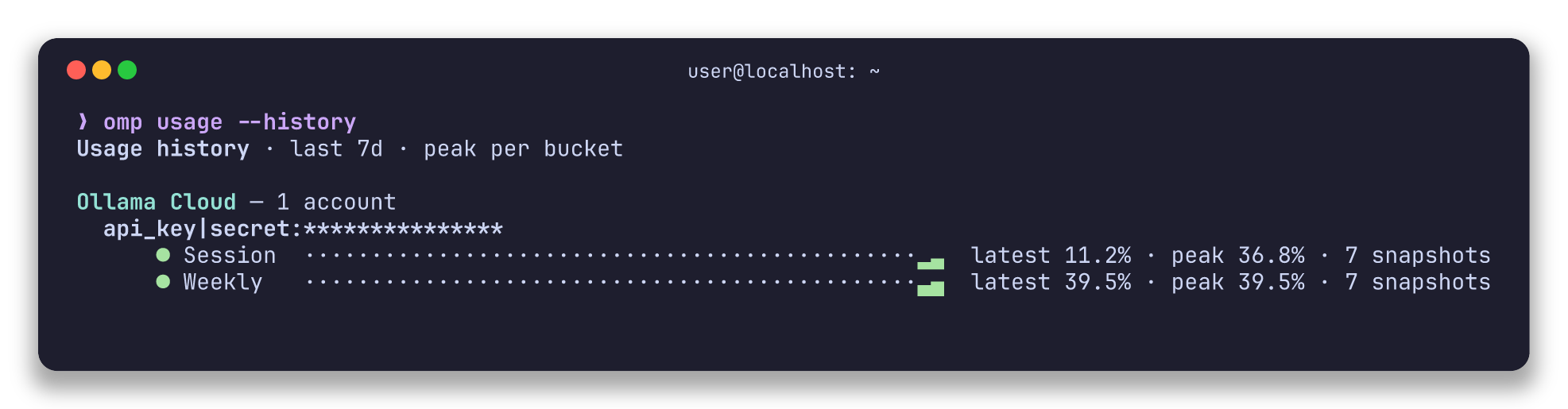
omp usage --history records snapshots and renders the trend per window:
Knobs
Environment variables, read once at startup. off, 0, false, and no
all turn a knob off.
| Variable | Default | Effect |
|---|---|---|
OMP_OLLAMA_CLOUD_PRICING |
on |
off zeroes every cost block (counter stays at $0.00) |
OMP_OLLAMA_CLOUD_STATS |
on |
off disables the widget and the collector |
OMP_OLLAMA_CLOUD_COST_FIX |
on |
off disables the session-cost patch (see below) |
OMP_OLLAMA_CLOUD_USAGE |
on |
off restores omp's built-in stub (reports "no quota API") |
OMP_OLLAMA_CLOUD_BASE_URL |
https://ollama.com |
provider endpoint, e.g. a local proxy. Trailing slashes are stripped |
OMP_OLLAMA_CLOUD_API |
ollama-chat |
wire API the provider speaks. openai-completions needs a base URL ending in /v1 |
omp loads ~/.omp/agent/.env at startup, so a line such as
OMP_OLLAMA_CLOUD_BASE_URL=http://127.0.0.1:11435 routes every request through
a local proxy over the native Ollama dialect. For a proxy that speaks the
OpenAI dialect, like ollama-cloud-meter, keep the /v1 suffix and add the API
knob:
OMP_OLLAMA_CLOUD_BASE_URL=http://127.0.0.1:11435/v1
OMP_OLLAMA_CLOUD_API=openai-completions
The quota fetcher keeps calling https://ollama.com/api/usage directly; only
model traffic is redirected.
omp caches the dynamic model list per provider in ~/.omp/agent/models.db
with a 24 h TTL. After flipping OMP_OLLAMA_CLOUD_PRICING, run
omp models refresh to force a fresh fetch and see the change immediately.
The extension system only runs inside sessions, so the standalone
omp usage CLI command keeps showing the built-in stub's "no limits
reported" for Ollama Cloud regardless of this knob; the session surfaces
(/usage, footer, --history) show the real numbers.
Session cost patch
omp's ollama-chat adapter never prices usage. It writes usage.cost as
$0 for every request, so the cost counter, /usage, and omp-stats all
show $0 for Ollama Cloud. The plugin re-prices the affected session lines
at turn end from the model's rate card. OMP_OLLAMA_CLOUD_COST_FIX=off
disables the patch. The plugin never touches lines that already carry a
non-zero cost, so the patch becomes a no-op once upstream omp fixes the
adapter.
Because the patch rewrites lines in place (byte lengths change), the plugin
also resets the patched file's incremental offset in omp-stats' stats.db,
so the dashboard's next sync re-parses it. /ollama-recost does the same
for the full history. Lines from the turn in flight are priced when the
turn ends.
Catalog upstream
Scheduled GitHub Actions in srnoob2570/ollama-cloud-catalog publish the
artifact: models.dev shape plus the x_ollama extension
(reasoning_options, quantization, rate card, hash gate). Two mirrors serve
the same file; the loader races them in parallel with a 5 s timeout each and
takes the first response that passes isCatalog. On total failure it falls
back to the disk cache at ~/.cache/omp-ollama-cloud/catalog.json,
refreshed on every successful fetch. With no network and no cached copy the
provider lists no models until a fetch succeeds.
Development
bun install
bun test
bun run typecheck
omp plugin link . for a live checkout; changes reload with a new omp
process.
License
MIT