@logan-robbins/smartypants0.5.0
Live Mermaid-style system diagram, compact IntentCode memory, and intent-drift flags for coding agents. Claude decides and writes through your Claude Code sign-in (Sonnet 5.5 decides by default; Typesafe Jev optional).
Untested on omp
This is a pi package. No one has reported whether it works on omp yet. If you try it, add your result below.
Reports 0
No reports yet.
Readme
Smartypants
The architecture diagram that draws itself while your coding agent works — and tells you when the code wanders.
Your agent forgets what you asked for. Smartypants doesn't. It hooks into Claude Code, Codex, Pi, Muse Code, and Grok Build, keeps one layered diagram of the system current on every turn, and flags the moment a diff leaves the design you described.
Live demo · Install · How it compares · Proof · What leaves your machine
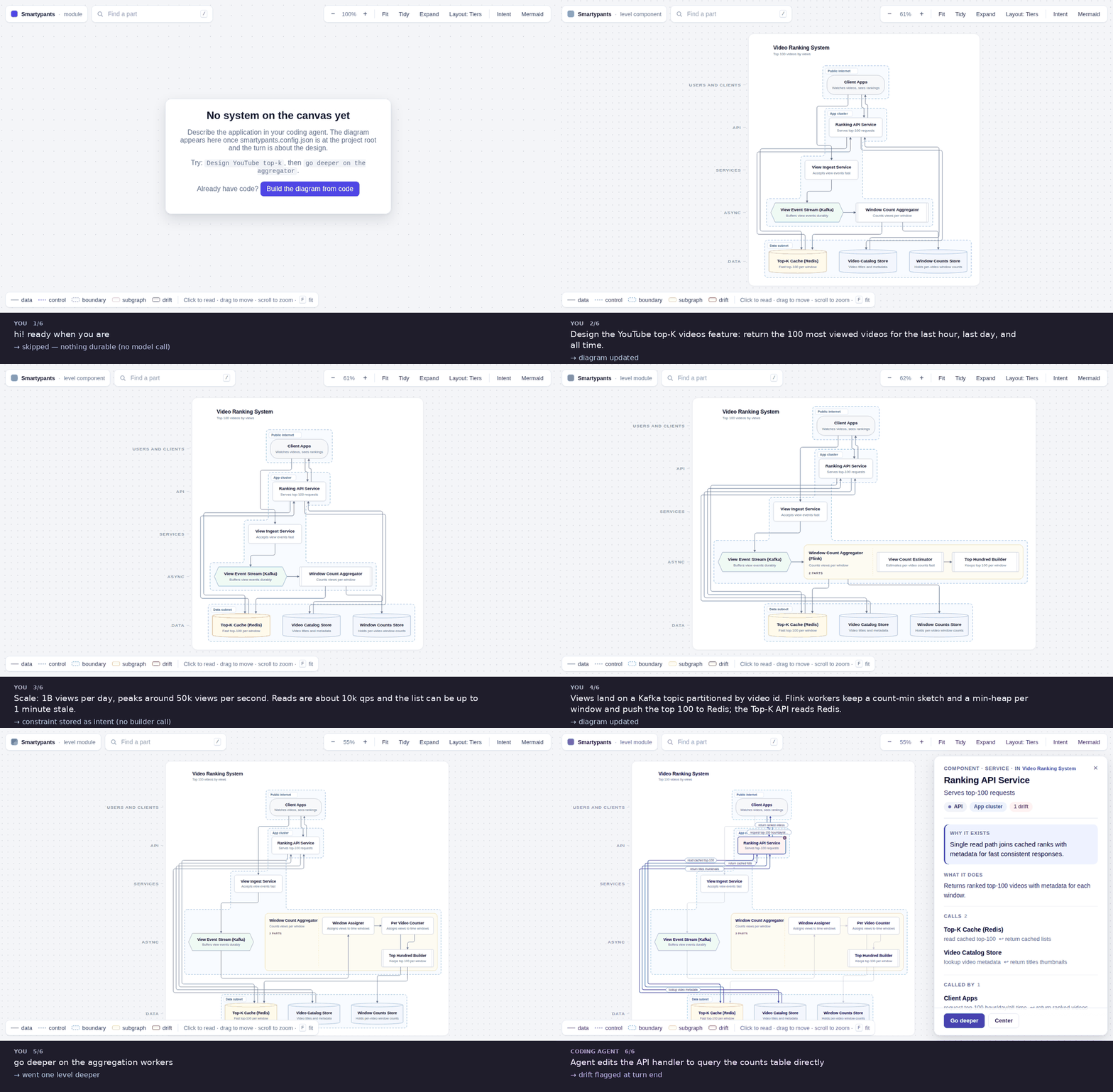
- Live, not a snapshot. Prompts, edits, and the end of every agent turn update the diagram in the background. Your agent never waits.
- Drift against what you said. Decisions and constraints from the conversation are kept as IntentCode (~200 tokens per design). At turn end, one batched check reads what changed in git; code that breaks a decision, a constraint, or a boundary turns red.
- Catches up on existing repos. From code plus compose, Kubernetes, Helm, and Terraform: real service names, flows, and network boundaries, in about a minute (LiteLLM, 13k files: 72 s and about $1 with Claude Code's default model, $0.21–0.52 with Sonnet 5.5).
- Reads like a staff engineer drew it. Users on top, storage at the bottom, the journey left to right, boundaries as frames. Each box has a plain name and one line; click it for the why.
Install
npm install -D @logan-robbins/smartypants
npx smartypants init        # hooks for every host + config; catches up if code exists
npx smartypants serve       # open the printed URL
The model is Claude, signed in the way your Claude Code already is. Smartypants runs this
machine's claude CLI headless (tool-less, settings-less, one answer per call), so whatever
Claude Code uses works with no extra key: ANTHROPIC_API_KEY, Bedrock / Vertex / Foundry, a
gateway on ANTHROPIC_BASE_URL, or your claude login. Two roles:
- Decisions: Claude Sonnet 5.5 at high effort answers the small per-turn questions (is this worth remembering, does this diff conform). ~3 s and ~$0.003–0.01 each, and the most accurate setting we measured (results).
- Writing: Claude Code's default model for your sign-in writes the diagram and drift notes,
only when a decision says there is work. Pin it with
"model".
On another harness without Claude Code, pick its builder with init --flavor codex|pi|grok|meta
(Config).
Alternative: Typesafe Jev for the decisions. ~0.2 s per decision for a fraction of a cent; Claude still writes, and answers the decisions itself if Jev is unreachable:
- Sign in at console.typesafe.ai/keys and create an API key.
export TYPESAFE_API_KEY=...in the shell that starts your agent (or put it in a dotenv file and set"envFile", or enter it in the Claude Code plugin's "Typesafe (Jev) API key" setting).- Set
"decider": "jev"insmartypants.config.jsonand restart the agent session.
Or as a plugin: /plugin marketplace add logan-robbins/smartypants then
/plugin install smartypants@smartypants (Claude Code) ·
codex plugin marketplace add logan-robbins/smartypants (Codex) ·
pi install git:github.com/logan-robbins/smartypants (Pi) ·
npx skills add logan-robbins/smartypants (any skills host).
No key? See it first: npx smartypants demo youtube-top-k && npx smartypants serve, or the
live demo (source in site/).
Then just work. Say "design YouTube top-K" and the diagram appears; say "go deeper on the aggregator" (or double-click it) to expand a box; let the agent code and watch for red.
On a project with code, going deeper reads the code. Ask "go deeper on how the MCP
credentials are managed" and Smartypants finds the matching files, lets Claude read them
(read-only: Read, Grep, Glob), draws the real modules with each note citing its file, and
corrects the diagram wherever it disagreed with the code. The corrections print and are saved to
.smartypants/deeper.json. On LiteLLM this took 75–94 s and $0.43–0.53.
How it compares
| Smartypants | Archify | drawio-skill | Whiteboard | GitDiagram · DeepWiki | ArchUnit · dep-cruiser | |
|---|---|---|---|---|---|---|
| Updates by itself as the agent works | every turn, via hooks | on request | on request | on request | on request | in CI |
| Knows what you asked for | yes (IntentCode) | chat context | no | decision log | no | rules you write |
| Flags drift | per turn, vs your intent | before/after diff | diagram diff | no | no | rule violations |
| Existing repo + Helm/k8s/compose/TF | yes, background | repo | code + IaC | repo | repo | code only |
| Output | layered interactive canvas, Mermaid export | animated HTML | draw.io | desktop canvas | web diagram / wiki | test failures |
Archify draws a great poster; Smartypants keeps the map and sounds the alarm. Details and sources: docs/research/competitors.md.
Proof
Live runs, Claude Sonnet 5.5 deciding and Claude writing (results · Jev deciding · with Muse Spark writing · selector benchmarks):
| result | |
|---|---|
| Stop-hook review of labeled agent changes × 2, end to end | 22/22 drift flags right, 0 missed, 0 false alarms, 10.2 s per turn (Jev deciding: 22/22, 7.3 s) |
| Held-out triage, 34 turns + 10 edits | Sonnet 5.5 high: 32/34 exact, 34/34 keep-vs-skip, 9/10 drift verdicts, 0 missed (Jev: 29/34 per rep; local rules alone 18/34) |
| Per-turn decision | Sonnet 5.5 high ~3 s, ~$0.003–0.01; Jev ~0.2 s |
| Five design interviews (32 turns, 10 edits), Muse Spark writing | triage 32/32, all 33 expected parts drawn, drift 10/10, $0.015 total |
| Noise turns ("thanks", "run the tests") | $0, no model call |
| Catch-up of LiteLLM (12,996 files, 10 code units) | 21 parts, 31 flows in 72 s; $1.02 with Opus 5.5 (Claude Code's default), $0.21–0.52 with "model": "claude-sonnet-5-5" |
| Catch-up on 10 open-source repos, Muse Spark writing | 36–115 s, $0.001–0.011 each (crawler notes) |
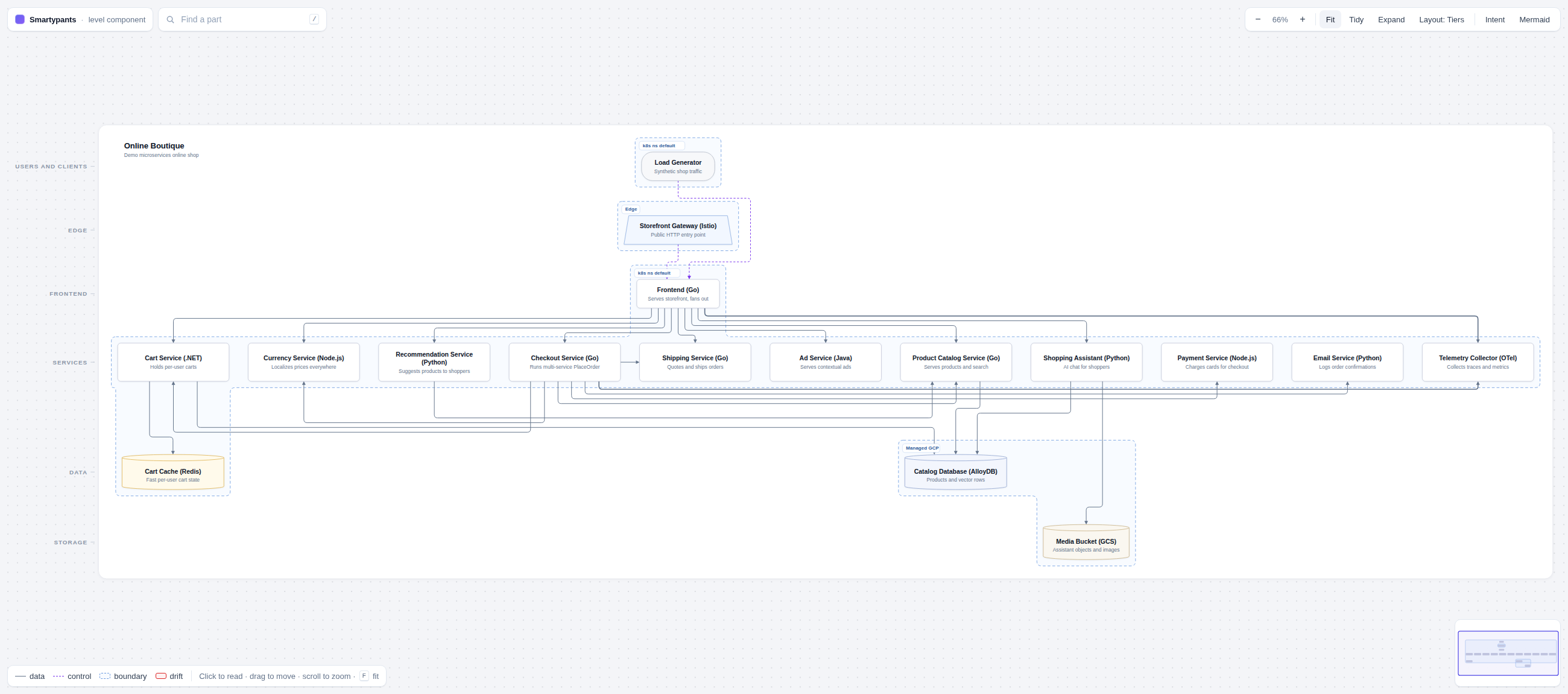
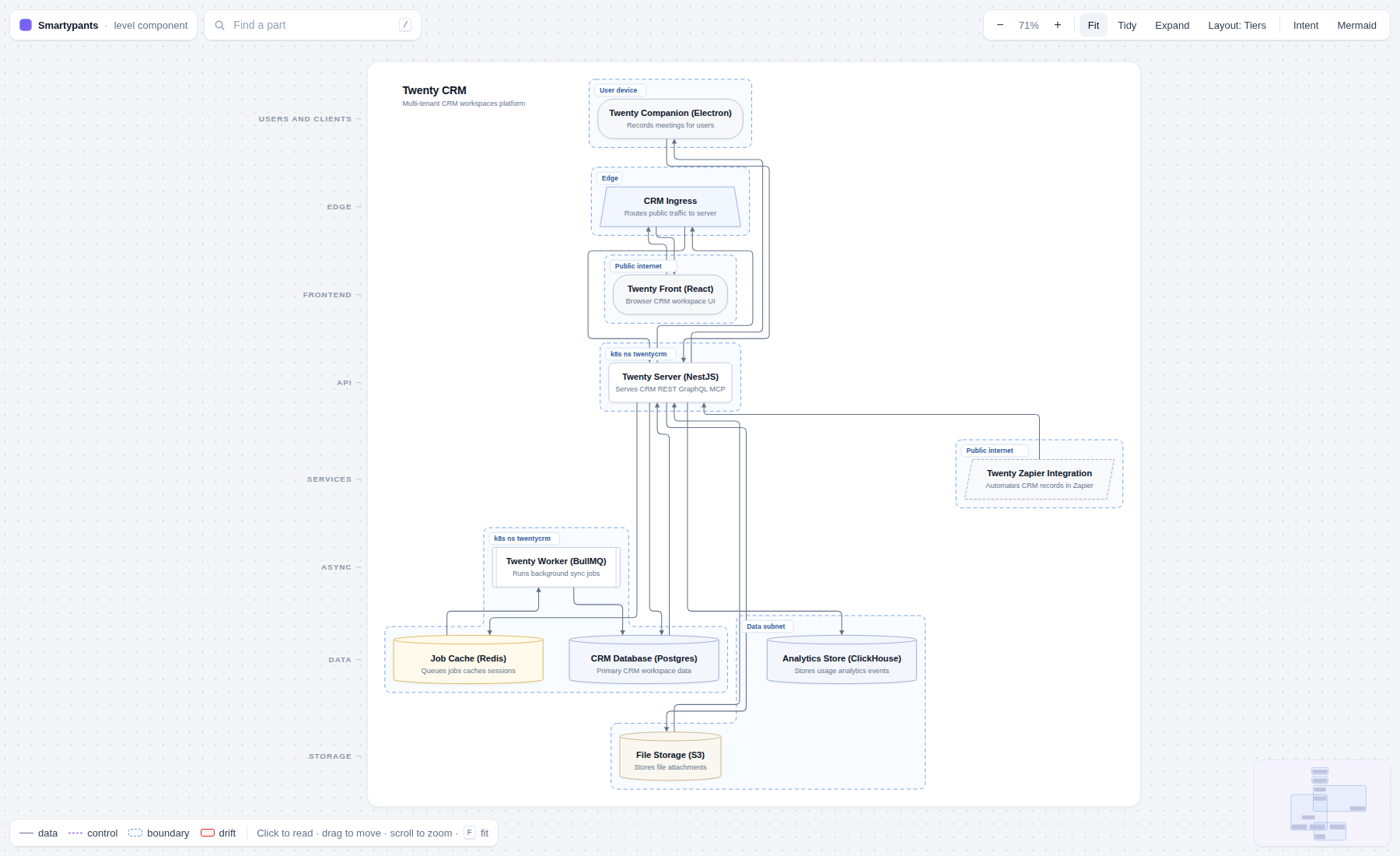
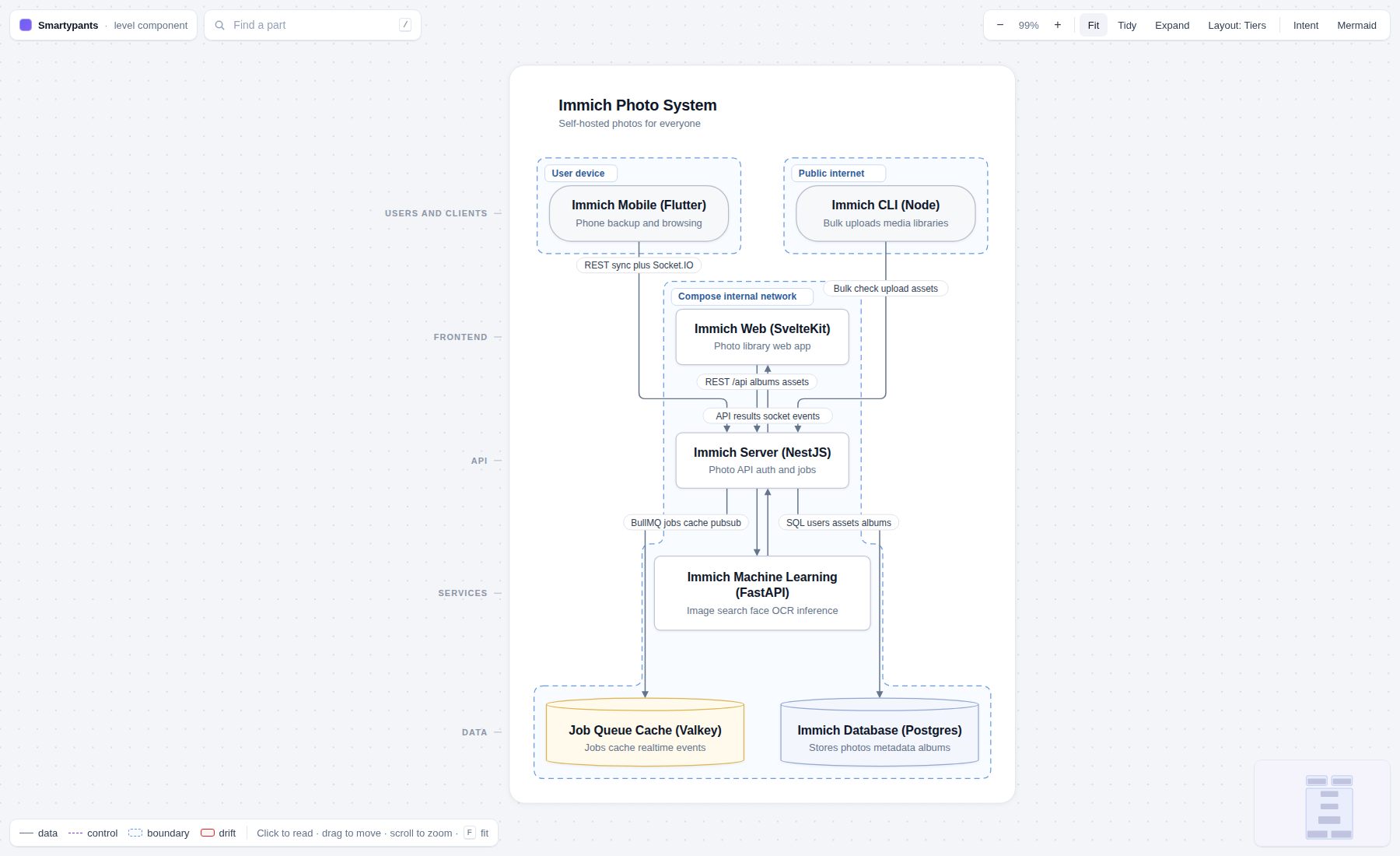
Caught up from code alone — GoogleCloudPlatform/microservices-demo (11 services, Istio gateway, AlloyDB, GCS), twenty, and immich:
The canvas
| top to bottom | |
|---|---|
| Users and clients | who starts the journey |
| Edge | CDN, WAF, load balancer, ingress, gateway |
| Frontend → API → Services | third parties at the right edge |
| Async | streams first, then the workers that consume them |
| Data | caches beside the databases they front |
| Storage | always the bottom row |
Inside a row the journey runs left to right. Dashed frames are network and trust boundaries. Everything is clickable and draggable — boxes, subgraphs, arrows, frames, layer labels. A click leads with why the part exists (the requirement or trade-off that forces it), then what it does, deep-dive notes, flows, drift, and the intent recorded about it.
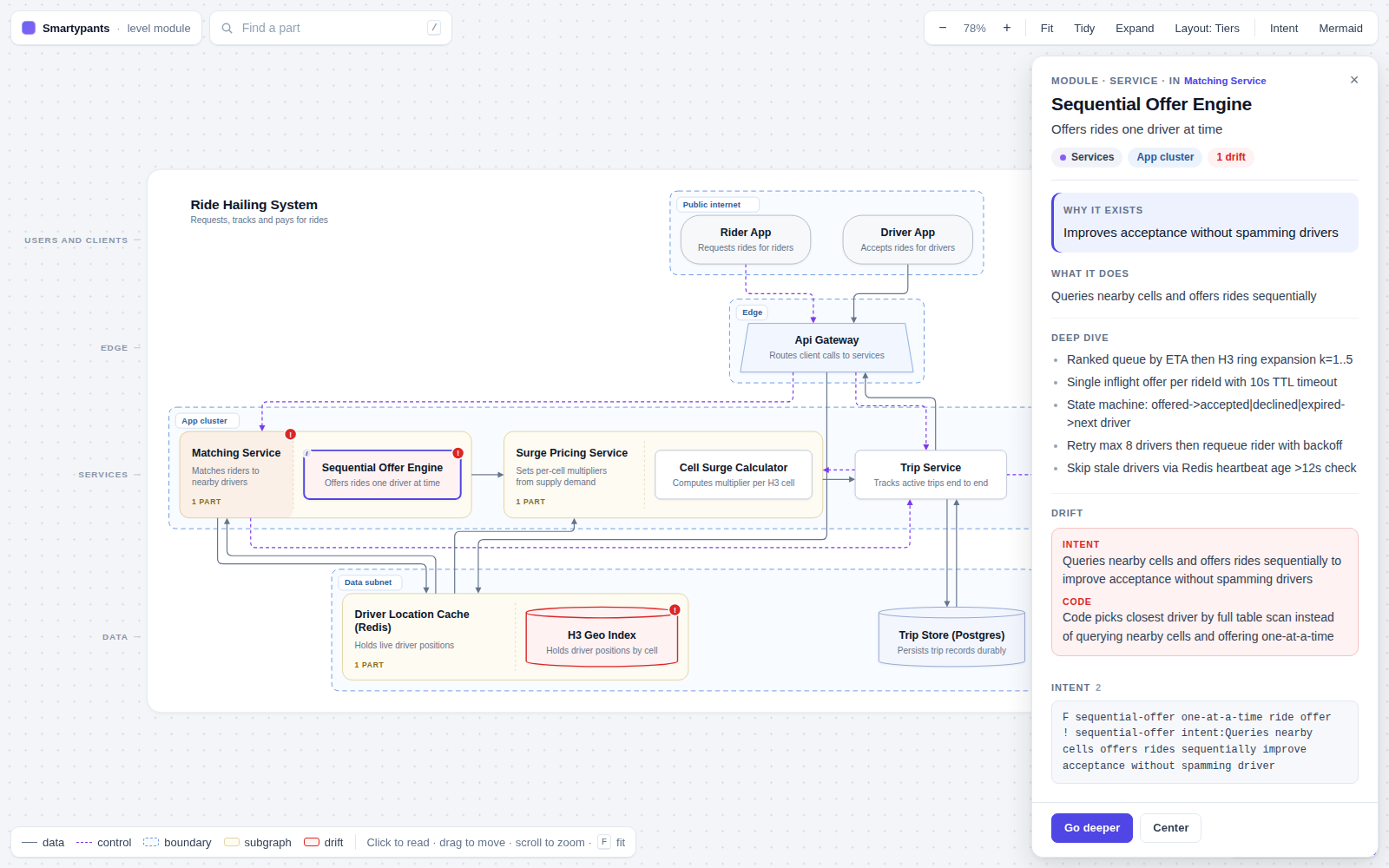
Keys: F fit · T tidy · L tiers/flow layout · I intent memory · / search · double-click to go deeper.
What leaves your machine
Nothing, in a project without smartypants.config.json. With the default claude builder:
design turns, part names, changed-file diffs at turn end, and (for catch-up) key source files go
to Claude through your own Claude Code, under the same account, provider, and data terms it
already uses. Smartypants never reads or stores a Claude credential. With "decider": "jev",
per-turn triage questions (turn text, part names) go to Typesafe (Jev). With the meta builder
they go to api.meta.ai, whose default muse-spark-1.3-contributor tier may be used for
training ("model": "muse-spark-1.3" opts out). Keys are never written to the diagram, memory,
or logs; the plugin stores the ones you enter in your OS credential store.
Commands
smartypants catchup     build the diagram from existing code, in the background
smartypants review      review what the working tree changed, now
smartypants deeper X    system → components → modules → deep-dive notes, read from the code
smartypants intent      print the IntentCode memory
smartypants drift       list where code left the intent
smartypants mermaid     export Mermaid
smartypants stats       turns skipped, calls, tokens, cost
smartypants demo NAME   shop-monorepo · youtube-top-k · uber · news-feed · messenger · url-shortener
smartypants reset       clear the diagram and memory
Plugin commands mirror these: /smartypants, /smartypants:deeper, :catchup, :review,
:intent, :drift, :diagram, :mermaid, :reset-graph.
Config
smartypants.config.json is the on switch. init writes:
{ "flavor": "claude", "depth": "auto", "seed": false, "decider": "auto", "deciderModel": "claude-sonnet-5-5", "deciderEffort": "high", "background": true, "review": "turn" }
| key | meaning |
|---|---|
flavor |
builder: claude (default; this machine's Claude Code and its sign-in), codex (OPENAI_API_KEY), pi, grok (XAI_API_KEY), meta (Muse Spark, META_API_KEY), muse |
model |
builder model; unset = Claude Code's default for your sign-in (e.g. claude-opus-5-5, or an alias like sonnet) |
depth |
auto (start from what you said, go finer as you do) or system / component / module |
decider |
who answers the per-turn menus: auto (with the claude builder: Claude, then local rules), jev (Typesafe Jev with TYPESAFE_API_KEY; Claude if Jev is unreachable), claude, meta, heuristic |
deciderModel |
the Claude model for those menus; default claude-sonnet-5-5 |
deciderEffort |
low · medium · high (default) · xhigh · max |
review |
turn (once per agent turn), edit (every edit), both |
background |
hooks return immediately; a project worker does the work |
seed |
existing codebase: catch up from code |
autoDeepen |
expand a box on its own when detail piles up (default 3; false to disable) |
envFile |
dotenv path for keys |
watch |
diagram another Claude Code / Codex instance (docs/WATCH.md) |
Hosts
| host | hooks | notes |
|---|---|---|
| Claude Code | prompt, edit, Stop |
project settings or the plugin |
| Codex | prompt, apply_patch, Stop |
approve the hooks once in Codex's hooks review |
| Pi | input, tool_result, agent_end |
project extension or pi install; Pi itself can run on Muse Spark |
| Muse Code, Grok Build | prompt, edit | .muse/hooks.json, .grok/hooks/smartypants.json |
How it works
Two jobs, the way WindTunnel pairs a selector (Jev) with a writer (Mercury): one model decides, Claude writes. A free local pass drops noise. The selector, Claude Sonnet 5.5 at high effort by default or Typesafe Jev as the alternative, then answers small closed menus: is this worth remembering, does it change the design, at what level, which part, does this diff conform. The writer runs only when the selector says there is work, and writes it: the diagram delta, the drift note, the IntentCode. An unsure pick leans toward doing the work, and the writer decides what actually lands, so a borderline file costs one write rather than a missed drift. Details: docs/ARCHITECTURE.md · docs/INTENTCODE.md · docs/PROMPTING.md · go-to-market: docs/GTM.md.
Develop
npm test                      # no network, no sign-in (a fake claude CLI stands in)
npm run eval                  # live interview transcripts on the Meta API (cents)
npm run eval:triage           # held-out triage benchmark
npm run eval:turnend          # turn-end review on labeled agent changes
node scripts/build-site.mjs   # website demo into site/demo
License
Apache-2.0. Use it, fork it, ship it; keep the NOTICE with any copy or derivative so the credit travels with it. Citing it: CITATION.cff.