@junjiezhou1122/pi-goal0.2.4
Persistent autonomous goals for pi — /goal loops until an independent verifier confirms completion or a genuine block; audited completions, findings re-injection, auto-release
Untested on omp
This is a pi package. No one has reported whether it works on omp yet. If you try it, add your result below.
Reports 0
No reports yet.
Readme
pi-goal
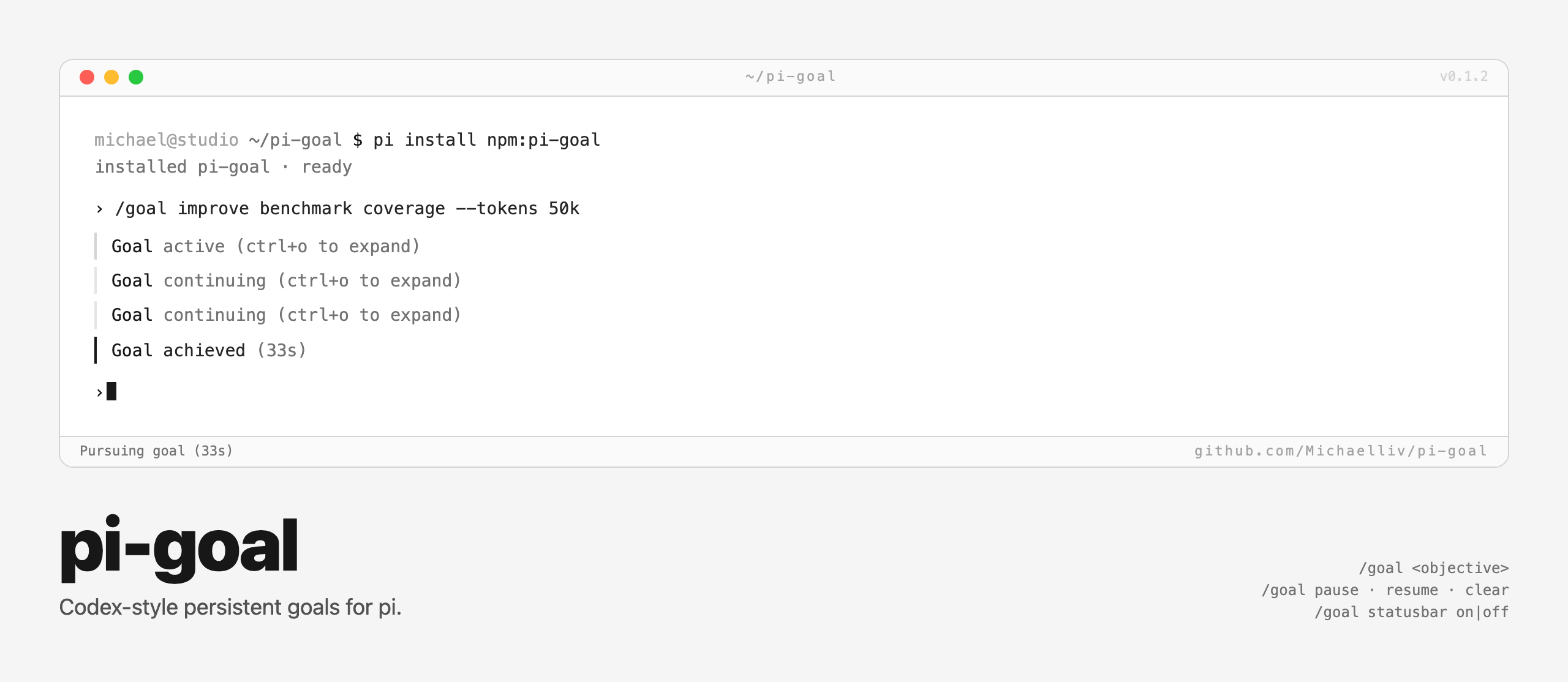
Persistent autonomous goals for pi.
pi-goal adds a /goal command and goal tools so Pi can keep working toward a long-running, thread-scoped objective until the goal is complete, blocked, paused, cleared, or token-budget-limited — and no completion or blocked claim counts unless an independent verifier process confirms it against fresh evidence.
Install
pi install npm:@junjiezhou1122/pi-goal
Or from git:
pi install git:github.com/junjiezhou1122/pi-goal
Independent fork of
Michaelliv/pi-goal(MIT), extended with an audited completion/blocked gate. Upstream stays atMichaelliv/pi-goal.
Usage
/goal improve benchmark coverage until the suite has strong evidence
/goal --tokens 50k finish the migration and verify tests
/goal --verify 3 --verify-tools read,bash,grep audit the migration
/goal --verify 0 finish the docs rewrite
/goal
/goal status
/goal pause
/goal resume
/goal clear
/goal statusbar off
When a goal is active, the extension shows compact visible lifecycle markers like Goal active and Goal continuing; expand them with ctrl+o to inspect the objective and usage. The full continuation instructions ride along as the content of that custom message, so the model always has the objective and audit guidance in the transcript while the renderer keeps the visible UI compact.
The same Pi agent keeps running normal turns in the same session context until it calls update_goal({ status: "complete" }), the user pauses/clears it, or the token budget is reached. Reloading Pi pauses an active goal instead of silently resuming it; use /goal resume to continue.
What it adds
pi-goal-writerskill: draft and review strong/goalobjectives with evidence-based success criteria/goal [--tokens 50k] [--verify 3] <objective>: set or replace a goal (verify flags below)/goalor/goal status: show the current goal/goal pause: stop autonomous continuation without deleting the goal/goal resume: reactivate a paused goal/goal clear: remove the goal/goal statusbar on|off: show or hide the footer status linecreate_goaltool: model can set or replace the current goal only when explicitly requestedget_goaltool: read current goal stateupdate_goaltool: model requests completion or reports blocked; both requests are audited by an independent verifier in an isolated process before they take effectget_goalandupdate_goalare only exposed to the model while a goal isactive; paused, cleared, complete, and budget-limited goals hide them so unrelated sessions are not tempted to call them- footer status:
Pursuing goal,Goal paused,Goal blocked,Goal achieved, orGoal unmet
Flow
/goal <objective>
  -> persist goal in the current Pi session
  -> show compact Goal marker and footer status
  -> deliver continuation instructions as the marker's message content
  -> trigger an agent turn
  -> account time/tokens on turn_end
  -> queue another continuation on agent_end while active
  -> model calls update_goal({ status: "complete" | "blocked" })
       -> extension spawns an isolated verifier process
            pass / genuine   -> request lands (complete / blocked)
            fail / premature -> goal stays active, findings returned as tool
                                output and re-injected by every continuation
  -> stop when the verifier grants a claim, user pauses/clears,
     verification rounds are exhausted (goal paused for user review),
     or the token budget is hit
Completion behavior
The model is instructed to audit completion against real evidence before calling update_goal. Calling update_goal is a completion request, not a declaration: the extension spawns an isolated pi process (--mode json -p --no-session --no-extensions) that re-derives the requirements from the objective and audits the workspace with fresh evidence. Only a pass verdict marks the goal complete.
On rejection, the goal stays active, the unmet gaps are returned to the model as tool output, and subsequent continuation prompts re-inject them until the next verification. After the configured verification rounds are exhausted, the goal is paused and the user decides (resume grants fresh attempts; --verify 0 disables verification entirely). Verification flags are parsed from /goal arguments only; the create_goal tool schema deliberately does not accept them, so the model can never weaken its own completion gate. The final turn is still accounted even when the model completes the goal mid-turn.
The model can also declare a goal blocked with update_goal({ status: "blocked", reason }) when it has verified that no useful work remains (missing credentials, user-only decisions, or a proven impossibility). Blocked claims get the same independent audit: genuine blocks the goal and notifies the user, while premature returns the concrete remaining work the auditor found. Both claim types share the same verification limit, and the continuation prompt tells the model the blocked escape hatch exists so impossible goals stop instead of looping. Uncertainty resolves to premature.
Verification flags:
--verify <N>: max verification attempts (default 3;0disables the verifier)--verify-model <provider/id>: model for the verifier (default: same as the session)--verify-tools <a,b,c>: tool allowlist for the verifier (default: all tools)--verify-cwd <path>: working directory for the verifier (default: session cwd)
State
Goal state is stored as Pi custom session entries with customType: "pi-goal" (schema version: 2). It follows the active session branch, survives reloads, and does not require an external database. v1 entries from older sessions load as-is; verification fields (verify, verifyRounds, verifyFindings, blockedReason) default sensibly when absent.
Credits
Forked from Michaelliv/pi-goal; the independent verifier, blocked verdict, and auto-release pipeline are this fork's additions.
License
MIT