@juanhuttemann/pi-deep-research0.1.3
Fact-checked, cited web research inside Pi: runs the deep-research CLI (drsh) on Pi's own model, with live progress, clarifying questions and plan review
Untested on omp
This is a pi package. No one has reported whether it works on omp yet. If you try it, add your result below.
Reports 0
No reports yet.
Readme
@juanhuttemann/pi-deep-research
Fact-checked, cited web research inside Pi. The extension
runs deep-research
(drsh): it plans sub-topics, searches them in parallel, analyzes the
evidence, and checks every claim against the text of the pages it fetched.
Pi's own model answers the model calls, through Pi's sign-in.
Install
drsh must be installed (0.30.0 or newer):
curl -fsSL https://raw.githubusercontent.com/juanhuttemann/deep-research/main/scripts/install.sh | bash
Then:
pi install npm:@juanhuttemann/pi-deep-research
From a clone, pi install ./integrations/pi. For one session,
pi -e ./integrations/pi/src/index.ts.
drsh's search and scraper settings still apply. SearXNG works with no
setup, while Exa, Tavily and Firecrawl use their keys from drsh setup.
/research-doctor checks them.
What it adds
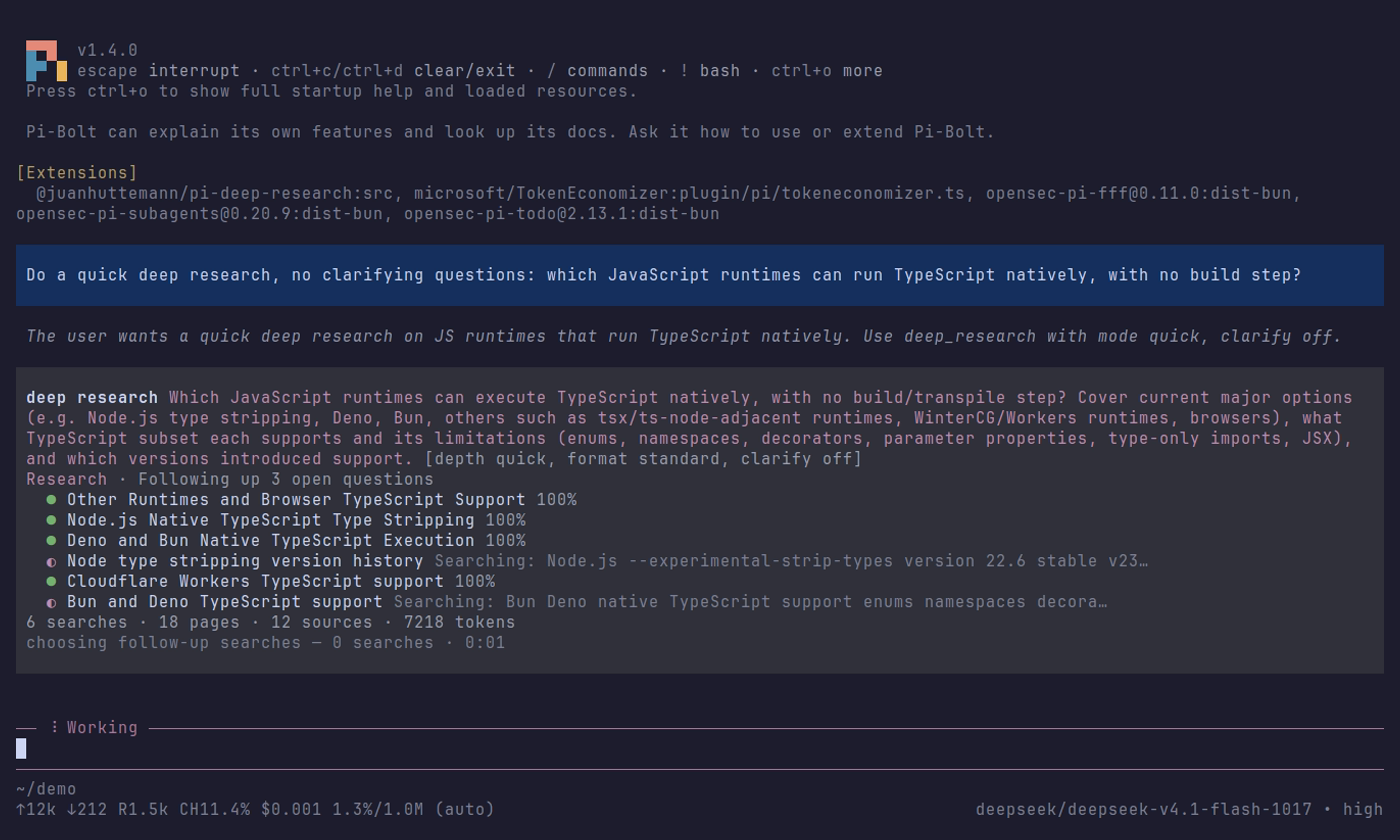
deep_researchtool. Ask Pi to research something.- While the run goes, the call shows the phase, each sub-agent, the searches, pages and sources so far, and the model's reasoning.
- When it ends, the call shows the confidence, the fact-check's verdicts, the claims it did not confirm, and the report's path.
- Esc stops a run. It keeps a checkpoint, and resuming from it skips the searches already done.
- When the question leaves something open, the clarifying questions open as Pi dialogs. In print or JSON mode they go back to the model, which asks you.
- Every run setting drsh has is a tool parameter: depth (instant, quick,
standard, deep), sub-topics, pages per topic, follow-ups, format,
words, tables and clarify.
domains,traceandreview_plan(review and edit the plan before any search) are parameters too. The settings come fromdrsh settings, so a new setting in drsh appears here with no update.
research_asktool. Answers a follow-up question from the pages a run already fetched, without searching again. The answer is not fact-checked./research [--topics 3 --follow-ups off --domains a,b …] questionruns a research yourself.- With no flags it opens the settings screen first.
- You answer the clarifying questions and review the plan, then the run starts and the agent reports what it found.
/research-stopends the run.
/research-modelpicks the model research runs use:- Pi's current model, the default.
- Another of Pi's models, for example a cheaper one for the many calls a run makes.
- drsh's own configured model.
/research-doctorchecks the model (through Pi), search and the scraper.
Each run's files (.md, .pdf, .json, checkpoint) go in
~/.cache/deep-research-pi/runs/ ($DEEP_RESEARCH_PI_RUNS to change it),
never into your project. DRSH_BIN points to a drsh that is not on
PATH.
How the model is reached
For each call, the extension starts an HTTP endpoint on 127.0.0.1 that
speaks the OpenAI chat-completions API. The endpoint accepts only a random
token, given to drsh as its API key, and closes when the call ends.
drsh runs with OPENAI_BASE_URL pointed at that endpoint, and each request
it sends is answered by ctx.modelRegistry.streamSimple. Streamed
reasoning, JSON mode, tool calls (for research_ask) and usage all pass
through. The run's usage is added to the tool result, so Pi's session
totals count it.
Development
npm ci
npm run typecheck
DRSH_BIN=/path/to/drsh npm test   # bridge tests run that drsh offline
From the repo root, make pi builds drsh from the tree and runs all three.