@code-fixer-23/pi-tiered-subagents1.0.0
Family-aware subagent runtime for pi: scoped specialists, layered agent definitions, and inspectable model selection.
Untested on omp
This is a pi package. No one has reported whether it works on omp yet. If you try it, add your result below.
Reports 0
No reports yet.
Readme
Pi Tiered Subagents
Pi Tiered Subagents gives Pi focused child agents for exploration, implementation, review, debugging, and research. It helps the parent agent delegate scoped work without blocking the conversation, chooses models according to each specialist's role and the parent's model family, and coordinates access to a shared workspace. A single Pi extension supplies agent-facing tools, progress notifications, and a transcript viewer—so users can delegate work, follow its progress, and continue a child's conversation without exposing the runtime as a cross-extension service.




Install
Requires Node.js 22.19.0 or later and Pi with the package's declared peer dependencies available.
pi install npm:@code-fixer-23/pi-tiered-subagents
This package is a replacement subagent runtime, not a second orchestrator. Do not enable it alongside another subagent runtime in the same session. Pi loads its TypeScript source directly; there is no separate build step.
No configuration is required to use the shipped specialists. For example, ask Pi:
Have Explore trace how configuration is loaded, then have Worker implement the scoped change. Give Reviewer the requirements and diff for an independent review.
Background work returns an agent ID so the parent can continue. Completion is announced automatically unless the outcome has already been collected; the parent can retrieve details, steer work in progress, or resume a settled child for follow-up.
Pi Tiered Subagents
The package ships one extension, loaded through extensions/index.ts. Its five specialist definitions are part of the runtime—not separate extensions or installable skills.
| Specialist | When to use it | Default capabilities and context |
|---|---|---|
explore |
Find files and trace existing behavior | Read-only file tools; fresh conversation; no shell |
worker |
Implement and validate a scoped change | Inherits the parent's active capability tools; fresh conversation |
reviewer |
Independently assess a supplied change | Read-only tools; fresh conversation; needs the requirements and diff or readable diff artifact |
debug |
Reproduce a failure and recommend a repair | Inherits active capability tools and the parent's conversation; instructed not to implement the production repair |
researcher |
Investigate external facts | Read-only file tools plus web_search, when available; fresh conversation |
All five start in the background by default. Tool availability still depends on the host session: naming an extension tool does not install it. Child capabilities exclude the three subagent-management tools, so children cannot recursively delegate.
Commands
/subagents:settings
Opens an interactive menu for runtime controls. It takes no command arguments; choose the setting in the menu, then enter a value or toggle it.
| Choice | Workflow impact |
|---|---|
| Max concurrency | Controls how many children can execute at once; default 4. Workspace writer scheduling still applies. |
| Default max turns | Sets the fallback work budget; 0 means unlimited. Positive ceilings normalize to at least two turns. Request and definition limits take precedence. |
| Wrap-up turns | Warns a child as it approaches its ceiling so it can finish and report; default 2. |
| Consumed-session retention | Keeps a collected child's session available for follow-up; default 10 minutes. |
| Unconsumed-session retention | Caps how long an uncollected child's session is retained; default 720 minutes. |
| Abort all subagents on ESC | When enabled, interrupting the parent also stops queued and background children; enabled by default. Foreground work is interrupted either way. |
| Mid-run updates | Allows background children to send material updates through notify_parent; enabled by default. Disabling it does not disable ask-back. |
Menu changes are saved to the project's shared settings file, not the global file. Family routing profiles and other structured settings are configured in the configuration guide, rather than through this menu.
/subagents:sessions
Opens a picker of subagent sessions, then a read-only transcript viewer. It takes no command arguments and does not switch the parent into the child's session. Live transcripts follow new output; retained transcript files can be opened as snapshots.
The viewer shows the agent, task, model, and reasoning level. It uses a regular custom component in normal terminal mode and an overlay in fullscreen mode. If no sessions are available, or a transcript cannot be read, Pi displays a notification instead.
Tools
These tools are called by the parent agent. Required and optional arguments below use type:name notation.
subagent
Launches a specialist for scoped work, or resumes an existing child for a follow-up. Use it when work benefits from a separate conversation, restricted capabilities, or independent assessment.
| Argument | Required | Behavior |
|---|---|---|
string:prompt |
Yes | Task instructions, or the follow-up message when resuming. |
string:description |
Yes | Short task label, typically 3–5 words, shown in the UI. |
string:subagent_type |
Yes | Shipped or custom agent identifier. Unknown and disabled identifiers are rejected, not replaced. |
string:model |
No | Exact provider/modelId for a new launch; overrides the definition and automatic routing. Unavailable pins fail rather than silently rerouting. |
string:thinking |
No | Reasoning request: off, minimal, low, medium, high, xhigh, or max, subject to model support and the reasoning rules below. |
number:max_turns |
No | Positive turn ceiling for a new launch; otherwise the definition or runtime default applies. The tool schema requires at least 1, and execution normalizes positive ceilings to at least 2. |
boolean:run_in_background |
No | true returns after acceptance; false awaits the outcome. New launches inherit the definition's default when omitted. Resumes default to foreground unless explicitly set to true. |
string:resume |
No | Existing agent ID whose conversation should continue. Uses the captured session configuration rather than preparing a new model or capability set. |
boolean:inherit_context |
No | For a new launch, overrides whether the child receives the parent's conversation. Otherwise the definition decides. |
For example, a model-facing call can delegate exploration without waiting:
subagent({
  subagent_type: "explore",
  description: "Trace configuration loading",
  prompt: "Find the configuration entry points and explain precedence. Report file paths.",
  run_in_background: true
})
Background acceptance does not mean execution has started: the child may queue for a concurrency slot or workspace access. Foreground calls return the settled outcome directly and suppress a duplicate completion announcement. Resume can be refused when the child is still running, its retained session is gone, or it belongs to a different parent-session owner.
get_subagent_result
Checks a child's progress or collects its outcome. Use it when the parent needs a result before deciding what to do next, or needs more detail than a completion notification provides.
| Argument | Required | Behavior |
|---|---|---|
string:agent_id |
Yes | ID returned by a launch. |
boolean:wait |
No | Wait for completion instead of immediately reporting progress; defaults to false. |
boolean:verbose |
No | Include the full conversation rather than only the report; defaults to false. |
number:timeout |
No | Maximum wait in seconds, when waiting. Omit to wait without a timeout. Expiry returns current progress and does not stop the child. |
Reports include status, available results or errors, and execution details. A child's pending question can be returned with its outcome so the parent can answer through a resume.
steer_subagent
Redirects a running child without discarding its conversation. Use it to narrow scope, supply new evidence, or correct an assumption while work continues.
- Required:
string:agent_id— the running child. - Required:
string:message— guidance to inject after its current tool execution.
Steering can be buffered while the child session initializes. It is not a way to restart settled work; use subagent with resume for that.
Communication from child to parent
Children receive ask_parent with required string:question when they need a decision or missing input. The child records the question and ends its turn; the normal outcome delivery carries it back. The parent then resumes that child with the answer. This is a handoff, not a blocking interactive user dialog.
Background children can also receive notify_parent with required string:message when midRunUpdates is enabled. It sends a one-way material update and lets the child continue immediately; the parent can respond by steering. Messages are capped at 2,000 characters, with truncation disclosed to the child.
Shortcuts
The extension registers no global keyboard shortcuts. The transcript viewer provides these local controls:
| Keys | Interaction |
|---|---|
| Esc or q | Close the viewer and return to the parent conversation. |
| ↑ / k, ↓ / j | Scroll one line up or down to inspect nearby transcript content. |
| Shift + ↑, Shift + ↓ | Page through earlier or later output. Pi's configured alternate-screen page-up/down bindings also work. |
Pi's configured alternate-screen top/bottom bindings jump to the beginning or end; the viewer footer displays the actual bindings. Mouse-wheel scrolling is also supported. Paging up or jumping to the top pauses live following, even when the content fits; returning to the bottom normally resumes following.
Outside the viewer, Pi's ordinary Esc interruption follows the interrupt policy described under /subagents:settings.
Features
Workspace scheduling and execution budgets
Only one child with potentially writing capabilities can operate in a workspace at a time. Read-only children can run alongside that writer. Scheduling follows the effective tools, not the role name: shells, editors, and unknown tools count as potential writers. This coordinates child access; it is not a filesystem sandbox or a lock on the parent agent's own edits.
Concurrency admission applies to foreground and background work. Near a configured turn ceiling, the runtime warns the child to wrap up, then stops the run at the limit. Retained sessions allow later follow-up without rebuilding the child's conversation; retention expiry can make a child non-resumable.
Role-aware model and reasoning selection
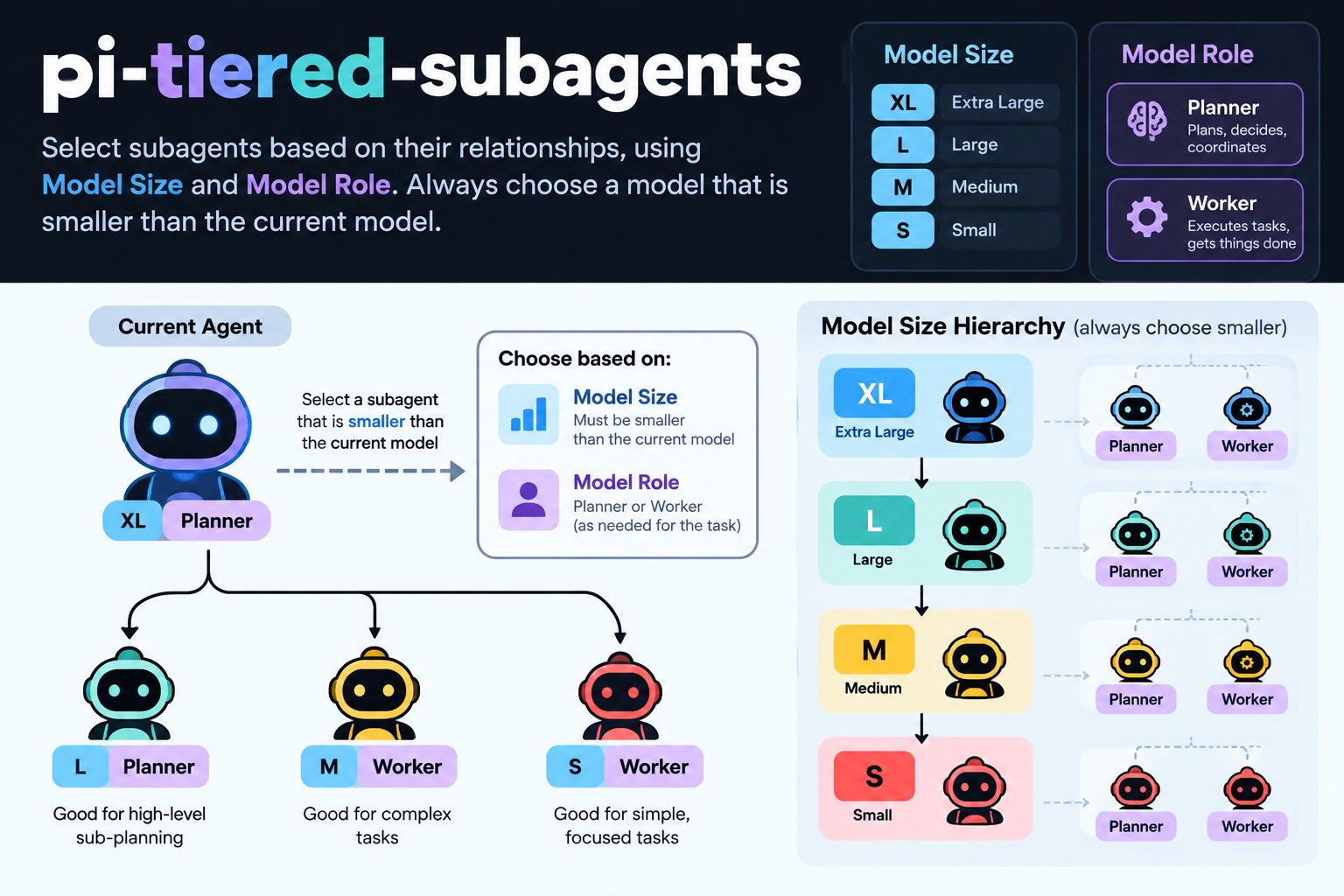
A request model pin wins over a definition pin; otherwise the runtime routes from the parent's model using the resolved specialist identifier.
| Specialist | Size families: GPT, Claude, Qwen | Planner/worker families: Gemini, MiniMax, GLM, MiMo, DeepSeek |
|---|---|---|
worker |
One size below the parent, clamped at S | Worker |
explore, researcher |
S | Worker |
debug |
M | Worker |
reviewer |
Start at the parent's own rung | Planner |
Custom identifiers use worker routing. Changing a display label does not change this policy. Routing is not always a downgrade: debugging can target M from an S parent, and reviewing can target a planner from a worker parent.
Automatic candidates stay within the parent's family and version. The router tries eligible rungs in preference order, preferring the parent's provider, then a unique runnable alternative provider. It skips unavailable or provider-ambiguous candidates. If none qualify—or the family, tier, or version is unknown—it retains the parent model and explains why. It never guesses by price or crosses versions. Exact user pins bypass this routing and never silently fall back.
Reasoning is selected after the model. Request thinking wins over definition thinking; otherwise the child takes the next supported non-off level below the parent's effort, staying at the floor when necessary. With no known parent effort, it prefers medium, then low, then the lowest supported non-off level. Explicit levels are clamped to model support; explicit off is not allowed on a reasoning model. Non-reasoning models report reasoning as not applicable.
Launch reports expose the selected model, reasoning, and reasons for retention or clamping. See the configuration guide for family profiles, exact pins, and troubleshooting.
Context and extension inheritance
Conversation inheritance is separate from the child's specialist instructions and project context. Debug inherits the parent conversation by default; the other shipped specialists start fresh. Child sessions resolve project context for their working directory and rebuild tool-surface instructions for their own capabilities.
Structured settings can exclude configured packages' extensions from children while keeping their other resources available. Provider-scoped promptInheritance can select portable inheritance for providers that re-home prompts into another harness; ordinary providers should keep full. These controls are explained in the configuration guide.
Progress, results, and parent-session ownership
As children work, the live widget and notifications make delegated activity visible without requiring repeated polling. Mid-run updates and completion nudges are coordinated with the parent's execution: agent_start holds notifications during a parent run, and agent_settled releases eligible notifications after that run settles. Outcomes already delivered through foreground execution or collected by a consumer do not produce duplicate completion nudges.
At session_start, the extension loads configuration and definitions and attaches the UI to the parent session. Launches belong to that session owner; a tentative session switch does not cancel its children. Shutdown stops queued and active work and disposes child resources so results cannot leak into another parent session.
Custom agents and settings
Definitions are Markdown files in <agentDir>/agents/*.md (normally ~/.pi/agent/agents/) or <cwd>/.pi/agents/*.md. PI_CODING_AGENT_DIR relocates the global agent directory. The lowercased filename is the identifier; project definitions refine global definitions, which refine shipped defaults field by field.
For example, .pi/agents/reviewer.md can change only a reviewer's reasoning while keeping its shipped instructions and tools:
---
thinking: high
---
A nonempty Markdown body replaces inherited standing instructions. Omitted fields inherit, null clears inherited model or thinking choices, tools: inherit uses the parent's active capability tools, and tools: [] grants no capability tools. Broadening a specialist's tools changes its permissions and workspace scheduling; definitions are not merely labels.
Runtime settings use @juanibiapina/pi-extension-settings:
- Global:
<agentDir>/settings-extensions.json. - Project:
<cwd>/.pi/settings-extensions.json. - Extension key:
pi-tiered-subagents.
Stored values are strings, including booleans, numbers, and JSON-encoded structured settings. Project values override global values, and menu saves write only project settings. The optional shared settings UI must load before this extension to receive its settings registration; this package's own settings command and storage do not require that UI.
See Configuration for all definition fields, copyable on-disk examples, precedence, and migration notes. The historical upstream subagents.json format is not this runtime's settings backend.
Developer boundaries
The runtime is private to the loaded extension. The package has no root runtime API export, no getSubagentsService() accessor, and no globally published service. There is no supported cross-extension runtime handle for launching, aborting, resuming, or provisioning workspaces. Delegation goes through the registered Pi tools described above.
Migration: remove imports of the old package-root service API and any dependency on its global symbol. Lifecycle events remain available as notifications, not as a replacement runtime-control API. The independent loadLayeredSettings utility remains exported at @code-fixer-23/pi-tiered-subagents/settings; it does not expose runtime state and is not this runtime's own settings backend.
Observing delegated work
Lifecycle notifications remain on pi.events under their existing channel names. There is no exported SUBAGENT_EVENTS catalogue. These notifications do not grant access to the runtime; use tool results to collect outcomes, and inspect status and errors before interpreting termination as success.
Initial execution: background acceptance emits subagents:created before concurrency admission. When the initial run starts, subagents:started signals that execution is beginning. During work, subagents:compacted reports successful context compaction, subagents:steered reports successful tool steering, and subagents:update carries child progress messages. The initial run ends with subagents:completed or subagents:failed; observers should inspect the terminal status rather than assume every non-failure event means successful completion.
Follow-up execution: a retained child emits subagents:resuming when its resumed run starts and subagents:resumed when that run ends. The latter also covers resumed errors, so check its status and error. This separates continued work from the initial run while preserving the child's identity. Terminal outcomes are persisted and considered for notification; foreground tool execution and result collection suppress duplicate completion nudges.
Preparing and binding child sessions
For integrations that need to coordinate child resources, the lower-level lifecycle starts with subagents:child:spawning, then emits subagents:child:session-created immediately before extension binding. A consumer that must register something before binding must handle session-created synchronously. After child session_start handlers finish, subagents:child:bound signals readiness before the first turn; failed binding skips this event.
After prompt execution resolves, subagents:child:completed marks the end of that execution path, and subagents:child:disposed accompanies final cleanup. Do not use this lower-level completion signal as a substitute for the tool's run outcome: it describes session execution, not an independent guarantee of task success.
Development
Run tasks from the monorepo root:
pnpm nx run pi-tiered-subagents:typecheck
pnpm nx run pi-tiered-subagents:test
pnpm nx run pi-tiered-subagents:lint
pnpm nx run pi-tiered-subagents:check         # Formatting check
pnpm nx run pi-tiered-subagents:metadata      # Package metadata validation
pnpm nx run pi-tiered-subagents:release-check # Packaging/install checks
The entry point composes the implementation in src/; terminal presentation lives in the internal src/ui/ module, not a separate extension. Tests cover launch preparation, scheduling, session ownership, model selection, result delivery, and UI boundaries. See stabilization evidence and known limitations rather than treating a historical test count as a current guarantee.
Further reading
- Configuration guide: models, specialist overrides, settings, and troubleshooting.
- Runtime status: implementation history and remaining constraints.
- Product specification and approved architecture specification.
- Local decision records.
- Illustrated source guide: open in a browser.
License and attribution
Licensed under MIT, with the upstream copyright notice consolidated into the same license file. This runtime derives from @gotgenes/pi-subagents v25.0.1 by Chris Lasher, itself a friendly fork of @tintinweb/pi-subagents. The inherit tool-selection convention was informed by Nico Bailon's pi-subagents; this package inherits the parent's active tools while excluding subagent-management tools.
The upstream comparison, architecture snapshots, and inherited decision records preserve reference material and provenance. Their source links and configuration descriptions may reflect the original layout; use this README, the configuration guide, and current source for this derivative's behavior.