@aleixrocal/pi-multi-skills0.3.2
Chain several /skill: invocations in one pi message — N skills, one command.
Untested on omp
This is a pi package. No one has reported whether it works on omp yet. If you try it, add your result below.
Reports 0
No reports yet.
Readme
pi-multi-skills
Chain several /skill: invocations in a single pi message: /skill:a x /skill:b y.


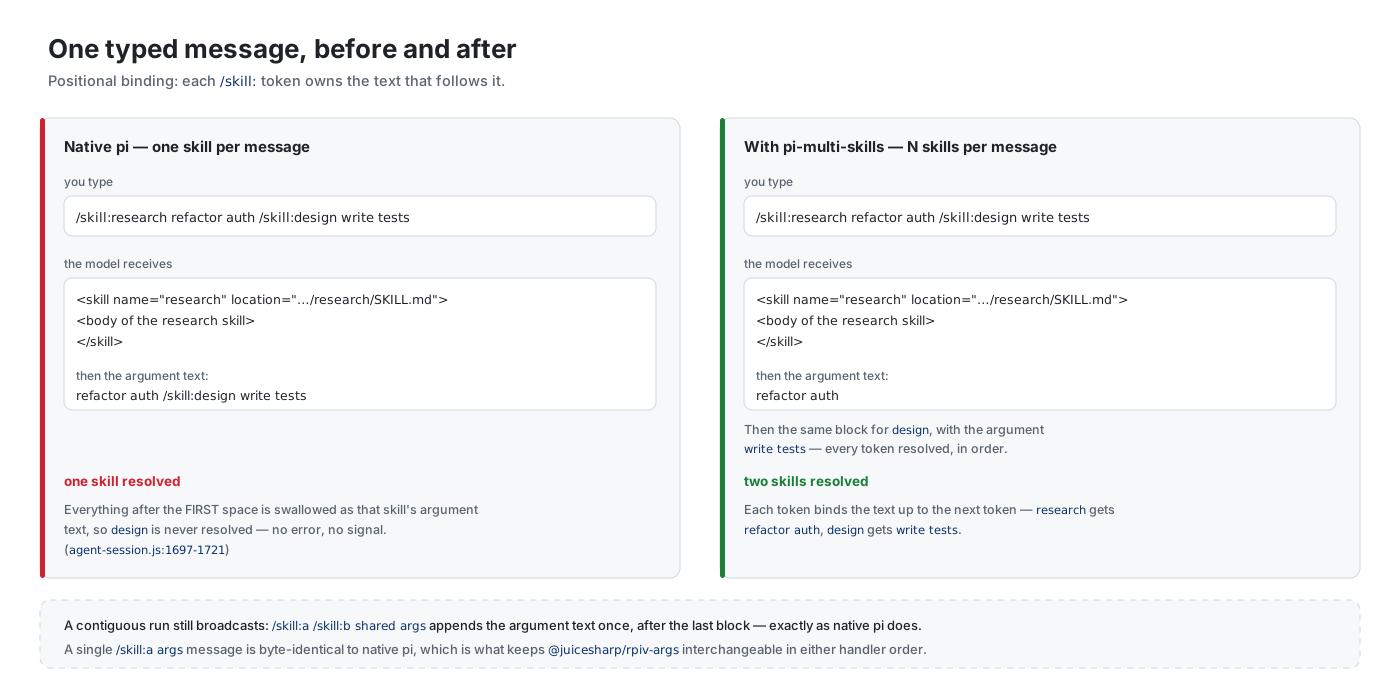
pi expands exactly one skill per message. Given /skill:a x /skill:b y it invokes a with
x /skill:b y as its argument text — the second marker is swallowed, with no error and no signal.
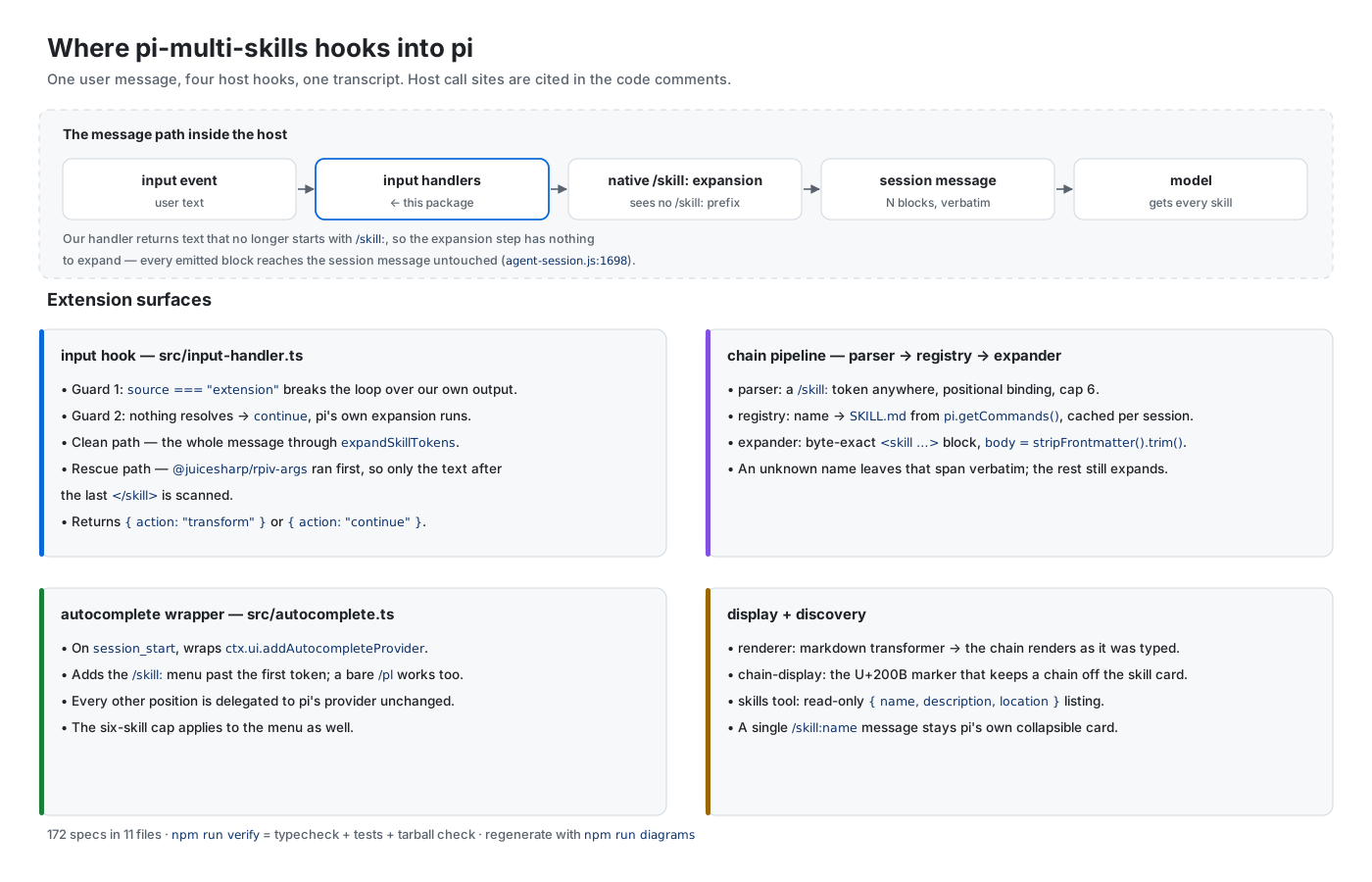
This extension runs an input handler before pi's own expansion and rewrites the message into one
<skill …> block per named skill, each followed by the argument text that skill owns:
| You type | pi alone | With this extension |
|---|---|---|
/skill:research auth /skill:design write tests |
research, invoked with auth /skill:design write tests |
research with auth, design with write tests |
/skill:research /skill:design shared |
research, invoked with /skill:design shared |
both, with shared after the last block |
A single /skill:<name> message is passed through untouched, byte-identical to what pi produces on
its own.
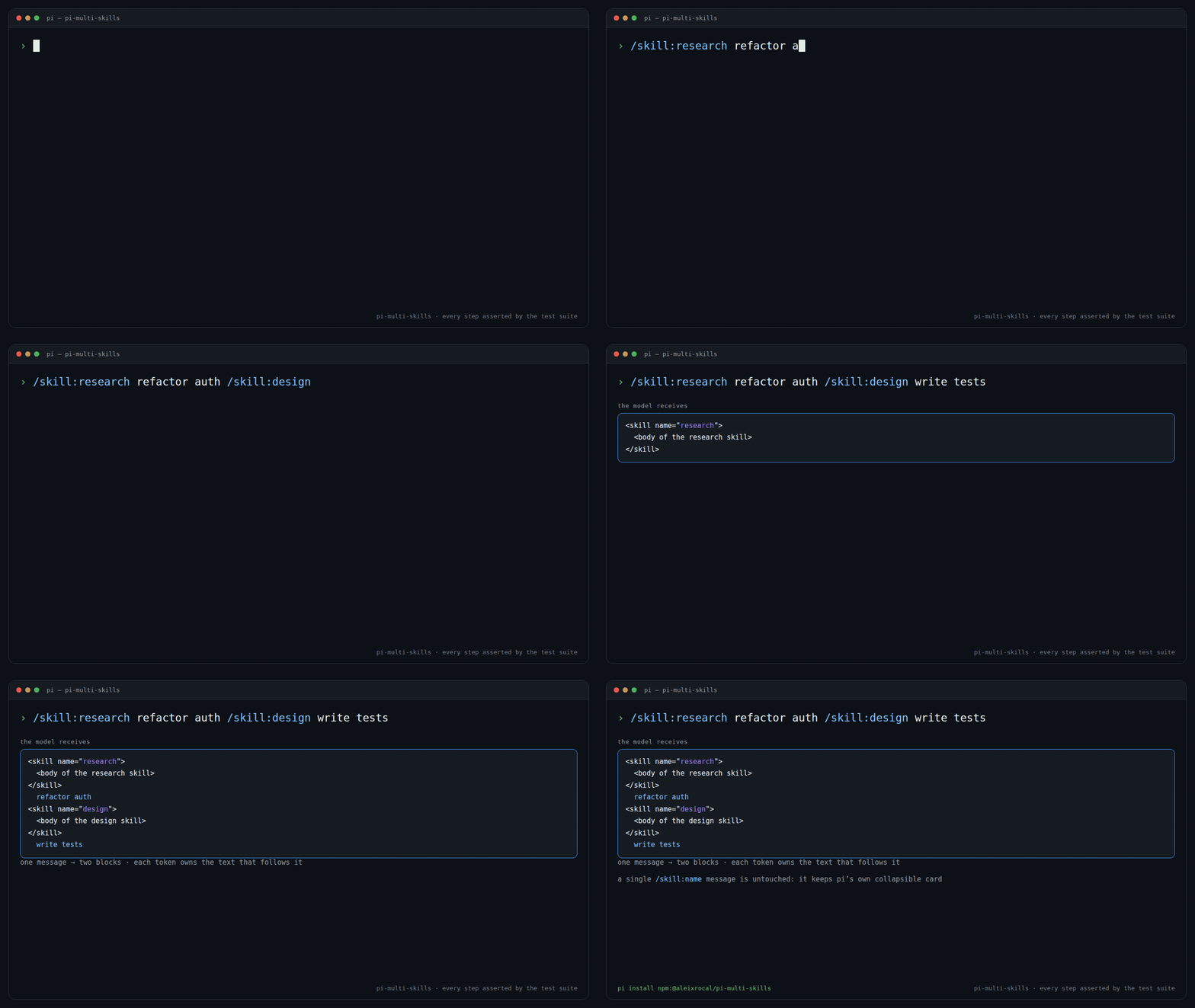
Twelve seconds of the flow, from the menu opening at the second /skill: token to the blocks the
model receives. The animation is rendered frame by frame from the behaviour the test suite asserts
rather than screen-recorded, so it cannot drift from the code; the full-quality
demo.mp4 (1280×720) is one click
away.
Install
pi install npm:@aleixrocal/pi-multi-skills
pi install git:github.com/AleixRocal/pi-multi-skills
pi install ./pi-multi-skills                 # from a local checkout
Requires Node >=22.19.0; the host packages are provided by pi. The package carries the
pi-package keyword, which is what lists it in the pi package gallery.
Usage
/skill:<name>is a token wherever it appears in the message, not only at the first character. Only that literal marker counts, so absolute paths (/etc/hosts), relative paths (src/app.ts), URLs (https://example.com/x) and a lone slash in prose pass through untouched.- Each token owns the text that follows it, up to the next token — or to the end of the message, for the last one. That is positional binding.
- Text before the first marker is kept in front of the blocks, as written.
- Six skills maximum. A seventh marker is not expanded; it is bound as the sixth skill's argument text instead, so text that overruns the cap degrades into text the model still reads and nothing typed is ever deleted.
| You type | What happens |
|---|---|
/skill:research auth /skill:design tests |
research runs with auth; design runs with tests. |
/skill:research /skill:design refactor auth |
Both markers are contiguous, so the run after them lands once, after the last block — the shape Claude Code's stacked skills use. |
/skill:nonexistent /skill:real x |
real still runs with x; the unknown token stays in the message exactly as typed. |
/skill:research auth |
Identical to native pi, byte for byte — the collapsible skill card and @juicesharp/rpiv-args interop are unchanged. |
/skill:a /skill:b /skill:c /skill:d /skill:e /skill:f /skill:g x |
a–f run; /skill:g x becomes f's argument text. |
Behaviour
A skill that cannot be resolved never costs you the chain
A token that names no skill in the session, or whose SKILL.md cannot be read, stays in the
message exactly as typed — the rest of the chain still expands.
Order independence with @juicesharp/rpiv-args
@juicesharp/rpiv-args expands the same
syntax, and extension load order is not controllable. When it runs first it consumes the leading
/skill:a and leaves /skill:b args as plain text; this extension detects the residual token
after the last emitted block and expands it, so both load orders produce the same chain. An
already-emitted <skill …> block is never reprocessed, and a skill body that happens to mention
/skill: is never re-expanded.
Autocomplete at every chain position
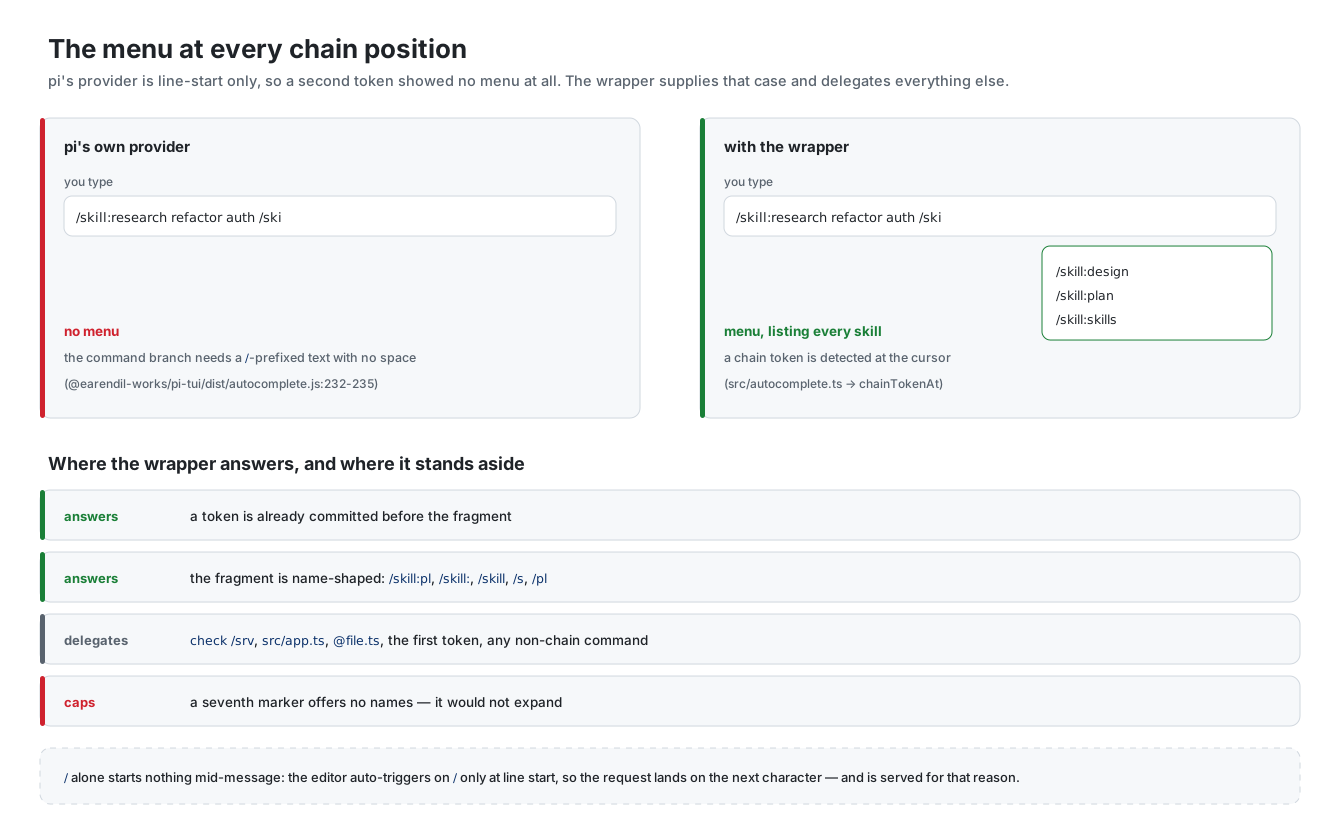
Pi's own menu is line-start only, so it closes after the first skill: the second /skill: falls
through to argument completions and shows nothing. This extension wraps pi's provider and supplies
the missing case. Entries are named /skill:<name> — the exact text the choice writes — and the
menu takes two shapes:
- Marker typed or half-typed —
/skill:pl,/skill:,/skill,/sk, … — listed on the partial name, or on every skill while only the marker is partial. - Bare name fragment —
/pl— listed on the name. This is the shape you reach for after picking the first skill from pi's own menu, which inserts the whole marker.
Both are accepted only past the first token, and only while the fragment stays name-shaped, so
check /srv and /skill:implement /plans/x.md keep pi's path completion instead of offering
skills. Everything else is delegated unchanged — the first token (pi's menu there lists every
command, not only skills), @ attachments, file paths, argument completions and non-chain
commands all come from pi's own provider. Inside a chain token, Tab completes the skill
rather than searching for a file path, and the six-skill cap applies to the menu too: once six
markers are on the line, a seventh offers no names, because it would not expand.
skills — mid-turn discovery
A read-only tool named skills lists the skills available in the session, with the canonical
SKILL.md path for each one:
skills({ "query": "design", "limit": 20 })
→ { skills: [{ name, description, location }], total, truncated }
query matches names and descriptions case-insensitively; limit pages the result (total and
truncated report what was left out). The tool never invokes a skill — pi expands skills from user
input only — but location is readable with the built-in read tool.
Transcript rendering
A chain is displayed as the chain that was typed — one /skill:<name> per token, each followed by
its own argument text:
/skill:research refactor auth /skill:design write tests
No XML block, no injected body. This is display only: the session message the model sees still carries the full blocks. A chain's message therefore carries one leading zero-width space, which is invisible and changes nothing the model reads.
- A single
/skill:namemessage is untouched — it keeps pi's normal collapsible skill card, byte for byte as native pi and@juicesharp/rpiv-argsproduce it. - The HTML export is not transformed (
pi --export), so an exported chain shows its blocks as plain text.
The chain, executed: the skill-chain skill
The extension delivers a chain; the model still has to run it. This package ships a skill that says how, declared in the manifest so pi loads it beside the extension:
- read each named
SKILL.mdin order and follow it as if it were the only skill invoked, - hand each skill its own argument text — the same positional binding the extension implements,
- report what ran, so a wrong split is visible instead of silent.
The same SKILL.md is portable: it installs into any agent with a skills directory (Claude Code,
Cursor, Copilot), where it does the chaining by hand. It says which of the two splits it is looking
at, because the host decides: pi binds positionally — each /skill:<name> token owns the text
up to the next one — while Claude Code stacks user-invocable skills at the start of a message
(/write-tests /fix-issue 123), expands the first plus up to five more, and hands the same trailing
text to every skill in the run. The stack must be contiguous: the first token that is not a skill
ends it, and that token with everything after it becomes the argument text for the rest.
Drop the skill in and it works:
cp -r skills/skill-chain ~/.claude/skills/ # personal; /skill-chain, or Claude invokes it
npm run skill:zip builds the archive for a marketplace upload; the skill is
skills/skill-chain/ in this repository.
Out of scope
- No system prompt is mutated — the extension contributes no
before_agent_starthandler. - A tool call cannot invoke a skill. pi expands
/skill:on user input only, soskillslists and never triggers. - Only pi's
/skill:<name>syntax is recognised. The$name-style invocation used by other tools is not supported.
Cost
A chained message carries the full body of every named skill: six large skills means six bodies in context. Nothing is truncated or cached — a skill edited mid-session is picked up on the next message.
Docs
| Document | For |
|---|---|
| AGENTS.md | AI agents: module map, the invariants that fail quietly, recipes for the usual changes. |
| CONTRIBUTING.md | Building, the PR flow, releasing. |
| CHANGELOG.md | What changed, per version. |
Diagrams, light and dark: message flow
· autocomplete ·
architecture ·
the handler's paths — the
.dark.svg beside each is the same diagram in the dark palette.
Bug reports and feature requests go to
Issues; every version is on
GitHub Releases.

Star History
License
MIT — see LICENSE.