pi-hot-idle-compaction0.1.1
Pi extension that keeps long sessions cheap across idle gaps: cache-hitting summaries, lazy tool-result stubbing, and cost-capped keepalives.
Untested on omp
This is a pi package. No one has reported whether it works on omp yet. If you try it, add your result below.
Reports 0
No reports yet.
Readme
pi-hot-idle-compaction
100% AI-written software. Every line of code, tests and documentation in this repository was written by AI coding agents, directed by a human maintainer. Licensed under the MIT License.
A pi extension that keeps long sessions cheap on providers whose prompt cache expires. It summarises while the cache is still warm, drops stale tool output instead of paying to re-read it, and can keep the cache alive for exactly as long as that is cheaper than missing it.
pi install npm:pi-hot-idle-compaction
Requires pi 1.4.0 or newer. It works with any provider that reports cacheRead token usage. Nothing here is
tuned to one provider: the cache lifetime and every threshold are settings, and
Choosing your values explains how to pick them from your own prices.
Why
A request that follows a long session re-sends the whole conversation. If the provider still holds it in its prompt cache you pay the cached-read price; if the cache expired while you were away you pay the uncached price for every token again.
Write C for the context size in tokens, u for the uncached input price, r for the cached-read price and
o for the output price (all per token). The cost of one return after a break:
| What happens on return | Cost |
|---|---|
| Cache expired, nothing done (cold miss) | C*u |
Old tool results stubbed on resume, fraction f removed |
(1-f)*C*u |
| Summary sent before expiry and served from cache | C*r + S*u + O*o |
| Cache read on each model call while the context stays big | C*r per call |
S is the instruction appended to ask for the summary (a few hundred tokens) and O the summary length.
Worked example with DeepSeek V4 Pro prices from one provider (u = $0.66/M, r = $0.022/M, o = $1.98/M)
at C = 400k: a cold miss costs $0.26, stubbing 60% costs $0.11, a cache-hitting summary of 8k tokens costs
about $0.025, and each model call on that context costs $0.009 in cache reads, so a 17-call prompt costs
$0.15 in reads alone. Your numbers will differ; the shape is what matters. Because cache reads recur on every
call, a lower compaction threshold usually repays a cheap summary within about one prompt.
pi's built-in compaction cannot do the third row. Its summariser serialises the conversation to text (tool results truncated to 2000 characters) and disables cache writes, so it never reads the prompt cache. This extension instead replays the exact transcript of the last request and appends one user message asking for the summary, so the provider serves the whole prefix from its cache.
What it does
- Floor. Below
minContextTokensit does nothing. - Threshold compaction. When a prompt finishes (
agent_settled) and the context is at leastcompactAtTokens, it compacts using the cache-hitting summary. Deciding between prompts is deliberate:ctx.compact()aborts a run in progress, and the prefix of the request that just finished is entirely cached. - Lazy stubbing. On the first request after an idle gap longer than the cache lifetime plus
stubbing.graceSeconds, old tool results are replaced by a stub naming the tool and its arguments, so the model can re-run it. The newestkeepMostRecentToolUsesare never touched, and only if stubbing clears at leastminimumTokensClearedtokens andminimumFractionOfContextClearedof the context. The stubbed ids are persisted in the session and applied identically on every later request, so the prefix stays stable and the following calls hit the cache again. - Idle summary. While idle, at
min(0.9 x lifetime, lifetime - 60s)after the last request, it compacts with a cache-hitting summary, but only if the context is at leastsummaryMinTokensand the lifetime is at mostidleSummary.maximumTtlSeconds. It refuses if it fires more thanidleSummary.lateToleranceSecondslate (a sleeping laptop), if a newer request exists, or if the agent is busy. - Keepalive (off by default). Re-sends the last request with a one-token output cap before expiry, capped
at the break-even count (the most pings whose total cost does not exceed one cold miss) and by
keepalive.maximumPings.
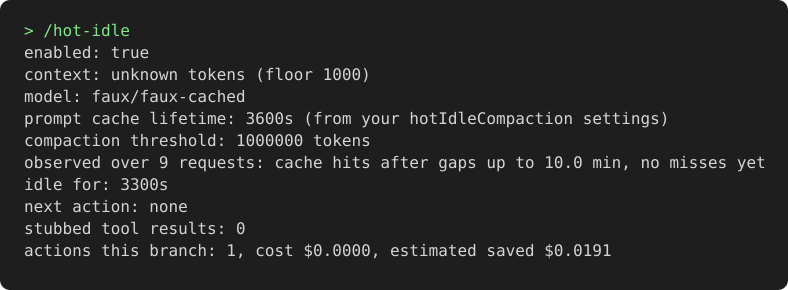
/hot-idle shows the context size, the lifetime and where it came from, the next scheduled action, the
stubbed count, what the cache has actually done (below) and the money ledger. Every action is also a
hot-idle-action entry in the session.
When the cache-hitting summary is skipped
It falls back to pi's own summary when it cannot be cheaper:
- the cache already expired;
- less than
summary.minimumCacheReadFraction(0.8) of the context was in the last request, for example right after ten large tool results landed in one turn; - an earlier cache-hitting summary in this session read less than that fraction from the cache. That summary is still kept (redoing it would pay twice) but later ones are disabled for the session.
Cache lifetime
The extension needs to know how long your provider keeps a prefix. In order:
hotIdleCompaction.perModel["provider/model"].ttlSeconds, thenperProvider["provider"].ttlSeconds, then the globalttlSeconds.- The model's own
promptCachedeclaration in pi (models.md). - A guess of 300 seconds, the common short lifetime.
/hot-idlesays so when it is guessing.
Provider documentation is the best source. Failing that, watch /hot-idle: it passively records, for each
request, the idle gap before it and whether the provider served the previous prefix from cache, and reports
"cache hits after gaps up to X min, misses after gaps from Y min". It never changes a setting; set
ttlSeconds yourself from that evidence, rounding down.
Settings
Under hotIdleCompaction in ~/.pi/agent/settings.json or .pi/settings.json. Every key is optional.
| Key | Default | Meaning |
|---|---|---|
enabled |
true |
Master switch |
ttlSeconds |
model declaration, else 300 | Cache lifetime |
minContextTokens |
100000 | Do nothing below this |
compactAtTokens |
300000 | Threshold compaction |
summary.maxOutputTokens |
8000 | Summary length cap (O) |
summary.minimumCacheReadFraction |
0.8 | Required cached share of the summary prefix |
stubbing.enabled |
true |
|
stubbing.graceSeconds |
60 | Idle beyond lifetime + this before stubbing |
stubbing.keepMostRecentToolUses |
12 | Never stubbed |
stubbing.minimumTokensCleared |
20000 | |
stubbing.minimumFractionOfContextCleared |
0.3 | |
idleSummary.enabled |
true |
|
idleSummary.minContextTokens |
250000 | summaryMinTokens |
idleSummary.maximumTtlSeconds |
7200 | Longer lifetimes are rarely outlasted by idle gaps |
idleSummary.lateToleranceSeconds |
60 | Refuse when firing later than this |
keepalive.enabled |
false |
|
keepalive.maximumPings |
none | Cap below the break-even count |
Eight of these can be overridden per provider (perProvider["provider"]) or per model
(perModel["provider/model"], which wins): ttlSeconds, minContextTokens, compactAtTokens,
summaryMinTokens, keepMostRecentToolUses, minimumTokensCleared, minimumFractionOfContextCleared and
keepaliveMaximumPings. An unknown override key is an error, so typos are not silently ignored.
{
  "hotIdleCompaction": {
    "ttlSeconds": 300,
    "compactAtTokens": 250000,
    "perProvider": { "my-gateway": { "ttlSeconds": 3600 } },
    "perModel": {
      "my-gateway/big-model": { "compactAtTokens": 200000, "keepMostRecentToolUses": 8 }
    }
  }
}
Choosing your values
Everything below uses C, u, r, o from Why.
ttlSeconds: from your provider's documentation or the/hot-idleobservations. Too long is the costly error: the extension then believes a dead cache is warm, so summaries costC*uinstead ofC*r. When unsure, pick the shorter value.minContextTokens: below this nothing is worth doing. A cold miss costsC*u, so choose the context size whereC*ustops mattering to you. If a miss at 100k costs a tenth of a cent, raise it.compactAtTokens: compaction pays when the cache reads it avoids exceed its cost. A summary costs aboutC*r + O*o + S*uand shrinks the context fromCto aboutC'(summary plus kept tail). Each following model call saves(C-C')*r, so it repays after(C*r + O*o + S*u) / ((C-C')*r)calls, which is a few calls whenu/ris large. Models with expensive reads or many calls per prompt want a lower threshold. Never exceed the model's context window minus pi'sreserveTokens.summaryMinTokens(idleSummary.minContextTokens): the idle summary replaces a possible cold miss, so it is worth its costC*r + O*o + S*uonly whenC*uis clearly larger: roughly whenu/r > 3andC*uexceeds what you care about. Default 250k.stubbing.keepMostRecentToolUses: what the model is most likely still working from. Raise it for tasks that revisit recent files.stubbing.minimumTokensCleared/minimumFractionOfContextCleared: stubbing breaks the prefix, so the whole stubbed context is rewritten at(1-f)*C*u. It only beats keeping everything (a cold miss atC*u) byf*C*u; below your noise floor it is not worth the lost detail. These two stop small, low-value stubs.keepalive.maximumPings: a ping costs aboutC*r; the break-even count isC*u / (C*r), aboutu/rpings. Keepalive only pays if you return before that many lifetimes pass, so cap it at the number of lifetimes you realistically leave a session idle (a lunch break is 12 pings at a 5 minute lifetime).
Compared with Claude Code
Claude Code
(idleCompaction,
prompt caching) compacts a conversation that has been idle
about 54 minutes, when it is on the one-hour cache lifetime and the context has reached 200k tokens (floor
100k). This extension does the same with the timing derived from the model's own lifetime
(min(0.9 x lifetime, lifetime - 60s)), and adds what Claude Code does separately: the stubbing here
corresponds to the time-based microcompact visible in the 2.1.307 binary (after about 65 minutes idle the
first request clears old tool results, keeping the last 12, only if it frees at least 20k tokens). Those
microcompact numbers were read from the binary, not from the documentation.
Differences: the lifetime is per provider or model and configurable instead of fixed at one hour, and keepalive is capped by break-even instead of unbounded.
herdr and Collie
herdr's pi integration reports a pane as idle as soon as pi's agent
loop settles, and Collie mirrors that state to a phone. This extension does
real work while the loop is idle (idle summaries, threshold compaction, keepalive pings), so it announces each
piece as herdr:working on pi's extension event bus, { active: true, label } when it starts and
{ active: false } when it ends, one pair per action. herdr counts these, so the pane shows working instead of
done while a summary runs. Where no listener exists the events do nothing. The extension opens no dialogs, so it
never needs herdr:blocked.
Design notes
Things found while building this against a real OpenAI-compatible provider with automatic prefix caching. They are properties of how pi and such providers behave, not measurements of any one provider's prices or lifetimes.
- Do not send
tool_choice: "none"on the summary request. Some providers render the prompt without the tool definitions when tool use is disabled, so the whole prefix differs and the cache misses completely. The summary instruction tells the model not to call tools instead. ctx.compact()aborts a run in progress. Called fromturn_endit turned the in-flight request into anabortederror. Threshold compaction is therefore decided atagent_settled, between prompts, when the last request's prefix is also entirely cached. A single very long prompt can overshootcompactAtTokens; pi's own overflow recovery is the backstop.- The replay must end on a user message. A request whose last message is an assistant message makes the provider continue it and answer with an empty stop. The summary instruction is therefore always appended as a user message.
- A large uncached tail defeats the idea. If ten large tool results land in one turn they are not in the
cache, so a cache-hitting summary of that context reads almost nothing from it.
predictWhetherCachedSummaryCanHitchecks how much of the context was in the last request and falls back to pi's summariser otherwise. - pi's own summary can cost about the same on tool-heavy sessions. Its serialiser truncates every tool result to 2000 characters, so when most of the context is tool output its summary request is small. The cache-hitting summary then wins on quality (it sees everything) rather than money. On conversations dominated by prose and code it is the cheaper one.
- Token estimates for stubbing are calibrated on the session. Each tool result's characters are scaled by
contextTokens / characters, using pi's measured usage, because a fixed characters-per-token ratio was off by almost 2x on some text. - Cache hits are block-granular. Providers report cached tokens in blocks (for example 256 or 128 tokens), so a fully cached prefix reads slightly less than its size; that is why the acceptance bar is a fraction (default 0.8), not equality.
Testing
The test suite makes no network calls and costs nothing.
test/*.test.tsunit-test the cost model and every decision as pure functions.test/wire.integration.test.tsruns a real pi session against a local fake chat-completions server that returns scriptedusageincludingcached_tokens. It checks the wire format of the summary request: identical prefix, tool definitions present and unchanged, notool_choice, final message a user instruction, and that a scripted cache miss disables later cache-hitting summaries.test/extension.integration.test.tsruns the real extension inside a real pi session (createAgentSession) against pi's faux provider, wrapped to simulate a prompt cache with a lifetime and driven by a manual clock. It checks that the summary request is the previous request's messages plus one instruction and reads the cache, that a miss disables later cache-hitting summaries, that stubs keep the newest tool uses and stay byte-identical on later requests, and that timers fire, cancel and refuse correctly.
nix develop        # node 24
npm install
npm test           # vp test (Vitest via Vite+)
npm run check      # vp check: format, lint and type checks
npm run format     # vp fmt
License
MIT