pi-actor-subagents0.1.25
Run persistent actor-style subagent swarms inside pi.
Untested on omp
This is a pi package. No one has reported whether it works on omp yet. If you try it, add your result below.
Reports 0
No reports yet.
Readme
pi-actor-subagents
Build arbitrary agent hierarchies in Pi where every agent can message every other agent. Inspect their conversations and steer them directly. Agents survive Pi restarts.
Pairs well with pi-infinite-context for long-running conversations.
Install
Requires Pi 1.2.0 or newer.
pi install npm:pi-actor-subagents
Subagents panel
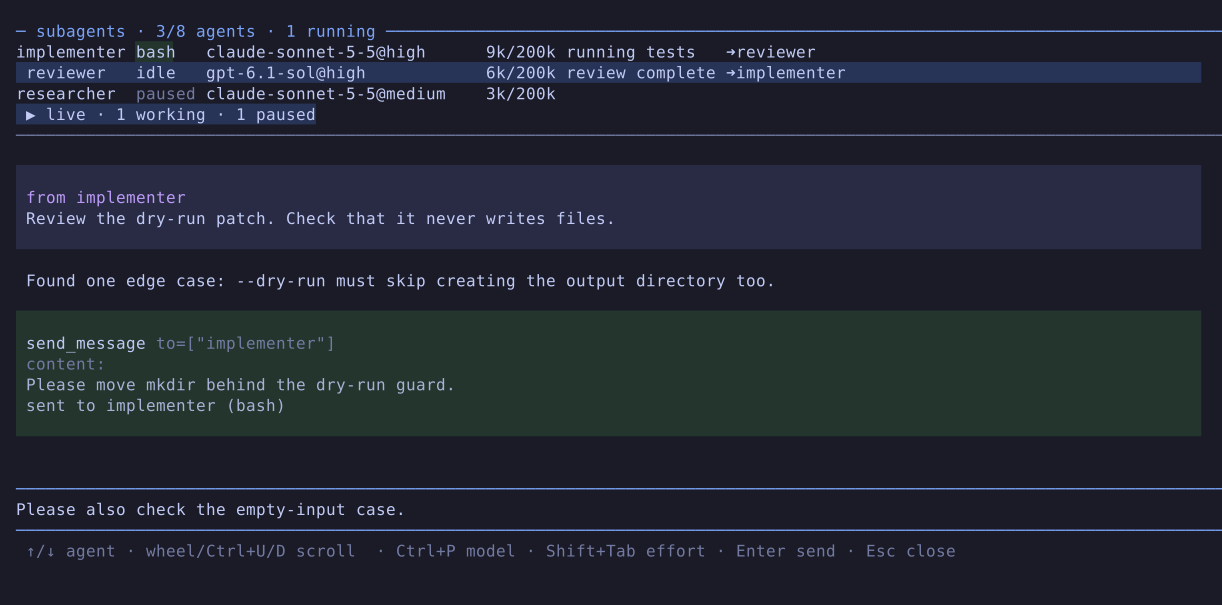
Click an agent in the roster to open its conversation. Inside the panel, click another agent or use ↑/↓ to switch. Click Esc at the top right, or press Escape, to close.
Mouse controls use Pi's fullscreen mode. /subagents and the keyboard controls also work without it. The input box messages the selected agent directly.
Tools
| Tool | Purpose |
|---|---|
spawn_subagent |
Create a named agent with its own system prompt, initial task, model, and session. |
send_message |
Send a message to one or more agents, including parents, children, and peers. |
list_subagents, subagent_history |
Inspect agent state and conversations. |
set_subagent_model, set_status |
Change model or thinking level; report progress and ETA. |
pause_subagents, resume_subagents, kill_subagents |
Control owned agents and their descendants. |
/subagents opens the panel. /subagents-pause, /subagents-resume, and /subagents-kill control named subtrees; omit names to target your direct children.
All tool results in the main session and subagents include start/finish timestamps, giving agents a sense of elapsed time for progress updates and ETA estimates. If a start time is unavailable, only the finish time is shown.
Configuration
Optional file: ~/.pi/agent/actor-subagents/settings.json (inside Pi's configured agent directory):
{
  "maxAgents": 8,
  "maxSpawnDepth": 3,
  "childExtensions": [
    "~/.pi/agent/npm/node_modules/pi-infinite-context/extensions/infinite-context/index.ts"
  ]
}
maxAgents: maximum live background agents (default:8).maxSpawnDepth: maximum hierarchy depth (default:3). Both limits must be positive integers; missing or invalid values use their defaults. Changes apply after restarting Pi.childExtensions: extension whitelist for subagents (default:[]). List extension files or directories; children do not inherit Pi's discovered extensions. Actor-subagents' orchestration tools are always available and need no whitelist entry. Changes apply to newly spawned agents. The example path assumespi install npm:pi-infinite-contextin the default Pi setup. Child extensions run withctx.mode === "rpc"andctx.hasUI === true: theirctx.ui.setStatustexts appear in the roster and inlist_subagents, and dialogs (confirm,select,input, …) resolve as cancelled.
Coordination
- Handshake: a new child is instructed to send its parent its understanding of the task and clarification questions, then wait for a
send_messagego-ahead before working. This is an agent protocol, not an enforced scheduling barrier. - Ownership: every agent controls the agents it spawns and their descendants; messaging and inspection are open to all.
set_statusis for background agents. - Errors: a new child error sends its live direct parent a scheduler message: it requests a turn when idle, steers a busy parent, and buffers while the parent is paused or still stopping. It does not restart the child. Pause, resume and kill notices stay silent.
- Persistence: reopening the same saved main session restores agents paused; resume them explicitly. Buffered messages, progress, and ETA are not saved.