@insaidermobile-ux/pi-security-review0.2.0
Security review for pi. Read-only agents find vulnerabilities, separate agents challenge each attack path, and a findings store keeps results across runs.
Untested on omp
This is a pi package. No one has reported whether it works on omp yet. If you try it, add your result below.
Reports 0
No reports yet.
Readme
pi-security-review
Security review for pi. Agents look for vulnerabilities in your code, then separate agents build and challenge each proposed attack path.
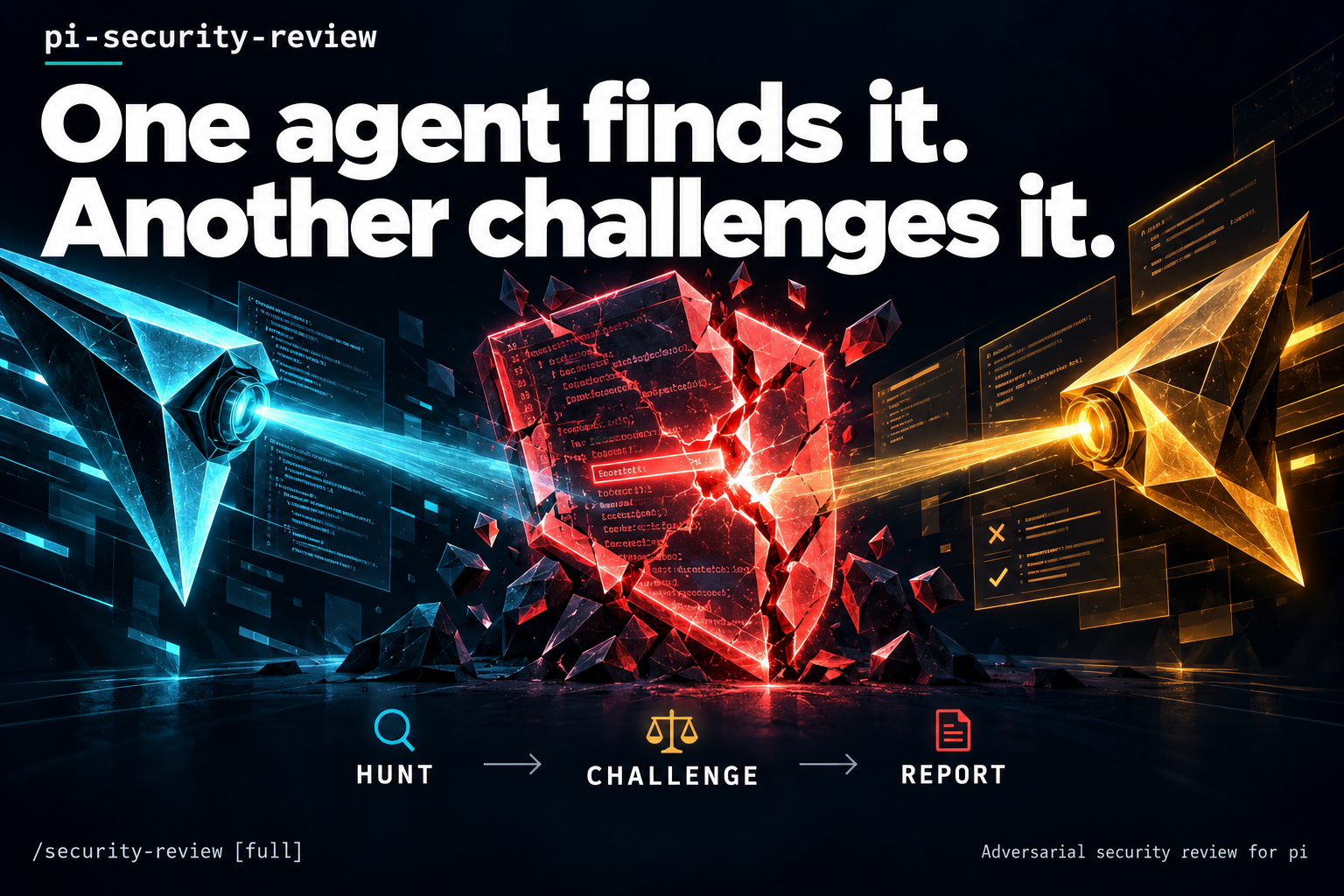


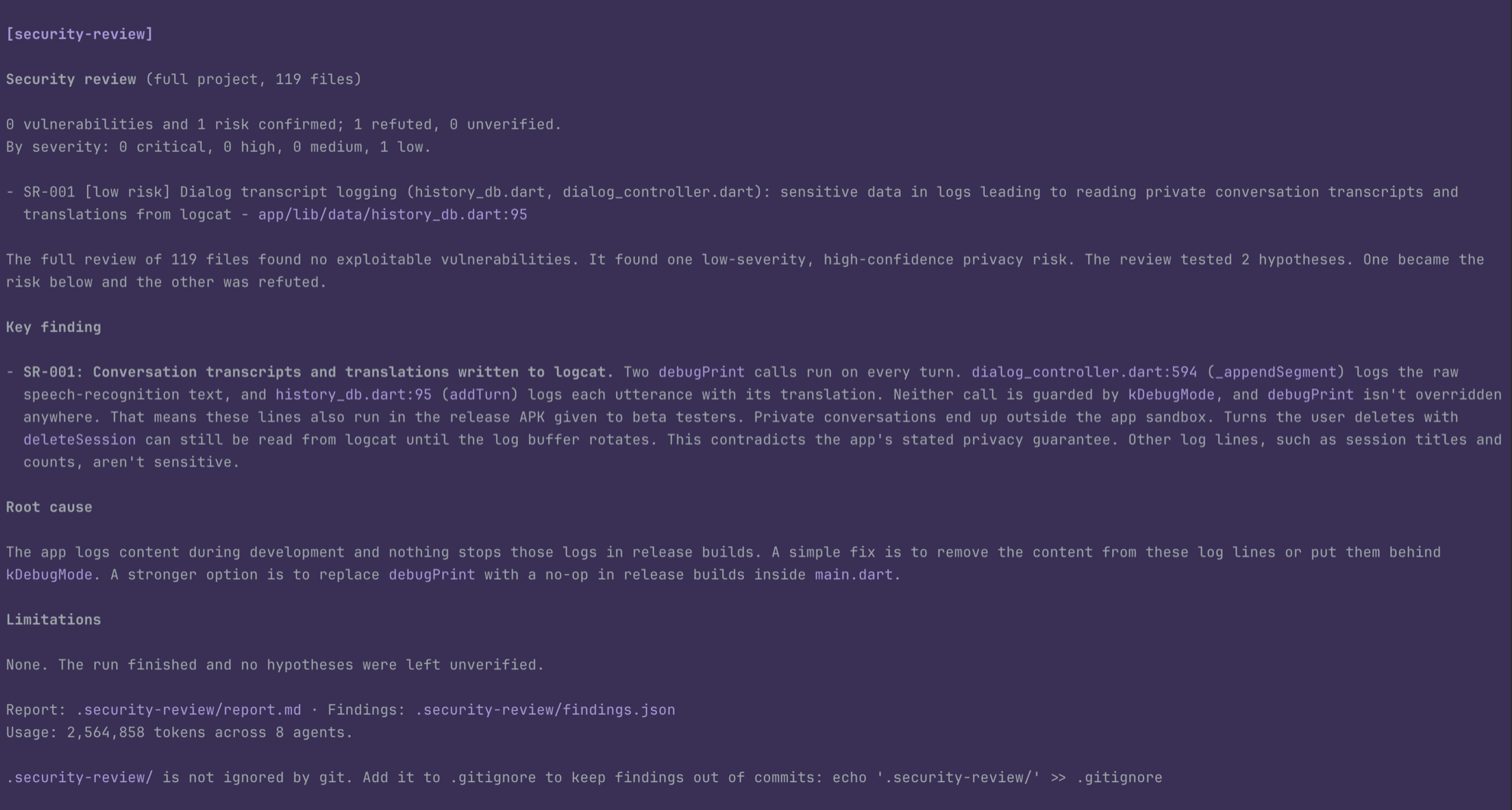
Run /security-review to review unmerged changes, or /security-review full to review the whole project. Agents inspect code without running or changing it. Findings include the attack argument and the challenger's response.
Inspired by Claude Code's /security-review and by the affirmer/challenger verification in VulnHunter. Severity definitions and domain guidance are adapted from Cloudflare's security-audit-skill (MIT, see THIRD_PARTY_NOTICES.md).
What it does
- An affirmer builds each proposed attack path. An independent challenger tries to refute it.
- Audit agents use read-only tools restricted to the project directory.
- The findings store deduplicates results and keeps your decisions across runs.
- You can choose a model for each role.
- You can review unmerged changes or the whole project.
Quick start
Requires Node.js 22.18 or later and pi 1.1 or later.
pi install npm:@insaidermobile-ux/pi-security-review
Then run this inside a pi session in a git repository:
/security-review
Git and local installation
# from GitHub
pi install git:github.com/insaidermobile-ux/pi-security-review

# from a local checkout
pi install ./pi-security-review

# project-local install (writes .pi/settings.json instead of your user settings)
pi install -l ./pi-security-review

# try it for one session without installing
pi -e ./pi-security-review
How it works
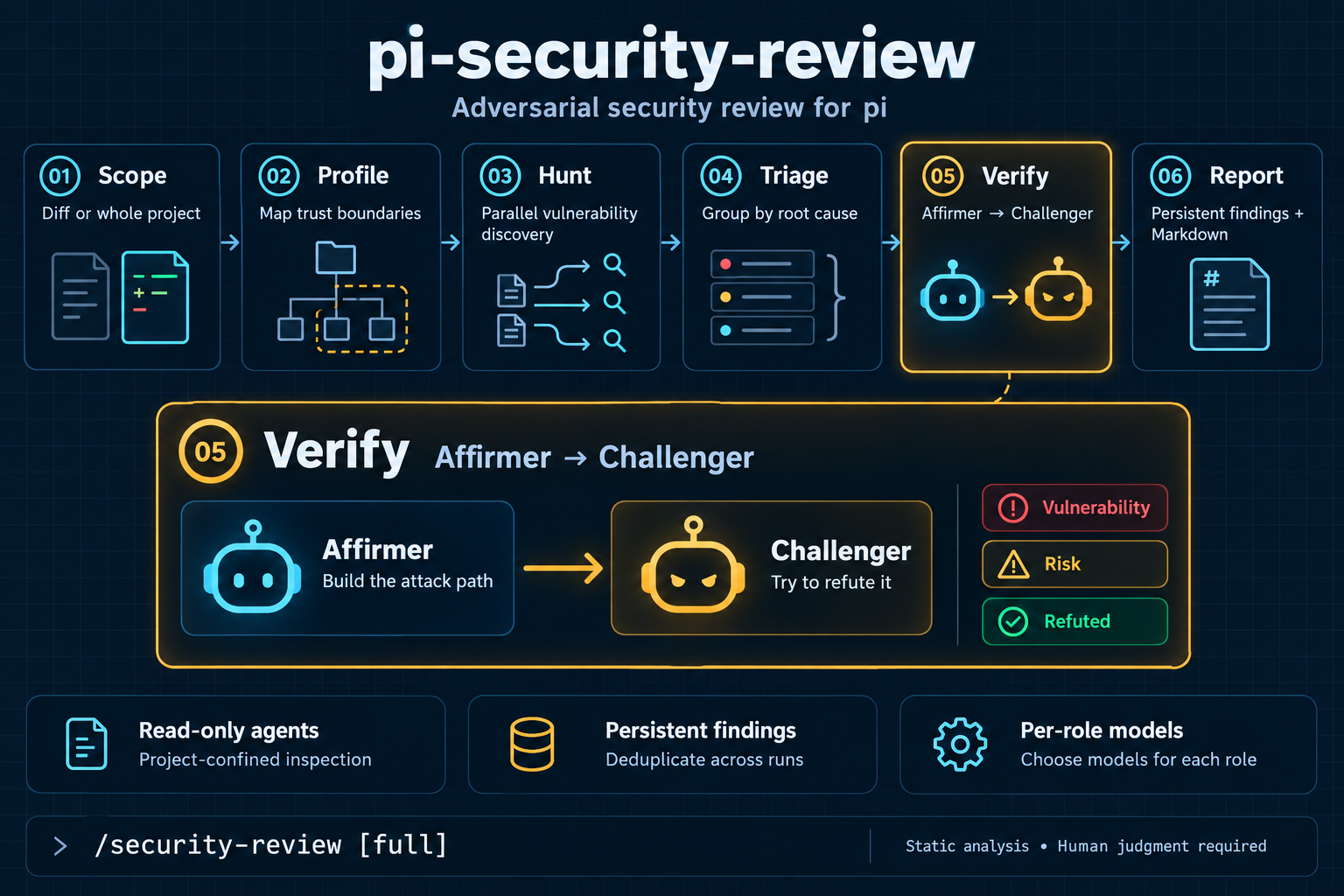
/security-review [full]
       |
       v
  [scope] --> [profile] --> [hunt] --> [triage] --> [verify] --> [report]
                              |           |            |
                 submit_hypothesis  submit_triage  submit_argument (affirm, then challenge)
                                                       |
                                       .security-review/findings.json + report.md
- scope: resolves which files to audit using git.
- profile: one agent records the project's stack, entry points, trust boundaries, authentication model, and external inputs. It also picks up to four security domains, such as AI agents, supply chain and CI, or client-side code, from a fixed list of nine. The extension caches this profile between runs.
- hunt: several agents in parallel look for candidate vulnerabilities and submit hypotheses with code anchors, a suspected source, and a suspected sink. In default mode there is one agent per vulnerability class: injection, access control, secrets and cryptography, files and deserialization, network, business logic, feature abuse, and a wildcard class for anything the others would miss. Every hunt agent also receives the attack classes of the profile's domains, and the verification agents receive the domains' rules for what counts as a finding. Hunters, affirmers, and challengers rate severity with the same definitions.
- triage: when there are at least two hypotheses, one agent groups those that a single code fix would remove. For example, it may group a SQL injection with the secret disclosure it enables. Verification checks the root cause and records the others as consequences. If triage fails, verification checks each hypothesis separately.
- verify: for every hypothesis an affirmer agent builds the attack path, then an independent challenger agent tries to refute it. It checks attribution (is the "attacker" already trusted?), code defenses between source and sink, and whether the attack has independent security value. Confirmed hypotheses become
vulnerabilityfindings, downgraded ones becomeriskfindings, and refuted ones are kept in a log with the reasoning. - report: the extension writes
report.mdand merges findings intofindings.json. One agent writes a short report summary. The command posts the result into the session.
Agents submit results through schema-validated tools, so every finding has anchors, a severity, a confidence, and both verification arguments.
Usage
Run the command inside a git repository.
| Command | Scope |
|---|---|
/security-review |
Changes not yet merged into the default branch: the merge-base diff against origin/HEAD (falling back to origin/main, origin/master, main, master), plus uncommitted and untracked files. Ignored files are skipped. |
/security-review full |
The whole project: tracked files plus untracked files not ignored by .gitignore. |
Both modes remove files matched by your configured exclude patterns.
Pi's status bar shows progress, for example security-review: hunt 3/8 or security-review: verify 7/12. When the run finishes, the command posts a summary with counts by severity into the session.
Press Esc to stop a review. The extension keeps verified results in the report and findings store and marks the run incomplete. In RPC mode, send /security-review cancel. In the terminal, commands typed during a review wait until it ends.
Output
Everything is written to .security-review/ in the audited project:
| File | Contents |
|---|---|
findings.json |
Persistent findings store. Repeat runs deduplicate by a line-independent fingerprint, falling back to vulnerability type and file when that match is unambiguous. |
report.md |
Human-readable report for the latest run, regenerated each run. |
profile.json |
Cached project profile. |
runs/ |
Per-run logs. |
The extension never stages or commits these files. If .security-review/ is not ignored, the summary recommends adding it to .gitignore.
Keep the directory out of git. findings.json and profile.json hold your own decisions and are given to agents as trusted context, so a branch that changes them could hide a finding from its own review. If either file is tracked and differs between the review base and HEAD, the command stops before any model call and tells you how to restore the file or stop tracking it. It also stops if .security-review/, its runs/ directory, or one of its files is a symbolic link, which a repository could commit to have the store read from a file it controls or written outside the project.
Reviewing findings
Each finding has a status: open, accepted-risk, fixed, false-positive, or stale. Edit status in findings.json to record your decision. The extension preserves accepted-risk, fixed, and false-positive across runs. When a hypothesis matches a finding marked false-positive, the challenger sees your earlier verdict and must present new evidence to confirm it again. A status you set while a review is running is kept: the run merges its results into the store as it is when verification ends.
After a complete full run, findings that were not observed again are marked stale. A full run that ends incomplete (an agent failed or timed out, the hypothesis cap was reached, a verified hypothesis could not be recorded, or the run was cancelled) marks nothing stale and says so in the summary, because unobserved findings may simply not have been checked. Default (diff) runs never mark findings stale, because they only see part of the project.
Settings
Settings live under the securityReview key of pi's settings files: ~/.pi/agent/settings.json (global) and .pi/settings.json in the project (read only when the project is trusted). Project values take precedence. All keys are optional.
{
  "securityReview": {
    "models": {
      "hunt": "zai/glm-5.3-flash",
      "challenger": "anthropic/claude-opus-5-5"
    },
    "exclude": ["vendor/**", "*.min.js", "test/fixtures"],
    "maxConcurrentAgents": 4,
    "maxHypotheses": 24,
    "agentTimeoutSeconds": 600
  }
}
| Key | Default | Description |
|---|---|---|
models |
session model for every role | Per-role model override as provider/model. Roles: profile, hunt, triage, affirmer, challenger, report. A typical setup uses a cheaper model for hunt and the strongest one for challenger. |
exclude |
[] |
Glob patterns removed from the audited files in both modes. A pattern without a slash also matches by name at any depth; a directory name excludes everything below it. Wildcards match names that begin with a dot, so *.json covers .eslintrc.json. |
maxConcurrentAgents |
4 |
Maximum number of audit agents running at the same time. |
maxHypotheses |
24 |
Maximum hypotheses verified per run. The most severe are verified first; the rest are listed as unverified and the run is marked incomplete. |
agentTimeoutSeconds |
600 |
Time limit for each audit agent, including waits between retries. A timed-out agent marks the run incomplete; other agents continue. |
Invalid values stop the command before any model call, with the setting name and the expected type. Unknown keys and unknown model identifiers are reported the same way.
Agents use the session's thinking level.
Security model and limitations
- Read-only agents, confined to the project. Audit agents get
read,grep,find,ls, and a restricted shell that only runs an allowlist of inspection commands (git log/show/blame/diff/grep/ls-files,rg,cat,head,tail,ls,wc) without a shell interpreter. They have nowrite,edit, or generalbash, so they cannot modify the audited project. Options that make these commands run a program or write a file are rejected, including abbreviated spellings. The repository's own git config is treated as untrusted too: every git command, the extension's own included, runs with configured filter drivers, signature programs, and the file system monitor switched off, with textconv and external diff drivers disabled, without descending into submodules, and without fetching. Every path must stay inside the project: absolute paths outside it,~,.., and symbolic links that lead outside are refused, so an agent cannot read your SSH keys or other projects. A refused path gets the same answer whether or not a file exists behind it.rgandlsdo not follow symbolic links, andwcdoes not read file lists. Text written by agents has control characters removed before it reaches your terminal orreport.md, and links in the summary show their address. - Static verification only. Agents never build, run, or test the audited project. Defenses that only exist at runtime can be missed, and reachability is argued from code, not demonstrated. Each finding carries a
confidencevalue. - Prompt injection. The audited code is untrusted input. Comments or strings in it can steer an agent's reasoning and cause missed or spurious findings. Read-only tools confined to the project limit the damage to the report itself. Your session's model does not see what audit agents wrote: the message it receives has only counts, finding ids, and file paths, while titles and the summary are shown to you alone. If you then ask the model to read
report.mdorfindings.json, it reads text written by agents that read untrusted code. This is a known limitation shared by comparable tools. - Rate limits and provider errors. Audit agents retry a model request that fails with a transient error (rate limit, overload, server or network error) up to 6 times, waiting 5, 10, 20, 40, 60, and 60 seconds. A hunt agent that still fails this way is run once more after the other hunt agents finish; if that works, the run stays complete and the Errors section of the report notes the re-run. Quota and billing errors are not retried. If your provider throttles concurrent requests, lower
maxConcurrentAgents. - A refused model stops the run early. If the provider refuses the profile agent's request with an error that retrying cannot fix, such as an invalid key or exhausted quota, no hunt agents start on the same model. The run ends incomplete with that error. When many agents fail with the same error, the summary reports it once, shortened; the run log in
.security-review/runs/keeps each agent's full error. - Models served by
pi-claude-bridge. Audit agents run without extensions, so the bridge would not recognize their prompts and would refuse them. The extension registers each agent's prompt with the bridge itself. Claude Code then receives its own system prompt plus the role instructions, without your project context files or skills, and can call only the audit agent's read-only tools. Each agent uses your Claude subscription quota, and the bridge writes one Claude Code session file per agent under~/.claude/projects/. Registration relies on an internal part of the bridge, verified with version 0.9.2. If a later version changes it, the bridge refuses the requests again and the run stops after the profile agent; setsecurityReview.modelsto another model until this extension is updated. - Cost. A run uses one profile agent, eight hunt agents in default mode (one per vulnerability class) or one per project subtree in
fullmode, one triage agent when there are at least two hypotheses, two agents per verified hypothesis, and one summary agent, plus a re-run for each hunt agent that failed on a transient error. Triage usually pays for itself by merging hypotheses before verification. Each domain the profile selects adds about 1k tokens to every hunt prompt, shared through the provider's prompt cache, and about 250 tokens to every verification prompt. Token usage of all agents is added to your session totals (/session). Use the settings above to bound cost. - Deduplication is heuristic. Findings are matched across runs by a fingerprint of vulnerability type, file, enclosing function, and sink API, not by line number. When the fingerprint differs, a finding still matches a stored one of the same type in the same file, but only if there is exactly one candidate on each side; otherwise it becomes a new finding. If an issue is fixed and a different issue of the same type appears in the same file, the new one inherits the old id and status. It is still fully verified, and the challenger is told to disregard an earlier false-positive verdict about a different code path.
- Root-cause grouping is a judgment call. Triage may miss a group, which leaves a duplicate finding, or group too eagerly: a consequence is dropped together with its root cause when the root cause is refuted. Refuted records keep their consequences so you can review them. Findings that earlier versions already split stay split.
- Not included. No proof-of-concept execution, sandboxing, CI integration, or pull-request comments.
Development
npm install
npm run check            # typecheck + tests (no model calls; agents run against pi's faux provider)
./scripts/check-load.sh  # load the package into pi and list its commands

# real-model checks against the seeded fixture in test/fixtures/vulnerable-app (uses your pi credentials)
node scripts/dry-run.ts all [--model provider/id]   # profile, hunt, triage, affirmer, and challenger roles
node scripts/rpc-run.ts --cwd <repo> -- "/security-review"   # whole command through pi's RPC mode

# a fixture repository that outlives the command, for rpc-run
SR_KEEP_TEMP=1 node -e 'import("./test/git-fixtures.ts").then((m) => console.log(m.makeFixtureRepo()))'
Role prompts are in roles/. The fixture under test/fixtures/vulnerable-app is deliberately vulnerable; exclude test/fixtures when running /security-review full on this repository.
License
MIT © insaidermobile-ux.